Based on comprehensive research, three transformative trends stand out as defining forces reshaping India’s technology landscape in 2025. Each represents a critical dimension of India’s digital evolution: indigenous platform adoption, market expansion, and technological leadership.
Trend 1: The Indigenous Tech Revolution - Arattai’s Explosive Growth
Zoho’s Arattai messaging app achieved unprecedented 100x growth in just eight weeks, surging from under 10,000 users in August 2025 to over 10 million by October. This exponential trajectory reflects a fundamental shift in India’s technology consumption patterns, where nationalist sentiment combined with genuine product capabilities can drive grassroots adoption at remarkable velocity.
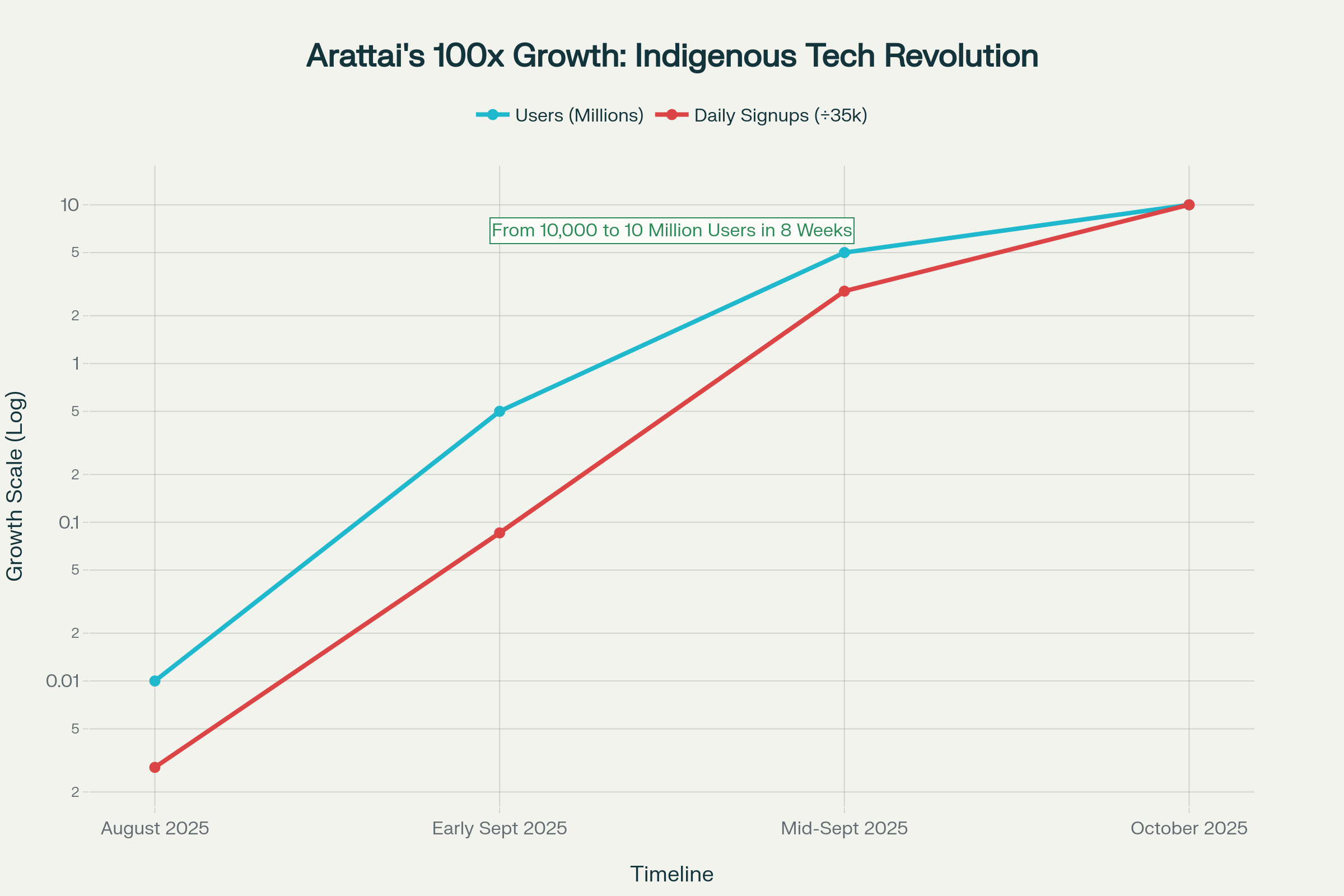
Arattai’s exponential user growth demonstrates the rapid adoption potential of indigenous technology platforms when backed by nationalist sentiment and government support.
The growth acceleration tells a compelling story: daily sign-ups exploded from a mere 100 in August to 350,000 by October—a 3,500x increase in user acquisition velocity. This wasn’t driven by traditional venture capital-backed growth hacking but rather by government endorsements, word-of-mouth momentum, and growing awareness of data sovereignty concerns.123456
Strategic Implications: Arattai’s success validates the “Made in India” technology movement and demonstrates that Indian platforms can compete with global incumbents when addressing domestic priorities. The app’s integration with Zoho’s enterprise suite, combined with plans for payments and business monetization, suggests a roadmap toward building comprehensive digital ecosystems independent of foreign technology stacks. This trend extends beyond messaging to cloud infrastructure, AI platforms, and semiconductor manufacturing—areas where India seeks technological autonomy.7
Trend 2: Digital Transformation at Scale - A $267 Billion Market by 2030
India’s digital transformation market is experiencing structural expansion, growing from $124.42 billion in 2025 to a projected $267.01 billion by 2030—representing a 16.5% compound annual growth rate. This growth reflects coordinated investments across government infrastructure (Digital India, IndiaAI Mission), enterprise modernization, and consumer digital adoption.8
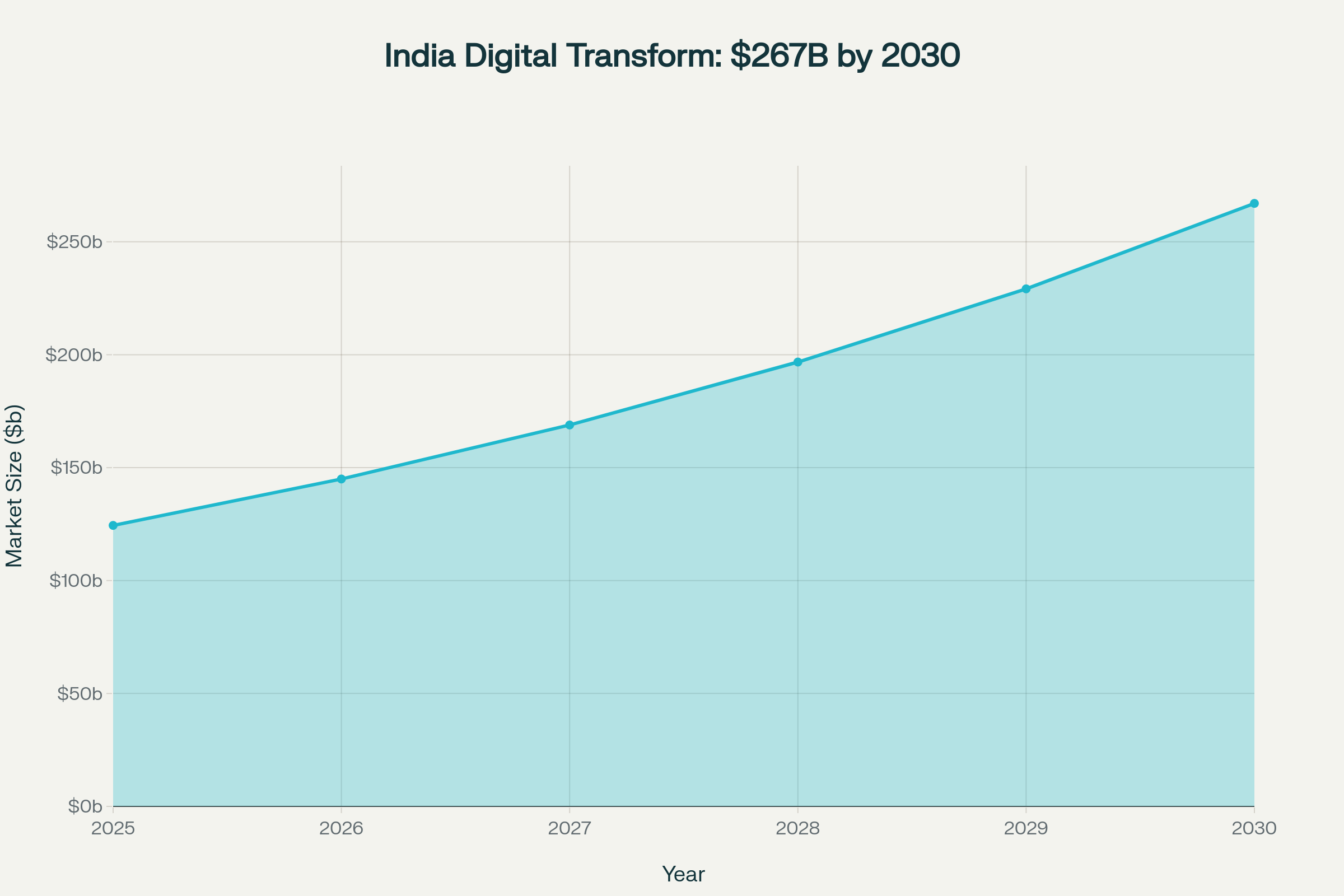
India’s digital transformation market demonstrates robust growth at 16.5% CAGR, more than doubling from $124.42 billion in 2025 to $267.01 billion by 2030.
The market doubling over five years is driven by multiple converging forces: mobile penetration exceeding 73% of the population, monthly data consumption surpassing 19 GB per user, and government investment of Rs 14,903 crore extending Digital India initiatives through FY 2026. India Stack infrastructure layers—including Aadhaar, UPI, and DigiLocker—have created standardized frameworks that dramatically lower integration costs for enterprises operating at population scale.89
Strategic Implications: This trajectory positions India among the fastest-growing digital economies globally, with implications for cloud computing (21.9% CAGR to $58.73 billion by 2030), cybersecurity (18.3% CAGR to $12.90 billion), and SaaS exports ($50 billion ARR by 2030). The scale of transformation creates opportunities for domestic technology providers to build for India first, then expand globally—reversing the traditional model where international platforms entered India after dominating developed markets.101112
Trend 3: AI Adoption Leadership - India Outpacing Global Benchmarks
India has emerged as a global leader in artificial intelligence adoption, with 30% of Indian enterprises maximizing AI’s value potential compared to 26% globally, and a remarkable 100% of Indian companies actively experimenting with AI versus 78% worldwide. Additionally, 65% of Indian enterprises are investing in Generative AI compared to 45% globally.1314
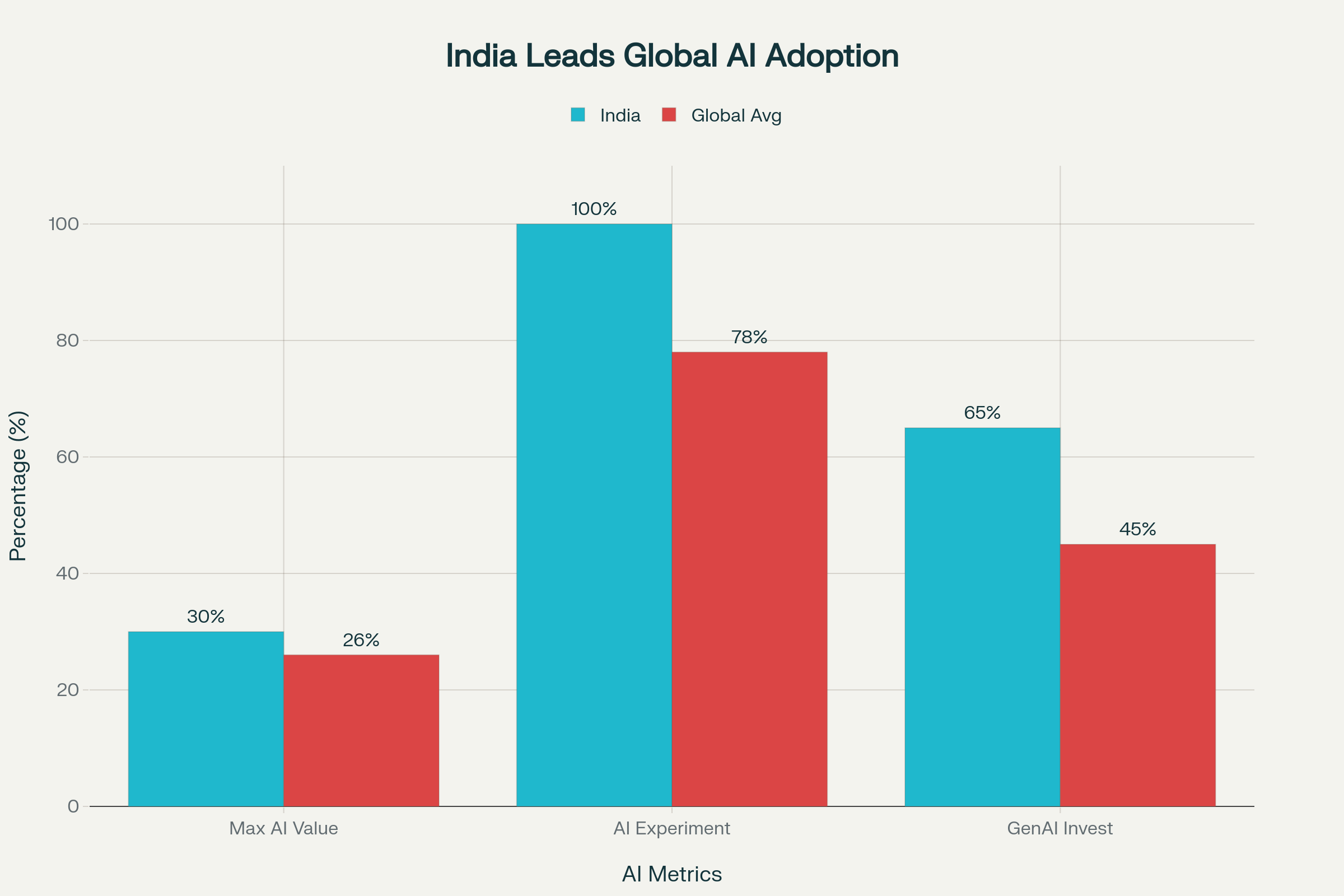
India demonstrates AI adoption leadership, with 100% of companies experimenting with AI compared to 78% globally, and significantly higher rates of GenAI investment and value maximization.
This leadership reflects strategic national initiatives including the IndiaAI Mission (Rs 10,300+ crore over five years providing 18,700+ GPUs and compute access), homegrown AI model development (Sarvam AI, Gan AI, Gnan AI, Soket AI), and enterprise demand for automation and efficiency gains. India’s AI spending is projected to grow 2.2x faster than overall digital transformation investments through 2025.131516
Strategic Implications: AI adoption leadership positions India at the forefront of the next technology wave, with applications spanning healthcare (telemedicine, diagnostics), financial services (fraud detection, credit scoring), agriculture (yield prediction, supply chain), and manufacturing (predictive maintenance, quality control). The combination of vast datasets, affordable talent, and government support creates potential for India to become an AI innovation hub—not just an implementation market. However, sustaining this leadership requires addressing the 58% skills gap in AI/ML talent and ensuring domestic compute infrastructure can support growing model training demands.17
Cross-Cutting Insights
These three trends interconnect powerfully. Arattai’s growth demonstrates that when digital infrastructure is in place (Trend 2), Indian consumers will rapidly adopt indigenous platforms addressing sovereignty concerns. AI adoption leadership (Trend 3) enables Indian enterprises to build competitive advantages through intelligent automation, supporting both domestic digital transformation and global competitiveness.
Together, they signal India’s transition from technology consumer to technology creator, from back office to innovation hub, from services provider to platform originator. The next 3-5 years will determine whether this momentum translates into sustained technological leadership or remains confined to specific pockets of excellence. Success requires continued infrastructure investment, talent development at scale, regulatory clarity, and coordination between government policy and private sector execution—precisely the holistic approach that characterized previous technology superpowers’ ascent.