The 10x Dev Myth Is Killing Your Team
Your best engineer just stopped caring. They still show up. They still deliver. But the fire is gone—and you’re too busy chasing unicorns to notice.
Here’s the contradiction: Companies worship the mythical “10x developer” while systematically creating environments that make their best people check out. We’ve built an industry where the path to “senior” means navigating broken systems, not building great ones. And we’re confused why the people who see this clearest are the first to mentally quit.
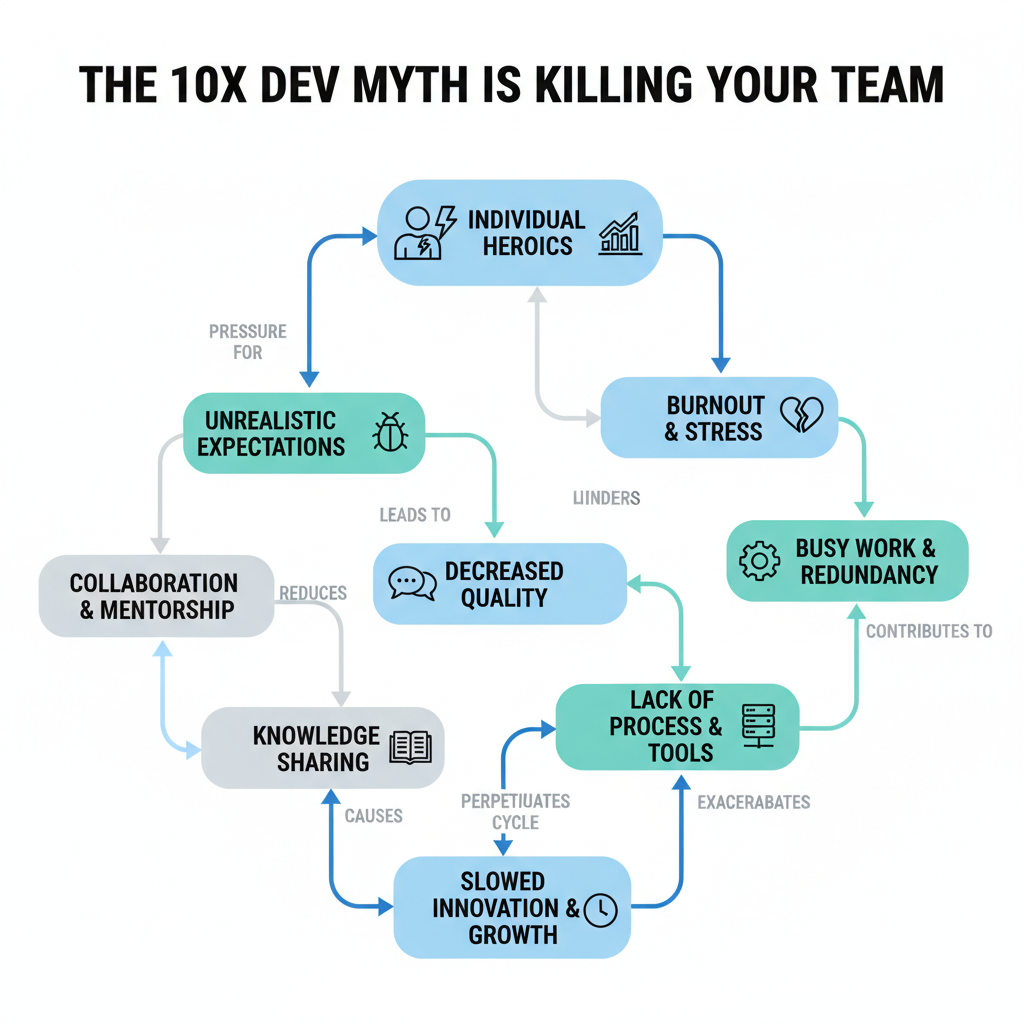
The Quiet Exodus Nobody Measures
Surface-level take: Senior engineers are leaving for more money. Stock packages negotiated during the ZIRP era are underwater. FAANG comp is down 20-40% from 2021 peaks. Engineers are chasing bags.
Look closer.
The data tells a different story. Blind polls and internal surveys at companies like Microsoft, Google, and Amazon show something alarming: the engineers with the highest institutional knowledge are disengaging at record rates. They’re not leaving for competitors—they’re staying and doing the absolute minimum.
This is quiet quitting with a seniority bonus. Your most experienced engineers know exactly how much discretionary effort to give before it stops mattering. They’ve seen five reorgs. They’ve rewritten the same logging pipeline three times. They know that “move fast and break things” means they’ll be the one fixing them at 2 AM.
The mechanism isn’t burnout. It’s rational disinvestment. When the expected value of extra effort approaches zero, senior engineers optimize accordingly.
The Algorithm Your Culture Doesn’t Understand
Every engineering organization has an implicit reward function. Think of it as a loss function in machine learning: the system optimizes for what it measures.
Your company says it rewards impact. In practice, it rewards visibility—and there’s a massive difference.
# How companies *say* they evaluate engineers
def perceived_value(engineer):
    return engineer.technical_impact * 0.7 + engineer.mentorship * 0.3

# How they *actually* evaluate engineers
def actual_value(engineer, org_visibility):
    # Real reward function: visibility dominates
    return (engineer.technical_impact * 0.4
            + engineer.mentorship * 0.1
            + engineer.political_visibility * 0.5)
Senior engineers see this reward function clearly. They know that spending 40 hours untangling a dependency hell gets zero recognition. They know that presenting at the all-hands—even with shallow work—gets promoted. So they optimize.
The cruel irony? The 10x dev myth assumes some magical productivity multiplier. The real multiplier is context and trust. Engineers with deep system knowledge and organizational trust can make decisions in hours that take juniors weeks. When those engineers disengage, you don’t just lose their output—you lose the shared mental model that makes everyone faster.
This is the hidden tax of quiet quitting. It compounds.
The Industry’s Expensive Blind Spot
Why does this keep happening? Because management has an incentive asymmetry problem.
Your VP of Engineering’s bonus depends on shipping Q3 features, not on retaining institutional knowledge. Your CTO is judged on headcount growth, not on engineering satisfaction. The signals that predict senior disengagement—decreased code review participation, shorter PR comments, fewer Slack messages in team channels—are invisible to the people who could fix them.
We’re optimizing the wrong metric. We track sprint velocity, deployment frequency, and cycle time. We ignore knowledge retention velocity—how fast expertise accumulates or leaks from the organization.
Consider this: Google’s SRE team found that 80% of production incidents were caused by changes made by engineers with less than 6 months of experience on the affected system. When senior engineers stop being the safety net, the system doesn’t just slow down—it breaks in new and expensive ways.
Your best engineers aren’t lazy. They’ve solved the same problem 47 times and realized no one listens to the solution until it’s a crisis. That’s not burnout. That’s learned helplessness, optimized over years.
Rewriting the Reward Function
Here’s what fixing this looks like—and it’s uncomfortable:
-
Separate “visibility” from “impact” in performance reviews. If your senior engineer’s review only improves when they present at demos, you’re optimizing for the wrong signal. Mandate that managers spend 30% of review prep time interviewing people who consume the engineer’s work, not just people who see it.
-
Cap the “bus factor” tax. Engineers who constantly rescue failing projects should be measured on creating systems that prevent the failures, not on heroics. Google’s postmortem culture—blameless analysis focused on systemic fixes—is a template, but most companies stop at the “blameless” part without creating the incentive to actually prevent recurrence.
-
Build explicit knowledge-sharing expectations. At Stripe, senior engineers have documented “areas of ownership.” If a senior engineer holds knowledge that nobody else has, that’s a risk, not a luxury. Make knowledge transfer a hard requirement for promotion, not a nice-to-have.
The counter-intuitive truth: your “10x” engineers aren’t producing 10x the code. They’re producing 10x the correct decisions per unit of organizational effort. When they quiet quit, the output metric drops by 10%. The decision quality metric—and the compounding failures it prevents—drops by orders of magnitude.
The “10x developer” isn’t a person—it’s a property of a system where context, trust, and recognition align. Your senior engineers aren’t leaving because they’re lazy. They’re leaving because you built a reward function that punishes the behaviors that made them valuable. Quiet quitting is a rational response to an irrational system. Fix the system, or watch your best people optimize for survival instead of impact.
The Uncomfortable Call to Action
Stop chasing unicorns. Start auditing your implicit reward function. Look at the last three promotions on your team. Did they go to the engineer who fixed the most fires or the one who built the systems that prevented them? If it’s the former, you’re paying the quiet quitting tax—and it’s compounding.
Your best engineers are watching. They know exactly how the game is scored. The question isn’t whether they’re willing to play. It’s whether you’re willing to change the rules.

Comments