The 80/20 Fallacy: Why Your “Good Enough” Model Is Actually Bleeding Users
You optimized your model to 80% accuracy. You celebrated. You shipped it. Then your retention numbers started their slow, excruciating death march south. Three months later, users are leaving in droves, and you can’t figure out why. After all, 80% is the magical Pareto threshold everyone talks about, right? Wrong. Actually, catastrophically wrong. The 80/20 rule is a distribution observation, not a quality target. And treating it as one is silently destroying your product’s value proposition, one wrong prediction at a time.
The Comfort Trap of “Good Enough”
Here’s the surface-level assumption that feels so seductive: get 80% of the use cases right, and you’ve captured 80% of the value. It sounds logical. It feels efficient. And it’s completely backwards.
Look at what happened with AI-powered customer support chatbots in 2023-2024. Companies like Klarna and Bank of America raced to deploy automated systems that could handle “80% of routine queries.” The math seemed bulletproof. Handle four out of five tickets automatically, save millions in support costs, redirect human agents to complex cases.
But here’s the ugly truth nobody talks about: that remaining 20% isn’t evenly distributed across your customer base. It clusters around your most valuable, most loyal, most engaged users.
When a bank’s chatbot incorrectly handles a “simple” balance inquiry from a 20-year customer, that’s not a 20% error rate. That’s a 100% customer experience failure.
Gartner’s 2023 customer service survey showed that 73% of customers who encountered an AI failure would consider switching providers within 30 days. The surface-level success of hitting 80% masks the silent exodus happening in your retention dashboard.
The Long Tail Hurts Most
What’s actually happening underneath your carefully crafted 80% model? The answer lives in the long tail of user interactions.
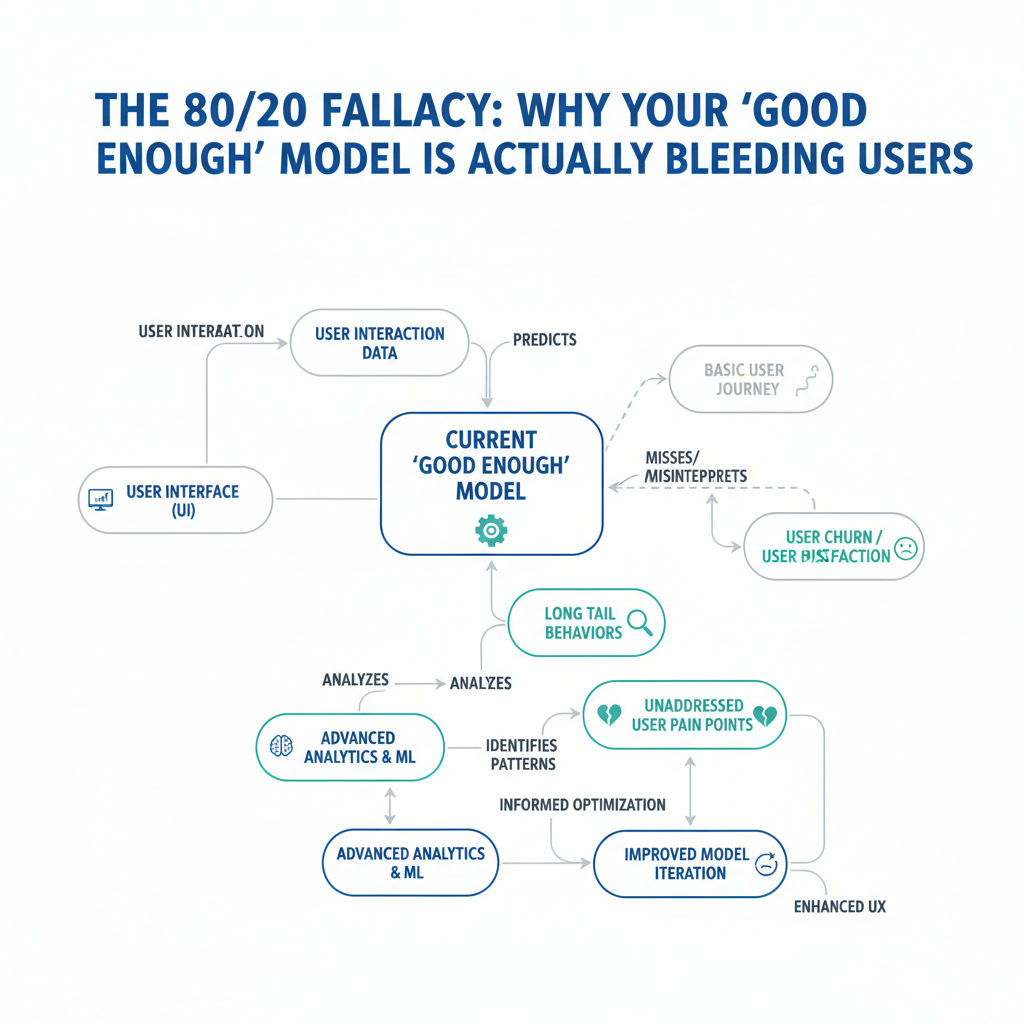
Think of your model’s performance not as a single number, but as a distribution curve. The 80% you’ve captured represents the fat, predictable middle—the password resets, the FAQ lookups, the “what’s my order status” queries. But your model isn’t failing randomly across that 20% error space. It’s systematically failing on the edge cases that matter most.
Here’s the technical mechanism: when training on user interaction data, the feature space naturally becomes biased toward frequency at the expense of fidelity. Your model learns to be confident in high-predictable scenarios (the 80%) while remaining brittle in precisely the nuanced situations that define user trust.
Consider what happened with Tesla’s Autopilot. The system handles 90%+ of highway driving scenarios flawlessly. But the 10% it fails on aren’t random—they’re situations involving emergency vehicles, unusual road conditions, or ambiguous signage. The errors compound because they’re systematic, not stochastic.
This creates a feedback loop that worsens over time. Users who encounter failures train themselves to avoid the feature entirely, creating negative reinforcement that the model can’t recover from.
The Hidden Covariate Shift
Why is everyone missing this? Because we’re all staring at the wrong metrics.
The industry’s blind spot is optimizing for aggregate accuracy instead of user-level reliability. Engineers track model loss curves, F1 scores, and confusion matrices. Product managers watch CSAT scores and deflection rates. Nobody is asking the question that actually matters: does the experience feel trustworthy?
The technical phenomenon at play is covariate shift—the distribution of inputs your model sees in production inevitably drifts from your training distribution. A model optimized for 80% average accuracy degrades non-uniformly across user segments.
Here’s a concrete example from Netflix’s recommendation system. Their early models hit excellent aggregate metrics for “viewing time.” But certain user segments—documentary lovers, international film fans, niche genre enthusiasts—saw dramatically worse recommendations. The aggregate score masked a systematic failure pattern.
The emotional reality for your users looks like this:
- First failure: “That’s weird, must be a glitch”
- Second failure: “This system doesn’t understand me”
- Third failure: “This product is broken”
- Fourth failure: “Let me check out Competitor X”
By the time your aggregate metrics drop by 5%, you’ve already lost your power users.
Building for the Edges
What does this mean going forward? Stop optimizing for the 80% and start designing for the edges.
The forward implication is clear: your model’s value isn’t determined by how well it handles the common case. It’s determined by how gracefully it fails on the uncommon one. This is where retention lives and dies.
Here’s what the best teams are doing differently. Instead of training one monolithic model, they’re building confidence-aware systems with explicit fallback mechanisms. When the model’s internal confidence drops below a configurable threshold (not just the decision boundary), it defers to a human or a simpler rule-based system.
# Confidence-aware prediction with graceful fallback
class TrustAwarePredictor:
    def __init__(self, ml_model, fallback_threshold=0.65):
        self.model = ml_model
        self.threshold = fallback_threshold

    def predict(self, input_data):
        # Get both prediction AND confidence
        prediction, confidence = self.model.predict_with_confidence(input_data)

        if confidence < self.threshold:
            # Log the low-confidence case for retraining
            self.edge_case_logger.record(input_data, prediction, confidence)

            # Fall back to safe default or human routing
            return self.safe_fallback(input_data)

        return prediction
This approach acknowledges a painful truth: sometimes the most valuable prediction a model can make is “I don’t know.”
Your model isn’t a single-prediction system. It’s a relationship management tool. Every time your model makes a wrong prediction for a power user, you’re not just making an error—you’re actively damaging a relationship. The 80% fallacy isn’t a math problem. It’s a trust problem. And unlike model accuracy, trust doesn’t recover smoothly when you retrain.
The Only Metric That Matters
Here’s your call to action: go look at your retention data segmented by user tenure. I guarantee you’ll see power users churning first. Not because your model is terrible for everyone, but because it’s terrible for exactly the people who matter most.
Stop celebrating the 80%. Start sweating the 20%. Because that 20% is deciding whether your product lives or dies. And right now, it’s telling your best users to leave.

Comments