The Kubernetes Hangover: When Microservices Backfire
You spent six months migrating your startup’s monolith into Kubernetes. You’ve got twenty-one YAML files, a service mesh that’s still “in progress,” and your deployment times have actually increased. The kicker? Your entire platform handles fewer requests per second than a single Redis instance. Welcome to the Kubernetes hangover — that queasy feeling when you realize you’ve optimized for infrastructure porn instead of shipping value.
The brutal truth: If your team has fewer than twenty engineers, you probably shouldn’t be running Kubernetes. But nobody tells you that at conferences.
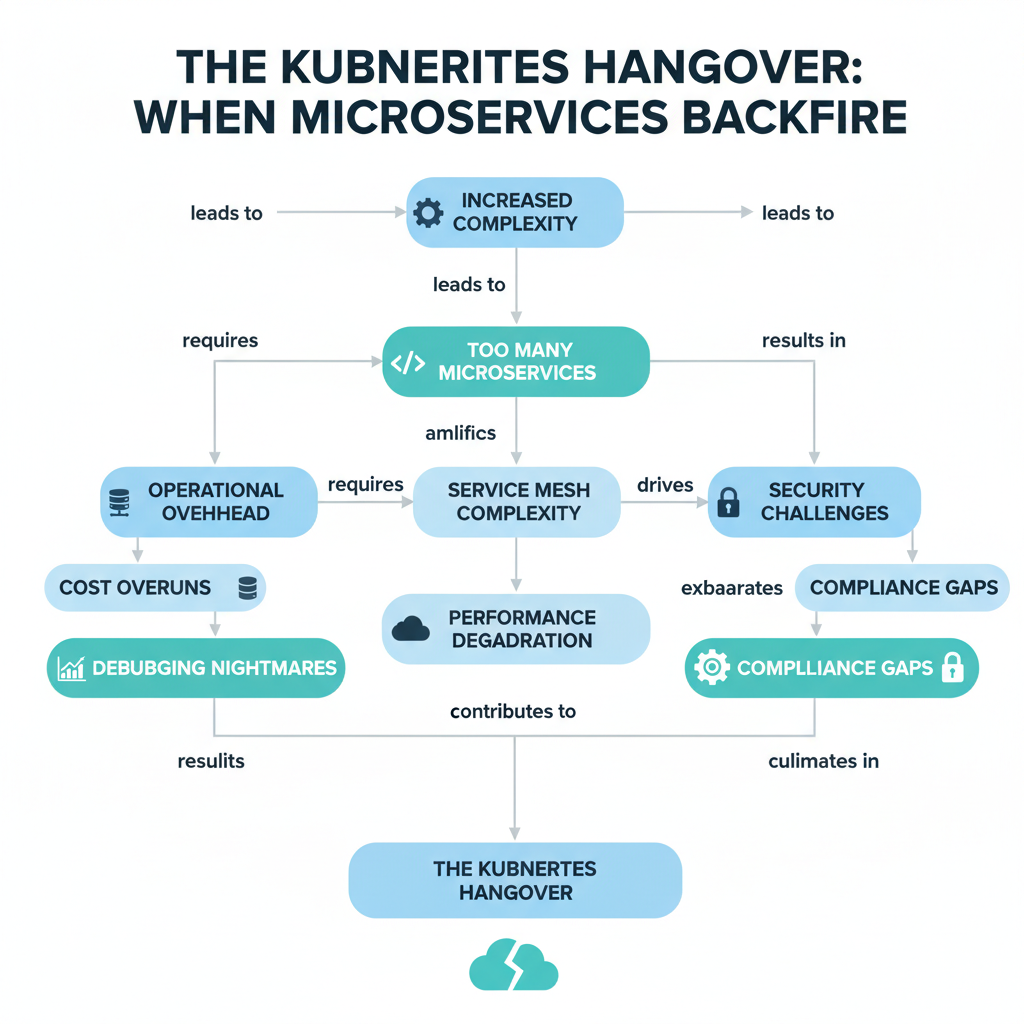
The Complexity Tax Nobody Talks About
Kubernetes doesn’t just add infrastructure complexity — it fundamentally changes your cognitive load. A monolith has one deployment target, one log stream, and one database connection pool. A Kubernetes deployment means you’re now managing:
- Service discovery (that’s a whole new failure mode)
- Pod lifecycle (your apps will crash in novel ways)
- Network policies (goodbye, localhost assumptions)
- ConfigMaps and Secrets (version control becomes a nightmare)
- Ingress controllers (seven different ways to route traffic, all of them wrong)
“We spent more time debugging our Helm charts than we did building features for customers.” — VP of Engineering, Series A startup
Here’s what the metrics actually show: According to a 2023 survey by the CNCF, 60% of Kubernetes users report significant operational overhead. For startups, that overhead often outweighs any scalability benefits — because you’re not scaling yet.
The Fallacy of “Future-Proofing”
I get it. You don’t want to be the team that hits the wall at 10,000 users and has to rewrite everything. But here’s the thing — that wall is imaginary for 90% of startups.
Consider this: Instagram ran on a single Django monolith for its first two years. Shopify handled $80 million in sales on Rails monolith before breaking into services. Basecamp, with 3 million users and 300,000 paying customers, still runs a single Rails app.
The mental model here is like buying a cargo truck for your first grocery run. Yes, eventually you might need it — but right now you’re carrying two bags of groceries and a loaf of bread.
The actual failure mode isn’t scaling up — it’s scaling complexity. Every time you add a microservice, you add:
- A network call (that will fail, eventually)
- A deployment pipeline (that you’ll maintain)
- A separate logging/observability setup
- Another database connection pool
- More surface area for security vulnerabilities
Why Your Developer Experience Is Dying
Remember when you could run your entire application with rails server or npm start? Now you need a local Kubernetes cluster, a container registry, and three different CLI tools just to see if your change works.
This isn’t just inconvenient — it’s destroying your iteration speed. A 2022 study from Microsoft Research found that developers working on microservices spend 46% of their time on infrastructure-related tasks, compared to 18% for monolith developers.
The irony? You broke apart your monolith to ship faster, but now you’re spending more time on infrastructure than on features. That’s the Kubernetes hangover in a nutshell.
Here’s a concrete comparison:
| Aspect | Monolith | Kubernetes Microservices |
|---|---|---|
| Local dev setup | One command | 45 minutes of Docker compose |
| Debugging | Single step-through | Jaeger tracing + logs from 8 pods |
| Database migrations | One script | Distributed saga coordination |
| Feature branch testing | git checkout |
Build + deploy + ingress config |
| New hire onboarding | 1 day | 2 weeks |
The Architecture You Actually Need
I’ll tell you what most startups should run: a clean monolith with explicit module boundaries. That’s it. You get one codebase, one deployment, one database, and one team that understands the whole system.
When you do need to split, you’ll know. It won’t be theoretical. You’ll have concrete data showing that database schema changes are causing pain across the team, or that deployment time has become a bottleneck.
The counter-intuitive insight here: A well-structured monolith is more scalable than poorly-designed microservices. Your single tight codebase outperforms a distributed system until you hit genuine resource constraints — and for most startups, that’s years away.
Here’s what this means for you: Stop optimizing for problems you don’t have yet. The Kubernetes hangover is real because we’ve collectively bought into a myth — that microservices are the default architecture, and everything else is legacy. They’re not. They’re a tradeoff, and for small teams, the tradeoff usually doesn’t work in your favor.
Your three takeaways:
- Complexity is not a virtue. Simple systems that ship are better than complex systems that don’t.
- Wait until you actually have scaling problems before you solve them.
- Measure your developer velocity. If Kubernetes is slowing you down, admit it.
The Real Move
Ship something ugly that works. A monolith with messy code that serves users is infinitely better than a Kubernetes deployment that serves zero customers because nobody on your team understands how to debug it.
If your startup is pre-Series A, you’re optimizing for the wrong thing. Stop building infrastructure for a traffic spike that may never come. Build features. Ship them. Iterate.
The Kubernetes hangover clears up when you stop drinking the Kool-Aid and start shipping code. Your users don’t care about your service mesh. They care about your product.
So go build it. With a monolith. And sleep better at night.

Comments