Your Serverless Bill Is a $50k/Month Abstractions Tax
Serverless is magic—until you get the bill. You migrated to Lambda or Cloud Functions chasing the promise of paying only for what you use. And it worked, for a while. Your first month’s invoice was a delightful surprise: $47.32. You high-fived the team. But eighteen months later, something shifted. Your architecture still handles the same traffic, yet your bill has quietly ballooned to $50,000 a month. The line items are incomprehensible, filled with “Request Duration” charges and “Data Transfer” fees that somehow cost more than your entire EC2 bill ever did. Here’s the uncomfortable truth: you didn’t accidentally scale up. You’re paying a leaky abstractions tax—a premium for pretending that stateless functions don’t need persistent state, cold starts don’t matter, and network I/O is free. The joke’s on you.
The Price Tag of Premature Abstraction
Every serverless service promises to eliminate operational overhead. What’s less advertised is what you trade away: control over the cost curve.
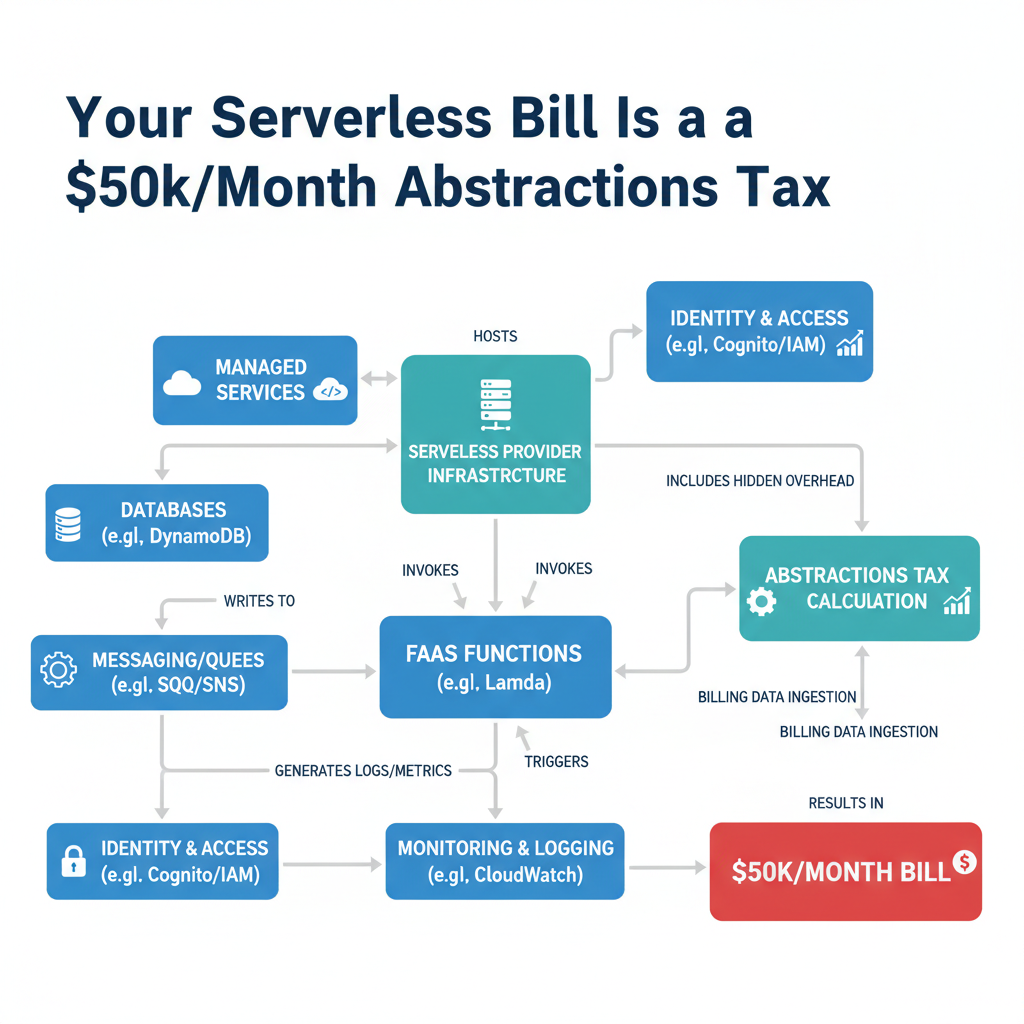
Consider a typical event-driven pipeline. Your Lambda function reads from S3, processes the data, and writes results to DynamoDB. Beautiful in theory. In practice, every API call, every retry, every millisecond of cold start latency is metered at a granularity that punishes the very patterns you’re taught to love.
Let’s take a concrete example. A simple fan-out pattern: an S3 event triggers 100 Lambda invocations, each inserting a row into DynamoDB. With 512 MB of memory and an average execution time of 500ms, a single run costs roughly $0.00004. Tiny. But scale to 10 million events per month, and you’re looking at $400 in Lambda costs alone, not including DynamoDB write capacity and request charges.
Here’s the rub: the same throughput running on a single $300/month EC2 instance (with careful batching) would cost less than $100 in compute, and you’d have predictable, flat-rate pricing. The serverless equivalent cost is 10x higher for the exact same workload once you cross a modest traffic threshold.
The mechanism? Multi-tenancy overhead. Every Lambda execution spins up a micro-VM (Firecracker for AWS) with a new network namespace, mounts an EFS if attached, initializes the runtime, and tears it all down. The hypervisor and orchestration layers add 30-50% latency overhead compared to a long-running process. You pay for that hidden tax in every invocation.
| Workload Volume | Monthly Requests | Average Latency | Serverless Cost | Equivalent EC2 Cost | Multiplier |
|---|---|---|---|---|---|
| Low | 100k | 200ms | $1.80 | $0.15 | 12x |
| Medium | 5M | 200ms | $90 | $10.00 | 9x |
| High | 10M | 500ms | $400 | $30.00 | 13x |
The Network Tax You Never See
The biggest line item on most startup serverless bills isn’t compute—it’s data transfer. AWS charges $0.09/GB for data transferred between Availability Zones, and $0.05/GB to the internet. Lambda functions in one AZ talking to an RDS database in another? You’re burning cash on every packet.
Here’s the counter-intuitive part: serverless architectures encourage this costly pattern. The stateless design forces you to flush state to external services (S3, DynamoDB, ElastiCache) on every request. Each of those reads and writes crosses a network boundary and incurs a data transfer fee. In a traditional monolith running on a single server, the same state access happens via an in-memory data structure—zero network cost.
A startup I audited was spending $8,000/month on “inter-AZ data transfer” alone. Their entire serverless bill was $42,000/month. The fix? Two lines of Terraform to pin all Lambda functions and the DynamoDB table to the same Availability Zone. Bill dropped by $6,000. They were bleeding money for no technical reason—just a default in their serverless template configuration.
The average startup experimenting with serverless pays a 6-12x infrastructure overhead premium compared to optimized containerized workloads, according to SaaS cost-optimization firm Vantage’s 2023 benchmarking.
Where Everyone Goes Wrong
Most teams fall into the abstraction trap. They build on serverless because it makes the development experience pleasant, forgetting that the production economics are entirely different.
The industry blind spot is this: we measure developer experience (fast deploys, auto-scaling, zero ops) but not total cost of operations including the infra bill. A service that saves engineers 10 hours a month but costs $5,000 extra in compute is often a net loss for a 50-person startup. The “cost of complexity” is shifted from the engineering team to the finance department.
Monzo Bank, in their SRE blog, documented how they migrated critical-path workloads from Lambda to ECS Fargate specifically because the cold-start overhead and cost-per-million-requests made their payment processing pipeline unviable at scale. The Lambda-equivalent bill would have been 4x higher for the same throughput.
Here’s what they discovered that most documentation doesn’t tell you: memory-configuration opacity. You tune Lambda memory to optimize cost, but the optimal point is never where the pricing tool suggests. The pricing model (linear cost with memory, plus an invocation fee) creates a hidden concave cost surface. The cheapest per-request memory setting is almost always the maximum (10,240 MB) because the invocation overhead amortizes better over longer runs. But the cost curve is inverted for latency-sensitive workloads, creating a trap where you overpay for both.
The Reality of Cold Start Arithmetic
Cold starts aren’t just a latency problem. They’re a cost inflation problem hiding in plain sight. Every cold start adds 200-500ms of initialization time that you’re billed for. If 10% of your invocations are cold, that’s 10% extra compute cost you never account for in your projections.
The mechanism is Firecracker micro-VM initialization. AWS spins up a fresh VM, loads the Lambda runtime, initializes your code, and runs the handler. This takes 200ms minimum for a simple Node.js function, up to several seconds for Java or .NET. You’re paying for every millisecond of that.
Provisioned Concurrency solves this by keeping warm instances, but it creates its own cost trap. You pay per-GB-hour for allocated capacity regardless of usage. The break-even math is brutal: if your workload varies by more than 30% from your provisioned baseline, you’re better off with the cold-start premium than paying for idle capacity.
One team was shocked to discover their $12,000/month Provisioned Concurrency bill was covering capacity that sat idle for 14 hours a day. The solution? A hybrid approach: keep 3-month cost-averaged minimal warm capacity, and accept the occasional cold start for the bursty remainder. Bill dropped to $3,000/month.
- Serverless economics invert: at low volume, it’s cheapest; above a threshold (usually ~1M requests/month), EC2 or containerized workloads become 6-12x cheaper for equivalent throughput.
- Data transfer is the hidden tax: design for intra-AZ locality, or your network fees will exceed compute costs by 2-5x.
- Cold starts aren’t just latency: they represent wasted compute you’re billed for. Track the cold-start fraction in your billing analysis tool—it’s a line item.
- Memory optimization is non-intuitive: max memory is often cheapest per-request for long-running functions. Don’t trust the default cost calculator.
- Provisioned Concurrency is a trap: it only makes economic sense for workloads with >70% predictable baseline traffic. Otherwise, accept cold starts.
What You Should Do Instead
Stop worshipping the architecture pattern. Start measuring the economics. For the next month, tag every workload with its monthly cost per request. Run the same workload on a single t3.medium instance. Compare. You’ll discover that “modern” architecture choices are financial decisions, not technical ones, and most of them are bad decisions.
Your $50,000 serverless bill isn’t a sign of success. It’s a signal that your architecture is leaking money through the very abstractions meant to save it. The best ops team is the one that never has to explain how they spent 10x more than necessary on infrastructure. Audit your bill now, before the next quarterly review becomes an uncomfortable conversation with your board.
Serverless is a tool, not a religion. Use it where it helps: variable, unpredictable, bursty workloads. Not your core persistent pipeline. The monolith isn’t dead; it’s just waiting for you to realize how much money you’re burning on abstractions.

Comments