AI ROI: How Smart Teams Reshape Work Instead of Replacing Workers
Have you heard the panic? AI is coming for our jobs. Headlines scream about mass displacement. But look closer at the companies actually seeing returns on their AI investments, and you’ll find a different story. They aren’t firing people. They’re giving them superpowers. This article will demystify the concepts of AI ROI, reshaping work, the “not replace” philosophy, and the people-plus-AI partnership. You’ll learn exactly how the smartest teams are using AI to amplify human talent, not eliminate it. No jargon, no hype — just clear explanations with concrete code examples you can understand.
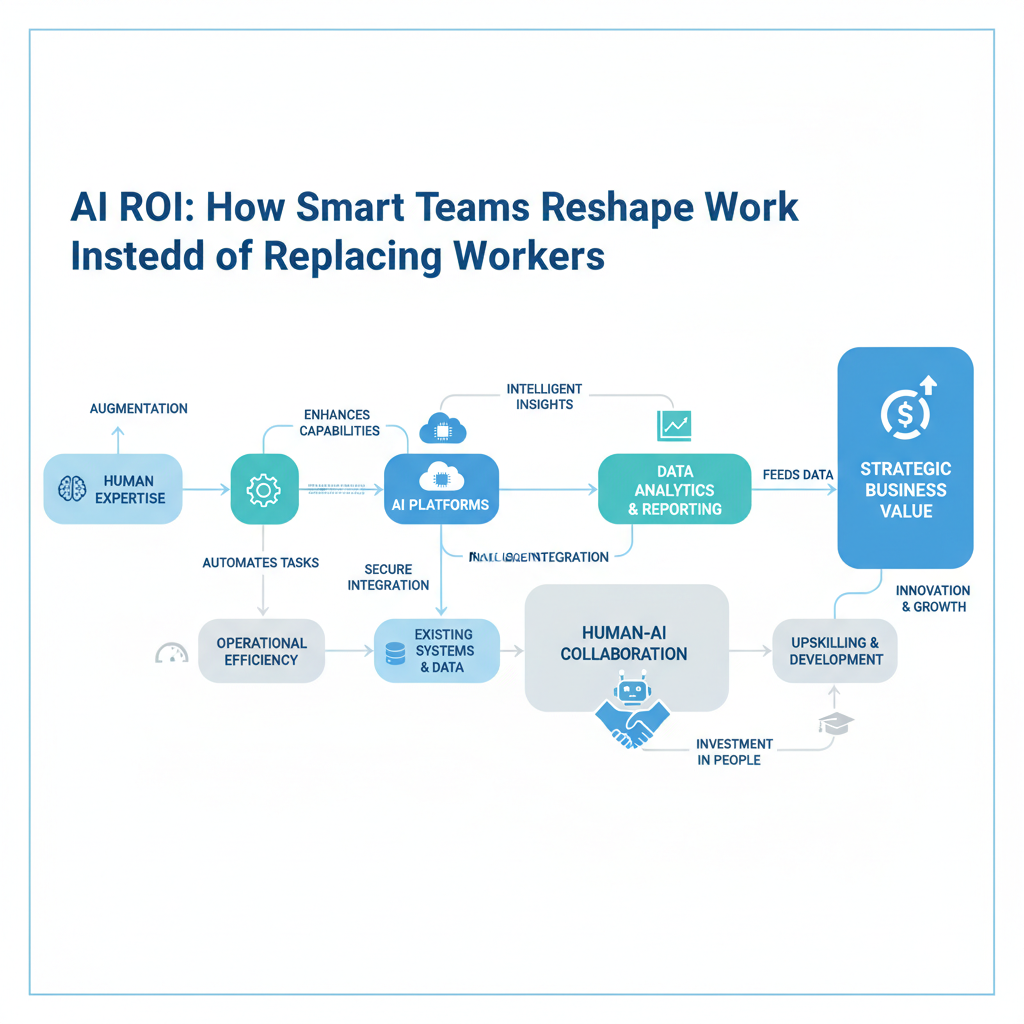
Understanding AI ROI
Plain-English definition: AI ROI (Return on Investment) is the net value you get back from an AI tool compared to what you put in. It’s not just about cutting costs. It’s about measuring whether the AI made your team faster, more accurate, or more valuable.
How it works under the hood: Companies track metrics before and after AI adoption. Common measurements include time saved per task, reduction in error rates, or revenue generated from AI-assisted work. The calculation subtracts the cost of the AI tool (licenses, training, integration) from the gains (faster output, fewer mistakes).
Real-world analogy: Think of a hammer. If you buy a hammer for $10 and it helps you build a fence in one day instead of three, your ROI is the value of those two saved workdays minus the $10. The hammer didn’t replace you. It made you more productive.
Concrete example: Imagine a customer support team handling 100 tickets per day. Each agent manages 20 tickets. After integrating an AI tool that drafts suggested replies, each agent now handles 35 tickets per day. The team’s total output jumps from 100 to 175 tickets without hiring anyone.
# Hypothetical ROI tracking snippet
tickets_before = 100
tickets_after = 175
cost_of_ai = 5000  # $5000 monthly

added_revenue = (tickets_after - tickets_before) * 10  # $10 per ticket
roi = (added_revenue - cost_of_ai) / cost_of_ai * 100
print(f"AI ROI: {roi:.0f}%")
# Output: AI ROI: 50%
The tool cost money but generated a 50% return by amplifying human capacity. That’s real AI ROI.
Reshape: How Work Changes
Plain-English definition: To “reshape” work means to redesign tasks so humans focus on what they do best while AI handles the repetitive, data-heavy, or predictable parts.
How it works under the hood: Reshaping involves mapping an existing workflow, identifying bottlenecks or tedious steps, and slotting AI into those specific points. The human role shifts from doing the boring stuff to supervising, interpreting, and strategizing.
Real-world analogy: Consider a chef. Before reshaping, they chopped vegetables, stirred sauces, and decided what to cook. After reshaping, a food processor handles the chopping. The chef now has time to experiment with flavors and presentation. The job isn’t gone — it’s better.
Concrete example: A data analyst used to spend 70% of their time cleaning messy CSV files. Now they use a Python script (plus a simple AI helper) to auto-detect and fix formatting issues.
# Before reshaping: analyst manually fixes every date format
# After reshaping: AI auto-detects and standardizes dates
import pandas as pd
from ai_helper import auto_fix_dates  # Hypothetical library

df = pd.read_csv("sales_data.csv")
df_clean = auto_fix_dates(df)  # AI handles the predictable errors
# Analyst now reviews only the ambiguous rows
ambiguous = df_clean[df_clean['date'].isna()]
print(f"Review {len(ambiguous)} rows manually")
The analyst didn’t lose their job. Their job got reshaped. They now add value where it matters.
Not Replace: The Core Philosophy
Plain-English definition: The “not replace” mindset means you deploy AI to augment human skills, not to eliminate workers. The goal is human + AI, not AI alone.
How it works under the hood: Leaders identify tasks where AI excels (speed, pattern recognition, repetitive processing) and tasks where humans excel (context, creativity, empathy, judgment). They then build workflows that combine both. Humans remain in the loop for decisions with high stakes or ambiguity.
Real-world analogy: A pilot doesn’t get replaced by autopilot. Autopilot handles straight-and-level flight, weather checks, and altitude adjustments. But the pilot takes over for takeoff, landing, and emergencies. One plus one equals three.
Real data callout: A 2023 study by Harvard Business School found that professionals using GPT-4 completed tasks 25% faster and produced 40% higher quality results — but only when they stayed involved in verifying outputs. AI alone performed worse than humans alone.
Concrete example: A legal team uses AI to scan thousands of contracts for risky clauses. But a human lawyer reviews every flagged clause before advising a client.
# AI finds potential issues, but human validates
flagged_clauses = ai_scanner.find_risks(contracts)
# flagged_clauses is a list of suspected problematic sections
for clause in flagged_clauses:
    print(f"AI suspects: {clause.text}")
    human_verdict = input("Is this actually risky? (y/n): ")
    if human_verdict == 'y':
        escalate_to_client(contracts[clause.doc_id])
The AI replaces the tedious scanning work. The human replaces guesswork with judgment. No one gets replaced — the work gets better.
People + AI: The Synergy in Practice
Plain-English definition: “People + AI” is the operational model where humans and AI collaborate as complementary partners. Each side does what it does best.
How it works under the hood: You build a feedback loop. AI proposes, human corrects. Human decides, AI executes. The system learns from corrections, improving over time. The human stays in control of strategy and ethics.
Real-world analogy: Think of a design team. AI generates 50 logo variations in seconds. The designer picks the best three, adds human soul to colors and typography, and presents them to the client. The AI handled volume, the human handled taste.
Non-obvious insight: The biggest gotcha? Without human oversight, AI can hallucinate confidently wrong answers. Truth check everything. The People + AI model only works if humans stay engaged.
Concrete example: A content writer uses an AI assistant to generate draft paragraphs. They revise each one.
# People + AI content workflow
def draft_with_ai(topic):
    draft = ai_model.generate(topic)
    print(f"AI draft: {draft}")
    print(f"Word count: {len(draft.split())}")
    feedback = input("What should change? ")
    revised = revise_paragraph(draft, feedback)
    print(f"Human-polished version: {revised}")
    return revised

final_article = draft_with_ai("How AI amplifies humans")
The writer stays the author. AI stays the assistant. Output goes up, quality stays high.
Comparison Table: How These Concepts Relate
| Concept | Core Idea | Human Role | AI Role | Outcome |
|---|---|---|---|---|
| AI ROI | Value from AI investment | Measure and optimize | Generates productivity gains | Financial returns |
| Reshape | Redesign tasks | Focus on high-value work | Handle repetitive work | Better job quality |
| Not Replace | Augment, not eliminate | Make key decisions | Assist with data/scale | Job security + productivity |
| People + AI | Collaborative partnership | Guide and verify | Execute and suggest | Amplified output |
These concepts stack. You need ROI to justify investment. Reshaping makes the work better. Not replace protects the team. People + AI makes it all work together.
Key Takeaways
- AI ROI measures net value gained, not just cost saved.
- Reshape means redesigning workflows so humans do creative work, AI does grunt work.
- Not replace philosophy keeps humans in the loop for judgment and ethics.
- People + AI creates a feedback loop that improves both sides over time.
- Real ROI comes from amplifying humans, not cutting them.
The teams winning with AI aren’t building a robot army. They’re building a better team — one where AI handles the tedious, and humans do the meaningful. That’s the future worth building.

Comments