The Java Backend That Deciphers Your Money: AI in FinTech
layout: default title: AI in FinTech with Java Backends date: 2024-05-15
Introduction
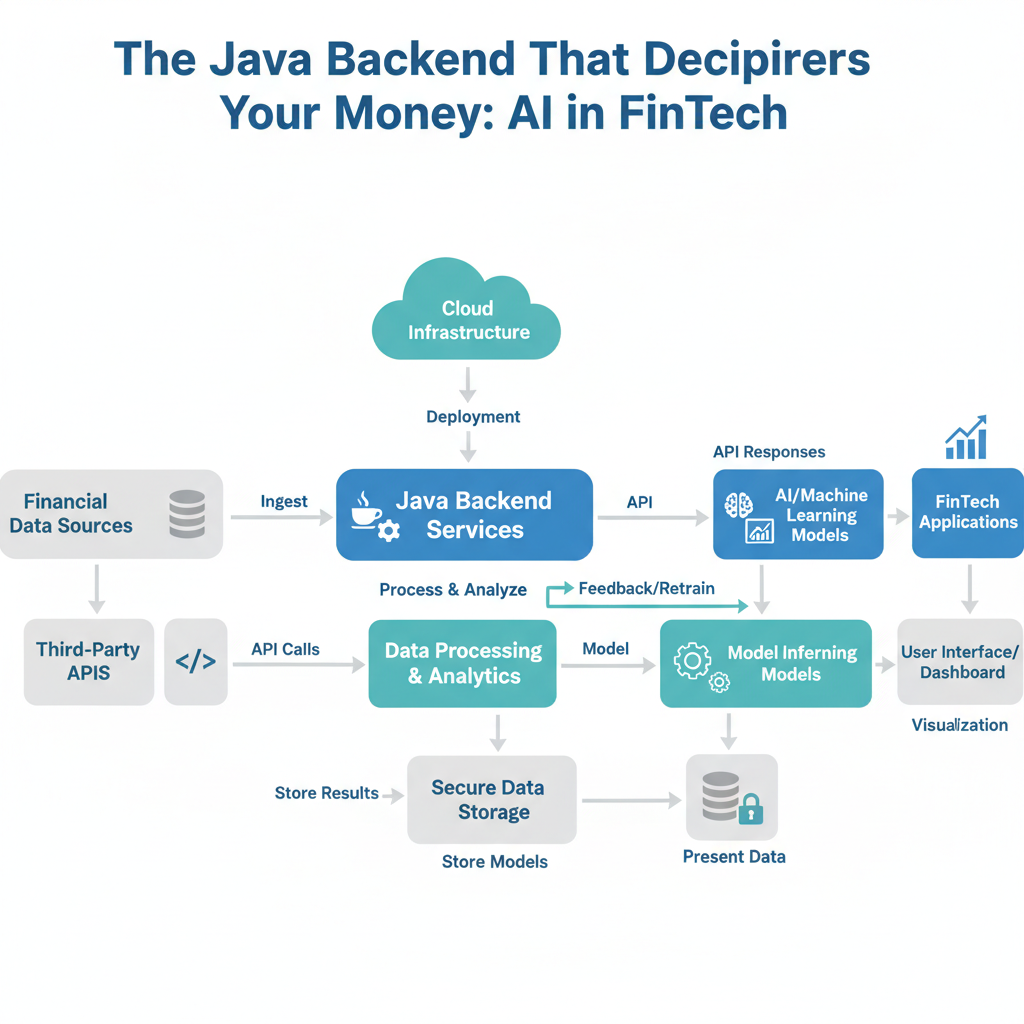
You hit “Pay Now” and money vanishes from your account, then reappears in someone else’s. That’s the simple version. Behind that click, thousands of transactions, currencies, and regulations collide. In FinTech—the blend of finance and technology—backends must handle this chaos at scale. This tutorial demystifies four core concepts your Java backend will encounter: Reconciliation, Analytics, and Compliance. We’ll define each term in plain English, show how it works under the hood with Java code, and ground it in a real-world analogy. By the end, you’ll understand how AI and Java tame financial data—no finance degree required.
Reconciliation: The Art of Matching Receipts
Definition: Reconciliation is the process of comparing two sets of records to ensure they match. In finance, you compare your company’s internal transaction log with the bank’s statement.
How it works: Your Java backend pulls transactions from your database and from the bank’s API (often via a file format called SWIFT MT940 or ISO 20022 XML). It then pairs records based on unique identifiers—like a transaction ID or amount + date combo. Any record that doesn’t have a perfect match gets flagged for human review.
Analogy: Imagine you and a friend both write down what you spent at lunch. Reconciliation is checking your lists against each other to confirm you both wrote “$12.50 for tacos”—and not “$12.50 for salad.”
Annotated Java Example:
public class Reconciliator {
    // Takes two lists of transactions from different sources
    public List<Transaction> reconcile(List<Transaction> internal, List<Transaction> bank) {
        // Convert bank transactions to a map for fast lookup by transaction ID
        Map<String, Transaction> bankMap = bank.stream()
                .collect(Collectors.toMap(Transaction::getId, t -> t));

        List<Transaction> flagged = new ArrayList<>();

        for (Transaction internalTx : internal) {
            Transaction bankTx = bankMap.get(internalTx.getId());
            if (bankTx == null || !internalTx.getAmount().equals(bankTx.getAmount())) {
                // No match in bank records, or amounts differ
                flagged.add(internalTx);
            }
        }
        return flagged; // These need human investigation
    }
}
Non-obvious insight: ID matching fails if the bank uses a different field (e.g., “reference number” vs “transaction ID”). A robust solution uses fuzzy matching on multiple fields, but that’s an O(n²) problem without careful indexing.
Analytics: From Noise to Narrative
Definition: Analytics is the process of examining raw financial data to find patterns, trends, and insights that inform decisions.
How it works: Your backend ingests transaction streams (often via Apache Kafka for real-time data) and stores them in a time-series database like InfluxDB or a columnar store like Apache Parquet. Then, it runs aggregations—sum of daily sales, average transaction value, outlier detection using statistical models. AI models (like isolation forests) can identify unusual spending patterns.
Analogy: A pile of grocery receipts doesn’t tell you much. Analytics turns that pile into a report: “You spend 40% more on coffee on Monday mornings.”
Annotated Java Example:
public class SpendingAnalyzer {
    public void analyze(List<Transaction> transactions) {
        // Group by category and sum amounts
        Map<String, Double> categoryTotals = transactions.stream()
                .collect(Collectors.groupingBy(
                    Transaction::getCategory,
                    Collectors.summingDouble(Transaction::getAmount)
                ));

        // Flag categories where spending exceeds 20% of total
        double total = categoryTotals.values().stream().mapToDouble(Double::doubleValue).sum();
        categoryTotals.forEach((cat, amount) -> {
            if (amount / total > 0.20) {
                System.out.println("Alert: " + cat + " is " + (amount/total*100) + "% of spending");
            }
        });
    }
}
Non-obvious insight: Real-time analytics in Java requires careful memory management. Streaming aggregations often use sliding windows (e.g., last 7 days), which demand efficient data structures like apache Kafka Streams’ KTable.
Compliance: The Watchful Auditor Without the Suit
Definition: Compliance means ensuring that financial operations adhere to laws, regulations, and internal policies—like anti-money laundering (AML) rules.
How it works: Your Java backend defines rules (e.g., “flag any transaction over $10,000 from a high-risk country” or “check every new customer against sanctions lists”). It applies these rules to each transaction or customer record as it enters the system. AI can enhance compliance by learning patterns of suspicious behavior that static rules miss.
Analogy: You’re a bouncer at a club. Compliance is checking every ID against the “no-entry” list and enforcing the “no more than two drinks per customer” rule.
Annotated Java Example:
public class ComplianceChecker {
    // Checks a new customer against a loaded sanctions list from a third-party API
    public boolean isCompliant(Customer customer) {
        // Rule-based checks first
        if (customer.getCountry().equalsIgnoreCase("HighRiskCountry")) {
            return false;
        }
        if (customer.getTransactionAmount() > 10000) {
            // Flag for manual review (return false for now)
            return false;
        }
        // AI-based check: call a pre-trained model
        double riskScore = AMModel.predictRisk(customer);
        return riskScore < 0.8; // Low-risk customers pass automatically
    }
}
Non-obvious insight: Compliance rules change frequently. Hard-coding them makes maintenance a nightmare. Use a rule engine like Drools that lets you express rules in a separate file—no code changes needed.
Comparison Table: How They Connect
| Concept | Input | Output | Example Tool in Java | Analogy |
|---|---|---|---|---|
| Reconciliation | Two data sources (internal + bank) | List of mismatches | Apache Camel, custom Java | Matching lunch receipts |
| Analytics | Raw transactions | Aggregated insights | Apache Spark, Kafka Streams | Turning grocery receipts into a spending report |
| Compliance | Customer/transaction + rules | Pass/Fail decision | Drools rule engine, TensorFlow Java | Bouncer checking IDs |
All three rely on robust Java backends, often with a queue (e.g., RabbitMQ) to handle load, a database (PostgreSQL) for persistence, and a monitoring tool (Prometheus) for health.
Key Takeaways
- FinTech is the intersection of finance and software—your Java backend sits at its core.
- Reconciliation compares two sets of data for mismatches; it’s the bedrock of audit.
- Analytics transforms raw numbers into actionable patterns using aggregations and ML.
- Compliance automates rule-checking against regulations and best practices.
- Every concept can be implemented in Java, but edge cases (fuzzy matching, sliding windows, rule-file maintenance) separate a toy from a production system.
Start with one concept. Build a small reconciler for a CSV file. Then add analytics. Then bake in a compliance rule. You’ll be surprised how fast it grows into a real FinTech backend.

Comments