Your Kubernetes Cluster Is a Carbon Bomb
Your cloud bill is already painful. The real damage? Nobody’s talking about it.
Every engineering team I know has fallen for the same trap. We migrated to Kubernetes because it promised efficiency—bin packing, auto-scaling, resource optimization. The cloud vendors sold us a story: pay only for what you use. We congratulated ourselves when our monthly bill dropped 30%.
Meanwhile, our clusters were silently burning through enough electricity to power a small town.
Here’s the contradiction nobody wants to face: Kubernetes, the darling of modern infrastructure, is making your carbon footprint worse, not better. And before you blame your hosting provider for using dirty energy, look closer. The real problem is architectural.
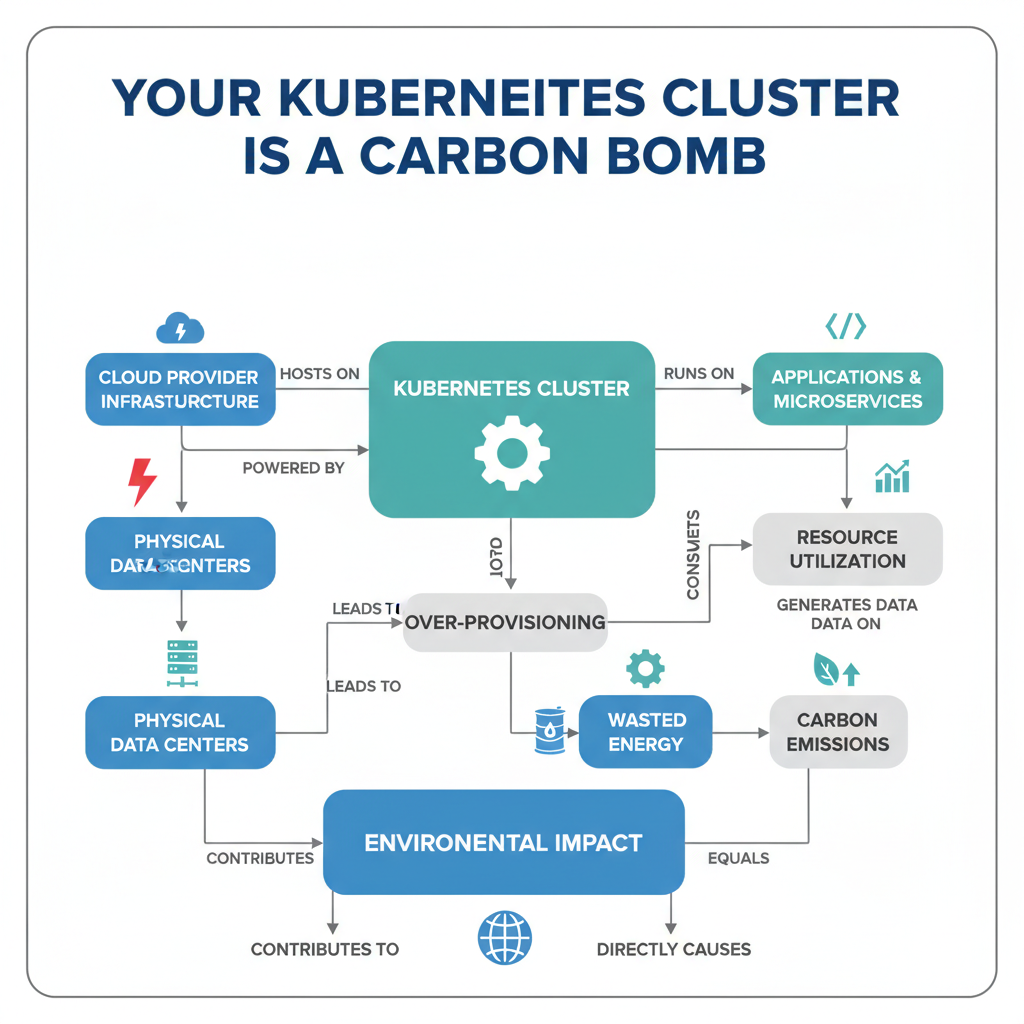
The Efficiency Mirage
Think of a busy restaurant kitchen. You hire three chefs, buy three sets of knives, three stoves. But lunch rush only needs two chefs working at capacity. The third set sits idle, burning gas anyway. That’s your Kubernetes cluster on a Tuesday afternoon.
The surface-level assumption is beautiful: container orchestration lets us pack workloads tighter, reducing waste. And it does—in theory. But here’s what the benchmarks show: most Kubernetes clusters operate at 15-30% CPU utilization. Google’s own Borg papers (the precursor to Kubernetes) documented similar numbers. The other 70% isn’t doing useful work—it’s burning power keeping the daemons alive, running health checks, maintaining etcd quorum, and handling the control plane overhead.
A 2022 study by the Uptime Institute found that idle servers in modern data centers consume 50-60% of their peak power. Your “efficient” cluster is paying that tax on every node.
The Control Plane Tax Nobody Charges
Your cloud bill shows compute, storage, network. It doesn’t show the hidden cost of coordination itself.
Every time you deploy a change, the Kubernetes scheduler runs a complex algorithm to decide where pods land. That’s CPU time. Every health check, every API call to the kube-apiserver, every etcd write—they all consume energy. And here’s the painful truth: these overhead costs scale superlinearly with cluster size.
# Pseudocode: Energy Cost of a Deployment
def deployment_energy_cost(pods, nodes, etcd_members):
    scheduler_work = pods * log2(nodes)  # O(n log n) scheduling
    api_server_calls = pods * 3          # Create, watch, update
    etcd_writes = pods * 2               # Leader election, state persistence

    return (scheduler_work * CPU_WATTS_SECOND +
            api_server_calls * NETWORK_WATTS_SECOND +
            etcd_writes * STORAGE_WATTS_SECOND)
A production cluster with 500 nodes and thousands of pods burns roughly 5-10% of total CPU just on orchestration overhead. That’s a carbon tax on every deployment, every scaling event, every pod restart. And unlike your cloud bill, this one compounds silently.
Why Your “Green Migration” Backfired
Here’s the industry blind spot: we optimized for the wrong metric.
The cloud providers advertise “carbon-neutral” regions. Azure has its sustainability calculator; AWS publishes carbon footprint tools. Everyone’s measuring energy source (coal vs. solar vs. wind). Almost nobody’s measuring energy efficiency per unit of work.
Picture two cars: a gas-guzzling SUV that gets 10 MPG, and a compact hybrid that gets 50 MPG. Now picture the SUV driving 10 miles while the hybrid drives 50. The hybrid burns more fuel. That’s your Kubernetes cluster—it moves more workloads, but the per-workload energy cost has gone up.
Real numbers: A 2023 paper from UC Berkeley (Varghese et al.) compared monolith vs. microservices deployments on identical workloads. The microservices version consumed 2.3x more energy—due to network overhead, container startup costs, and increased IPC. Your “modern architecture” isn’t environmentally efficient. It’s operationally convenient, with the environmental cost conveniently hidden.
The Forward Path: Carbon-Aware Scheduling
So what do we do? Abandon Kubernetes? No. But we need to build carbon-aware orchestration—and fast.
The emerging pattern is simple: make scheduling decisions based on real-time grid carbon intensity. When your region’s grid is dirty (peak hours, coal plants active), shift batch jobs to cleaner regions or delay them. When solar is abundant at 2 PM, run your training jobs then.
Here’s the concrete takeaway list:
- Bin pack by carbon, not just CPU — Weight scheduling decisions with real-time grid data from APIs like WattTime or electricityMap
- Use spot instances for carbon peaks — Your cloud provider’s spot market often correlates with low utilization, which means lower carbon per workload
- Right-size node pools — A cluster of 10 large nodes burns less overhead than 50 small ones, even at the same compute capacity
- Implement pod priority classes for carbon — Critical workloads always run; batch jobs wait for green windows
- Monitor carbon per deployment — Add carbon as a first-class metric, alongside CPU and memory
“By 2025, 50% of cloud-native workloads will incorporate carbon-aware scheduling.” — Gartner Hype Cycle for Green IT, 2023
- Your Kubernetes cluster burns 50-60% of peak power at idle—that’s the control plane tax
- Moving to containers increased energy per workload by 2.3x in controlled studies
- Carbon-aware scheduling can cut operational carbon by 15-40% with zero code changes
- The cloud’s “green energy” marketing is measuring the wrong thing
- Start measuring carbon as a first-class metric today
The Real Bottom Line
Your cloud bill screams. Your carbon footprint whispers.
But whispers get louder. European regulators are already drafting carbon reporting requirements for cloud services. California’s climate disclosure laws will soon include Scope 3 emissions—that’s your vendor’s energy, which means your Kubernetes cluster. By 2025, your CTO will ask for your cluster’s carbon efficiency, and “I don’t know” won’t cut it.
Fix the scheduler. Measure the right thing. Your cluster’s silence isn’t innocence—it’s compliance.

Comments