Why Your “Genius Hire” Is Tanking Team Performance
I watched it happen in real-time. A startup had scraped together a small team of solid, mid-level engineers. They weren’t rock stars — just reliable, communicative, and surprisingly effective. But the CTO was obsessed. He’d read a Paul Graham essay and convinced himself they needed a 10x engineer to level up. So they hired Alex.
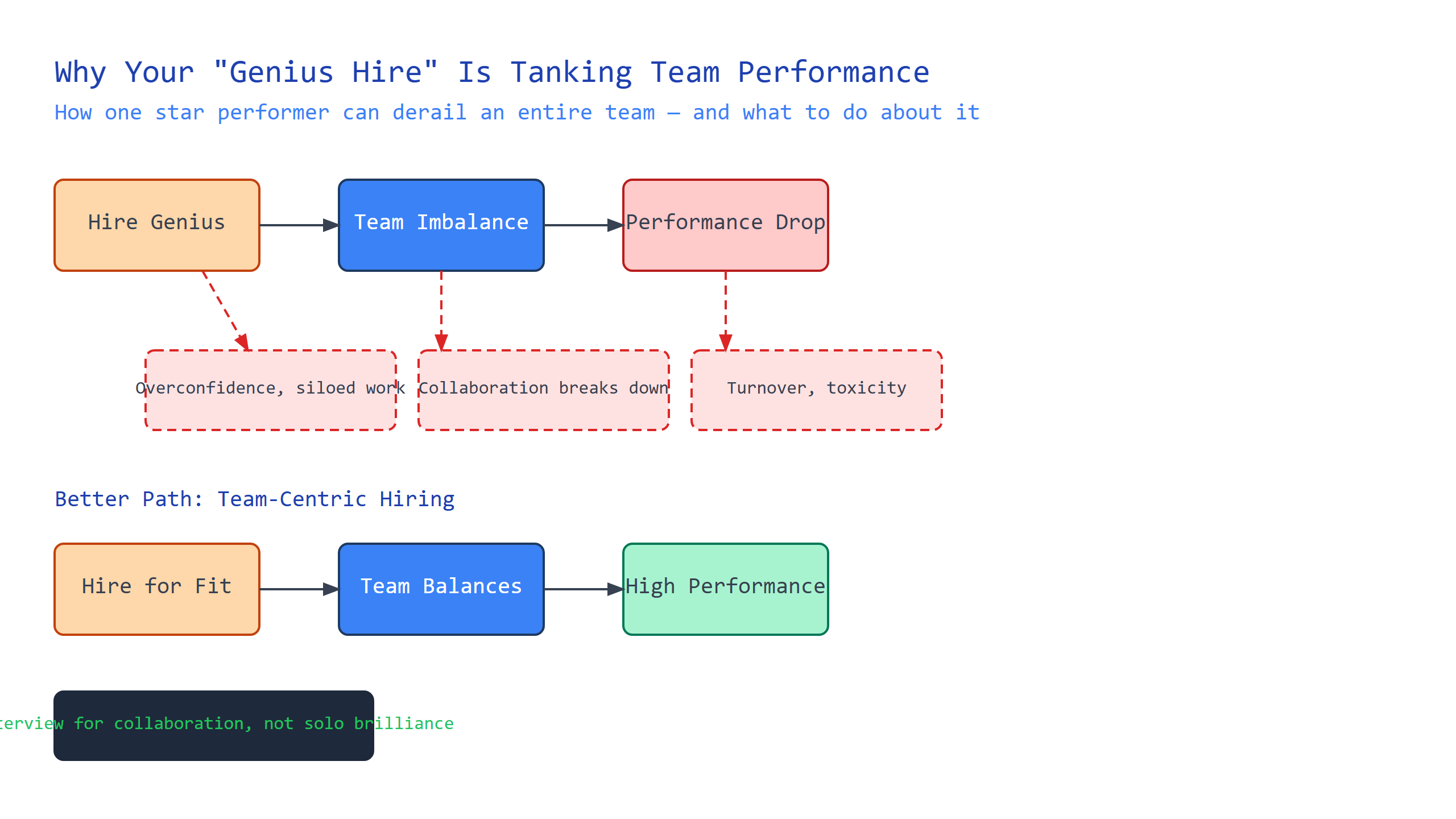
Alex was brilliant. Could ship a full feature in a weekend. Knew obscure system internals by heart. And within three months, everyone on the original team was miserable. The codebase was a labyrinth of cleverness. Decisions were made in Slack DMs after midnight. Alex didn’t do code review — it was beneath them. The team’s velocity plummeted. Two of the “B-players” quit. The company that had been shipping reliably now had a bus factor of one and a culture of fear.
Nobody talks about the 10x engineer’s hidden multiplier: it’s often negative.
The Cult of the Solo Genius
The startup world worships outliers. We tell founding stories that sound like comic book origin stories — one person, a laptop, and sheer willpower disrupting an industry. Paul Graham’s “Keep Your Identity Small” gets quoted like scripture. Founders proudly declare they only hire “the top 1%.”
But here’s the uncomfortable truth: most of your software isn’t revolutionary. It’s CRUD. It’s payment integrations. It’s coordinating ten microservices that talk to each other. The hard problems aren’t algorithmic — they’re relational.
The 10x myth assumes that individual output is the only variable that matters. It ignores the reality that most software is built by teams. Real teams. The kind where shipping a feature means understanding Sarah’s API, documenting for next month’s intern, and not breaking the pipeline Jake built last Tuesday.
When you optimize for individual brilliance, you optimize for silos, knowledge hoarding, and technical debt that compounds like credit card interest.
The Hidden Cost of Genius
What nobody tells you about hiring a 10x engineer: they often operate at “10x the cost to everyone else.” Here’s how it actually plays out:
-
Knowledge asymmetry: Paul only understands Paul’s code. When he’s out sick, everything stops. Teams become fragile, not resilient.
-
Process bypass: Geniuses hate process. They skip code reviews, ignore documentation, and treat testing as optional. They’re technically right — but the team is left holding a bag of clever, untestable code.
-
Culture erosion: Teams with a “star” inevitably develop a veneration gap. Juniors stop asking questions. Seniors defer. Psychological safety? Not in this room.
Stanford professor Robert Sutton spent fifteen years studying “star” performers. His finding: stars who work alone actually reduce team performance by 15-30%. But stars who collaborate and mentor — who actively share knowledge — increase team performance by 25-40%. The difference isn’t raw ability. It’s behavior.
Alex wasn’t a bad engineer. They were a bad teammate. And in a startup, where every day is about shared ownership and moving fast, bad teammates are toxic assets.
The B-Team That Outperforms
I’ve seen this pattern play out at three different startups now. The “A-team” — the one with GPA-obsessed founders and FAANG pedigree — always burns out or fractures within 18 months. The “B-team” — the one with women and veterans and people who actually worked at a non-tech company before — quietly outlasts everyone.
Why? Because B-teams compensate for individual weaknesses with behavioral strengths. They communicate more. They document better. They know how to handle conflict without HR getting involved. And critically, they build systems that work even when someone’s kid is sick or when the CEO changes the roadmap at 3 PM on a Friday.
Google’s Project Aristotle confirmed this: the highest-performing teams weren’t the ones with the most IQ points. They were the ones with the most psychological safety. Teams where everyone felt they could ask a “dumb” question or flag a bug without being blamed.
Last week, I talked to a tech lead at a Series B company that explicitly rejects “10x” candidates. Their interview process assesses three things: competence, collaboration, and humility. They hire for a “willingness to be wrong in public.” Their churn is half the industry average. Their velocity is higher than it was with the previous “star” team.
How to Build a Team That Works
Here’s what this means for engineers and managers reading this:
For engineers: Stop optimizing for being the only one who can fix a bug. That’s job security, sure — but it’s also career imprisonment. The most respected engineers at high-growth companies are the ones who make everyone around them better. They write clear PR descriptions. They pair with juniors. They automate themselves out of a job. That’s how you get promoted, not by being the only person who understands the payment service.
For managers: Stop looking for unicorns. Start looking for people who ask “how can I help?” before they ask “what’s in this for me?” Build for resilience, not speed. Create systems that fail gracefully because your team is redundant, not because you have one genius who can fix anything.
A concrete step: try interviewing for “empathic rigor” — the ability to challenge an idea without making it personal. Ask candidates about their biggest conflict on a team. Look for people who take responsibility, find the lesson, and describe how they repaired the relationship.
-
If you’re an engineer: Pick one project this week where you deliberately reduce the bus factor. Document something. Pair with someone. Make yourself replaceable. It feels counterintuitive. It’s how you grow.
-
If you’re a manager: Identify the person on your team who makes others better. Promote them. Not the person who ships the most code at 2 AM. The person whose PR reviews make other people’s code better.
-
If you’re a founder: Stop listing “10x engineer” in job descriptions. You’re attracting the wrong people. You want people who are great AND generous. Those exist. They just don’t call themselves 10x.
Conclusion
The next time you’re tempted to hire a genius, ask yourself: “Will this person make our team 10x better, or 10x more fragile?” Because in startups, every hire is a culture bet. The ones who compound are rarely the loudest. They’re the ones who listen, teach, and trust that the whole is greater than the sum of its parts.
And if you’re an engineer who’s been called “10x”? Congratulations. Now prove you’re 10x for real. Not by shipping alone. By making your whole damn team ship better.

Comments