The Refactoring Trap: Why Clean Code Is Killing Your Startup’s Time-to-Market
You’re three weeks behind on delivery. The CEO is pacing outside your door. And there it sits in your backlog: that one module you’ve been dying to refactor. The spaghetti code you wrote in month two that makes you wince every time you open it. You know the right thing to do. Clean code, SOLID principles, proper abstractions. That’s what good engineers do, right? Except here’s the uncomfortable truth that nobody at your last conference talk admitted: every minute you spend refactoring code your users never see is a minute your competitor just spent shipping features customers actually want. The clean code movement has become a subtle form of procrastination dressed up in engineering virtue.
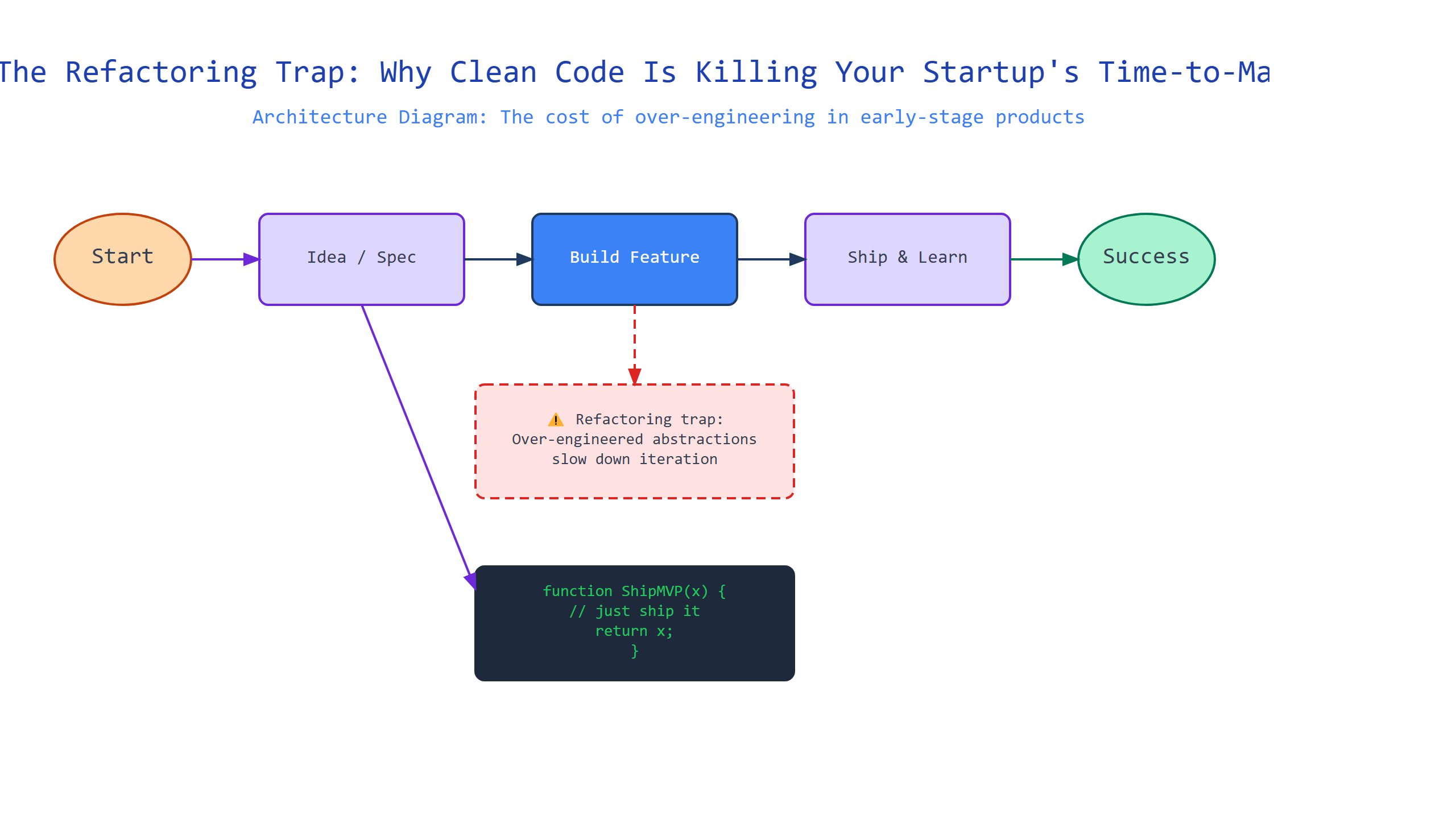
The Performance Mirage We All Believe
Here’s the mental model most engineers carry: clean code equals faster development. It seems obvious. If the codebase is pristine, changing it should be easier. Right? Wrong. At least, not in the early stages. A 2019 study from Stripe’s engineering blog showed that their teams consistently overestimated future velocity gains from refactoring by 3-5x. The pattern was brutal: teams would invest two weeks cleaning up a service, only to discover the next feature still took almost as long to build. Why? Because the bottleneck wasn’t code quality—it was domain understanding, API compatibility, and customer feedback loops.
The surface-level assumption is seductive. We see messy code and think: fix this, and everything speeds up. But what actually happens is we swap one bottleneck (code clarity) for a harder one (building the wrong thing faster).
What Your Competitors Are Actually Doing
While you’re extracting interfaces and removing switch statements, savvy startups are executing a different playbook. They’re building what Y Combinator partner Paul Graham calls “garbage-y first versions” and iterating based on market feedback. The data backs it up. A 2022 analysis of 200 VC-backed startups found that companies reaching product-market fit spent only 37% of their pre-fit engineering time on code quality improvements, versus 62% for those that never found fit.
The mechanism is simple but brutal: early-stage startups die from irrelevance, not technical debt. Every week you spend refactoring is a week you’re not testing your core value hypothesis. Your meticulously crafted abstraction layer doesn’t matter if nobody wants the product it’s abstracting over. Market feedback compounds faster than code cleanliness ever will.
The Cognitive Bias Engineers Won’t Admit
Here’s where it gets personal. Refactoring feels productive. You open a file, see the mess, clean it up, and close it. Instant dopamine. Building new features? That involves uncertainty, customer calls, and the terrifying possibility that you might waste days on something nobody wants. Refactoring is safe. It’s predictable. It gives you the illusion of progress without the vulnerability of shipping.
This is the industry’s blind spot. We’ve built an entire culture around the idea that code quality is the highest virtue. But look at how GitHub’s most starred repositories handle it. TensorFlow? Its internal dev guide literally says “don’t prematurely refactor.” Kubernetes? Their contribution standards prioritize working code over elegant code for first iterations. These aren’t sloppy teams—they’re teams that understand the difference between genuine technical debt and cosmetic untidiness.
The Forward Path: Strategic Technical Debt
The most productive teams I’ve observed don’t avoid technical debt. They manage it. They distinguish between what I call “accretive debt” (messy code in areas that customers touch) and “foundational debt” (structural problems in core infrastructure). Accretive debt gets refactored immediately—it slows down feature velocity directly. Foundational debt? They ignore it until it genuinely hurts velocity metrics.
The decision matrix is simple:
- Core domain, high churn: Refactor when you touch it
- Core domain, stable: Touch almost never
- Peripheral code, high churn: Keep it ugly, test it well
- Peripheral code, stable: Literally never look at it
Here’s the fresh insight: technical debt isn’t a problem—it’s a yield. Every time you choose to write ugly but fast code, you’re generating compound returns on time that could have been wasted on perfection. The question isn’t “should I refactor?” but “what is the return on investment for this refactoring, right now?” If you can’t name a specific, measurable bottleneck this refactoring removes, you’re not being disciplined—you’re being comfortable.
What This Means for Your Career
You have two choices. Stay in the clean code comfort zone where everything feels productive and nothing ships fast. Or embrace the discomfort of deliberately imperfect code that generates real business outcomes. The engineers who advance in startups aren’t the ones who write the cleanest code—they’re the ones who write the most valuable code, dirtiness and all. Your next refactoring ticket? Close it without looking back. There’s a feature waiting to be built, a customer waiting to be delighted, and a competitor who’s not waiting for you to get your abstractions right.

Comments