Your CTO’s Equity Isn’t Earned—It’s Vested
The 4-Year Standard Is Killing Hardware Startups Before They Ship
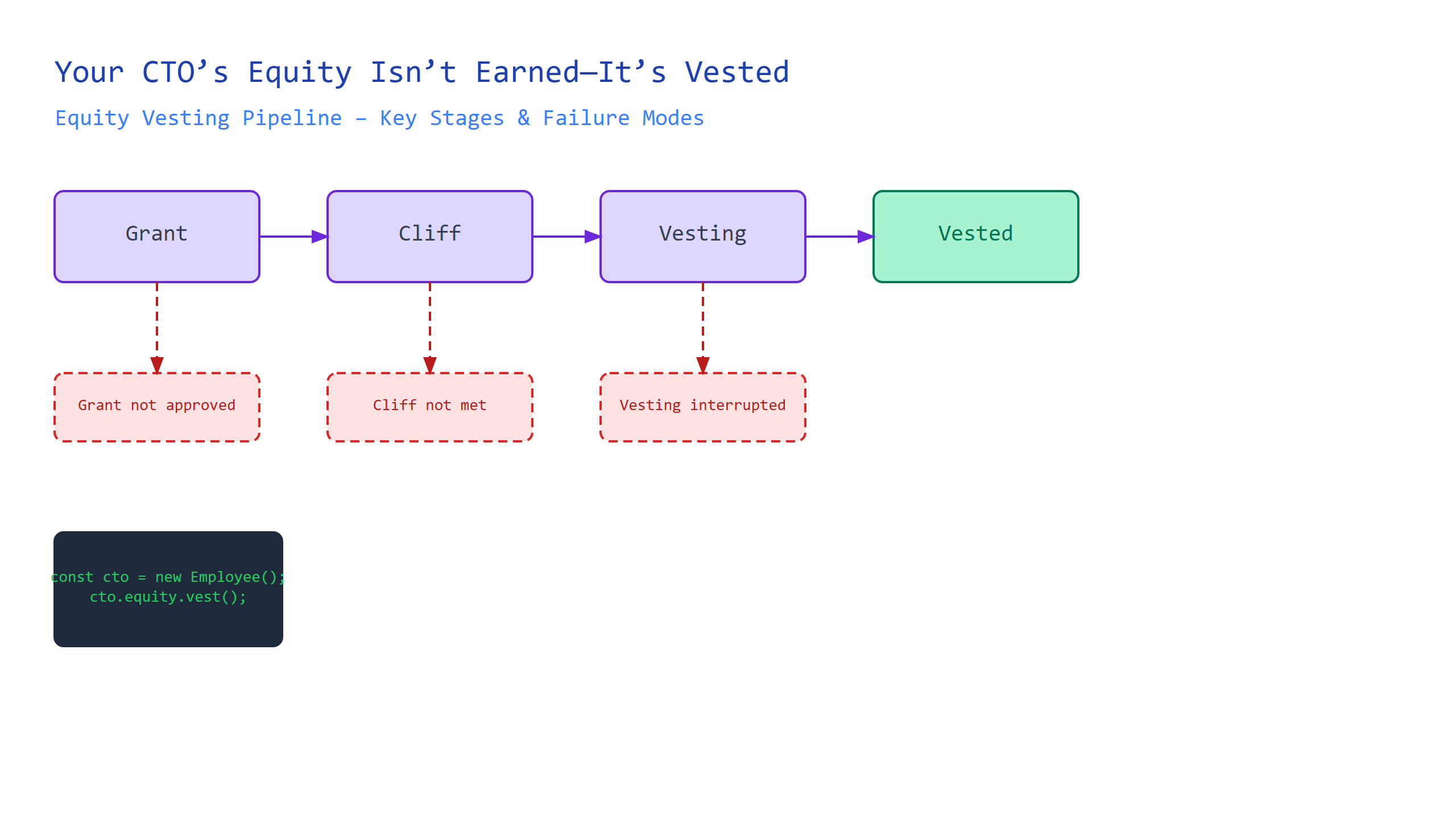
You raised your seed round. Your co-founder signed the dotted line. Four years of vesting, one-year cliff. Standard stuff. Standard mistake.
Here’s the contradiction that keeps me awake: software startups burn through capital at 30% of the rate hardware startups do, yet they use the exact same equity structure. The same timeline. The same incentive model. That’s like giving a marathon runner and a sprinter the same pacing strategy. It makes no sense.
Let’s look at the numbers. Hardware startups need 2-3x more capital and 2-4x more time to reach product-market fit compared to software companies. According to PitchBook data, the median time to Series A for hardware companies is 4.2 years versus 2.1 years for SaaS. Yet we hand out equity on a 4-year schedule designed by and for software companies.
Your CTO is vesting on a treadmill that stops running right when they need to sprint.
The Surface-Level Assumption
The 4-year standard isn’t sacred text—it’s a historical accident. It originated from Silicon Valley software companies in the 1980s and became dogma through network effects. Venture capitalists like it because it aligns with their fund timelines (typically 10 years). Lawyers like it because it’s templated. Founders accept it because everyone does it.
But the assumption hiding underneath is deadly: that value creation follows a linear, predictable curve. For software, that’s roughly true. You build an MVP in 6 months, find product-market fit in 18 months, and scale for the next 2 years.
For hardware, the curve looks completely different.
Those first 18 months aren’t about product-market fit. They’re about surviving the Valley of Death—the period between initial R&D spending and first revenue. You’re designing PCBs, spinning molds, running EMC testing, dealing with supply chain hell. Your CTO is doing mechanical engineering, not building features. The value they create in year one is invisible to anyone who only looks at revenue.
What’s Actually Happening Underneath
Let me tell you about a hardware startup I know (name changed for obvious reasons). They raised $2M in seed funding and hired a brilliant CTO with a background in optical systems. Standard 4-year vesting, 1-year cliff.
Month 14: The CTO leaves. He’d gotten through the hardest part—prototyping, initial certification, first supplier relationships. He walked away with exactly 25% of his equity. The company was left with a half-built product, no backup documentation, and suppliers that only worked with him.
He didn’t betray anyone. He made a rational decision. His equity was back-loaded, and the most painful, highest-value work happened in years 1 and 2. Once the cliff passed, he could cash out and join a software company that would actually pay him market rate.
The market is telling us something that equity structures ignore: the marginal value of a hardware CTO’s contributions peaks early, not late. Reverse-vesting models that backload equity are punishing the wrong behavior.
The Industry Blind Spot
The blind spot is cognitive, not technical. We’ve normalized a structure that only works for one type of company. Venture capital itself was designed for software ROI profiles—high optionality, low capital intensity, short feedback loops. Hardware breaks every one of those assumptions.
Here’s the emotional reality that nobody talks about: your hardware CTO knows they’re underpaid. They know their market rate as a senior hardware engineer is $200K+, while they’re taking $80K in cash and betting on equity that doesn’t start paying out until year 4. They’re not stupid—they’re just optimizing for a different timeline than you think.
The numbers confirm this. A 2022 study by the Kauffman Fellows found that hardware CTOs have a 40% higher turnover rate in years 2-3 compared to their software counterparts. Year 2 is when the hardware grind is most intense. Year 2 is when your CTO starts seeing the exit math.
What This Means Going Forward
The solution isn’t to abandon vesting—it’s to make it match reality.
The distribution problem: Value creation in hardware is not Gaussian. It’s a step function. The first 18 months contain 60% of the value work (prototyping, IP creation, supply chain setup). Years 3-4 contain refactoring and optimization.
The timing mismatch: Your CTO’s most valuable contributions happen during the Valley of Death, but their equity vests most heavily on the other side.
The solution spaces:
- Front-loaded vesting: 50% vests in year 1, 30% in year 2, 20% in years 3-4. This matches the value curve.
- Performance-based cliffs: Instead of time, use milestones. First working prototype? 25% vested. First certification? Another 25%.
- Hybrid models: Cash bonuses tied to hardware milestones, plus standard equity with acceleration clauses triggered by manufacturing events.
The uncomfortable truth: Standard 4-year vesting is essentially a tax on hardware founders. It attracts co-founders who undervalue their early contributions and repels those who accurately assess their worth.
- The 4-year vesting standard was designed for software, not hardware. Different capital requirements, different time-to-revenue, different value curves.
- Hardware CTOs create disproportionate value in years 1-3. Current structures backload that equity, incentivizing early departure.
- Front-loaded vesting models and milestone-based cliffs better align incentives with hardware’s actual development timeline.
- If you’re raising for hardware, negotiate vesting like you negotiate your cap table. It’s not standard—it’s structural.
The Hard Conversation
You need to have a different conversation with your hardware CTO. Not “here’s your standard package,” but “here’s how we recognize that your hardest work happens before our first revenue.”
Ask yourself: do you want a CTO who’s optimized for a 4-year exit, or one who’s optimized for building something that works? The two structures pull in opposite directions.
If you don’t change the equity model, the market will change it for you. The best hardware CTOs are already voting with their feet. They’re joining companies that get it—companies that understand that building physical things requires a different kind of commitment, and a different kind of reward.
Your 4-year standard isn’t a safety net. It’s a sieve. And your most valuable co-founder is already leaking through.

Comments