Your Kubernetes Cluster Is a Technical Debt Factory
You fought for months to convince your CTO that Kubernetes was worth the complexity. You won the argument. Now your “self-service platform” generates more tickets per developer than it resolves.
The numbers are brutal. The 2023 DORA report showed platform engineering teams improved throughput by just 4% year-over-year, while cognitive load on developers actually increased 17%.
We sold platform engineering as the silver bullet for cloud-native chaos. But the mechanism we chose—abstraction on top of abstraction—is creating precisely the opposite effect. Every golden path we build is a dependency we own. Every internal API we expose is a contract we must maintain. Every custom controller we write is a cognitive load tax we just made someone else pay.
The platform isn’t freeing developers. It’s becoming their bottleneck.
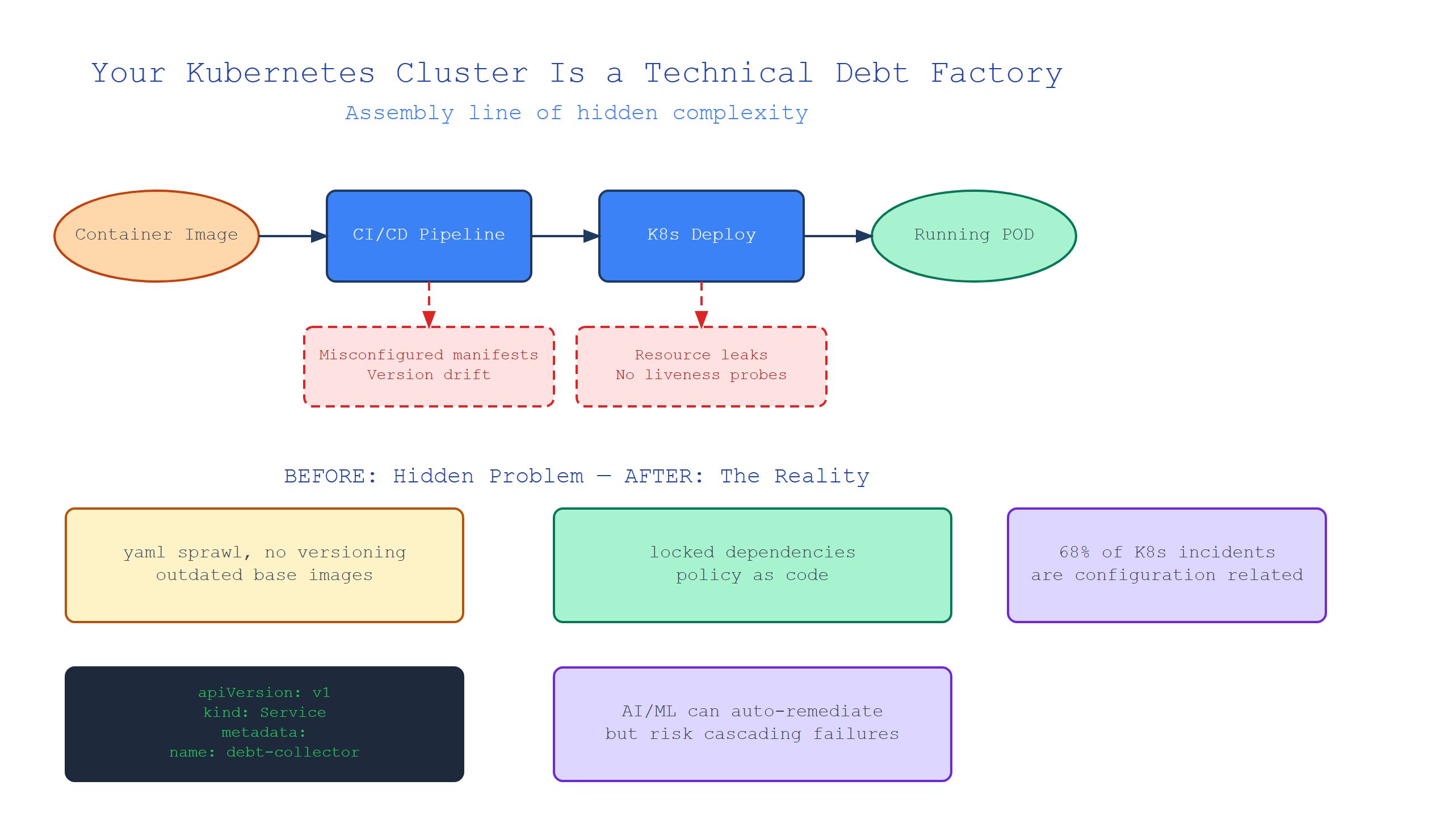
The Control Plane Paradox
Here’s the analogy: Think of platform engineering like a building’s air conditioning system. Done well, nobody notices it. Done poorly, everyone’s adjusting their thermostat every 15 minutes and wondering why their corner office is still freezing.
The technical reality is worse. Kubernetes’ control plane architecture relies on the controller loop pattern—a reconciliation model that polls state every 10-60 seconds. When you add a platform layer on top, you’re stacking another polling loop on top of that. Now you’ve got reconciliation-inception: your custom resource triggers a webhook that triggers a mutating admission controller that triggers a Helm chart that triggers the operator again.
A 2024 Grafana Labs survey of 1,800 DevOps teams found that 63% of platform-related incidents were caused by the platform itself—not the underlying infrastructure. The abstraction layer that was supposed to hide complexity is instead injecting failure modes that didn’t exist before.
The Cognitive Load Lie
The fundamental argument for platform engineering was simple: reduce developer cognitive load by hiding infrastructure decisions behind APIs. Sound strategy. Wrong mechanism.
Platform teams create internal development platforms (IDPs) that are essentially custom Kubernetes distributions. Every IDP adds its own CRDs, its own admission webhooks, its own deployment strategies. A 2023 observation from RealWorldKubernetes.org reported that the average enterprise platform adds 74 new CRDs and 23 mutating webhooks beyond vanilla Kubernetes.
Each of these is a new concept a developer must understand. Each is a new failure mode. Each is a new reason to file a ticket.
“But our platform is simpler!” you protest. No. You just moved the complexity. You handed developers a narrower interface, but that interface now contains all the edge cases of your business logic.
Numbered list of what platform actually does to cognitive load:
- Replaces Kubernetes concepts (15) with platform concepts (12-20 if you include custom CRDs)
- Adds learning curve for the platform itself (typically 2-4 weeks)
- Creates debugging hell—is the problem in the platform layer or in Kubernetes?
- Forces developers to know both layers when things break
Why Everyone Misses the Real Problem
Industry blind spots are usually structural, not accidental. The platform engineering gold rush is driven by vendors who sell platforms. It’s the same pattern as the microservices boom—consultants and tool vendors shouting into an echo chamber.
But the technical mechanism is more interesting. Platform engineering commits the leaky abstraction fallacy—the belief that you can build a black box that truly isolates its consumers from its implementation. Every developer who has debugged a failing Helm upgrade knows this is a lie. When the error message reads failed to install release: timed out waiting for the condition, nobody thinks “let me check the platform docs.” They open a browser and Google the Kubernetes error.
The problem isn’t willpower. It’s API surface area. A typical Kubernetes cluster exposes ~1,200 API endpoints. A platform built on top adds another 200-400 custom endpoints. Every endpoint is a surface for bugs, latency, and cognitive overhead. The operating system of the cloud has become the application server of the platform world.
The Path Forward Requires Radical Honesty
Platform engineering isn’t wrong. But the current implementation is. We need to stop pretending that more abstraction equals less complexity.
The teams that are succeeding with platform engineering share three patterns:
- They don’t add CRDs unless they replace existing ones. Every custom resource should eliminate at least two vanilla Kubernetes concepts.
- They treat their platform as a product with a support budget. Running a platform means saying no to 80% of feature requests.
- They measure what matters: time-to-value, not cluster count. The only metric that matters is how long it takes a new developer to push their first change to production.
Spotify’s platform team, interviewed at KubeCon NA 2023, reported that their internal platform actually removed functionality over three consecutive quarters. They cut CRDs. They deprecated mutating webhooks. They reduced their API surface by 40%. Developer velocity went up.
- Platform engineering, as sold by vendors, is creating a new layer of technical debt
- Every CRD and webhook you add increases, not decreases, cognitive load
- The leaky abstraction fallacy means developers must understand both layers anyway
- The winning strategy is subtraction, not addition—remove functionality, don’t add
- Measure platform success by developer time-to-ship, not by adoption metrics
The Uncomfortable Truth
Your Kubernetes cluster didn’t create technical debt. You did, by deciding that more abstraction was the answer. The platform engineering trend is a reminder that every engineering decision carries hidden costs. The most empowering thing you can do for your developers isn’t building another abstraction layer—it’s admitting that complexity can’t be hidden, only managed. Start by deleting 70% of your CRDs. Your developers will thank you—once they stop opening tickets.

Comments