Streaming Is a Luxury Most Apps Can’t Afford
You’ve been sold a lie: that real-time stream processing is the inevitable evolutionary endpoint of data architecture. Kafka streams, Flink pipelines, Kinesis consumers — every conference talk, every vendor blog, every “modern data stack” diagram treats streaming as the default. Here’s the uncomfortable truth: for 80% of use cases, batch processing is not only cheaper and simpler — it’s faster.
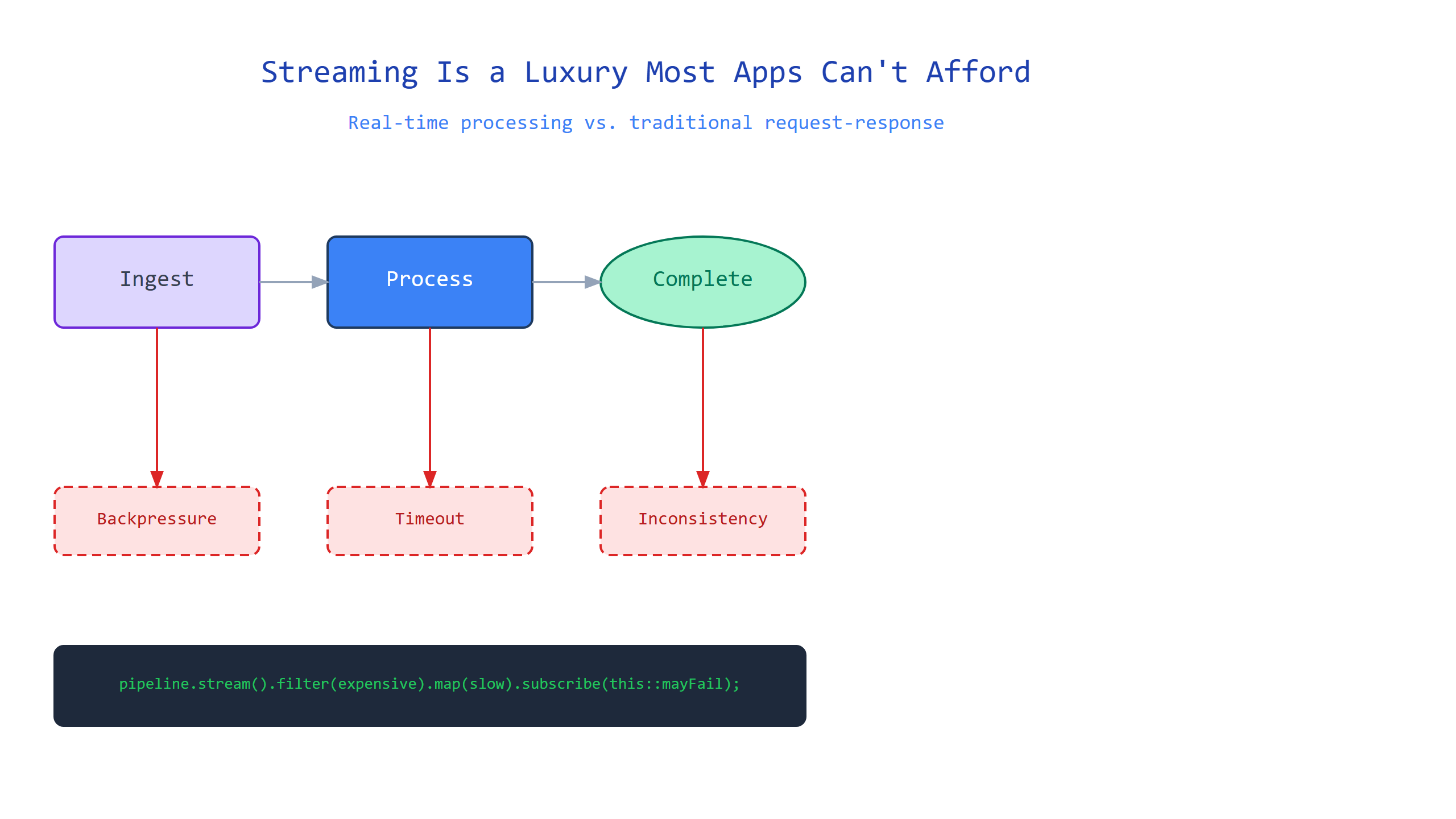
The Latency Mirage
The assumption is simple: streaming = lower latency, batch = higher latency. That’s technically true at the micro level but catastrophically wrong at the macro level. Think of it like this: batch is a freight train, streaming is a bicycle courier. Yes, the courier delivers each envelope the moment it’s ready — but the freight train moves 10,000 packages at once at 10x the speed per package.
What actually happens in practice? A typical streaming pipeline — let’s say Kafka → Flink → S3 — introduces 200-500ms of processing latency per event. But that’s after you’ve dealt with exactly-once semantics, state management, checkpointing, and backpressure handling. The complexity tax is real, and it compounds.
Consider a concrete example from Uber’s 2019 engineering blog: their streaming fraud detection system required 40+ custom operators just to handle watermarks and out-of-order events. The batch equivalent? A simple Spark job with 10 lines of windowing logic. The streaming version was harder to debug, harder to test, and harder to reason about. And the latency difference? 2 seconds versus 30 minutes for their use case.
The Hidden Cost of Always-On
# Simplified streaming pipeline pseudocode
stream = kafka.subscribe("user_events")
stream
  .window(Duration.ofSeconds(30))
  .aggregate(count_events())
  .stateful_operation(user_store)  # Requires Redis/RocksDB
  .exactly_once()                   # Coordination + checkpointing
  .to_sink("processed_events")
Now the batch equivalent:
# Batch pipeline pseudocode
df = spark.read.parquet("events/*.parquet")
df.groupBy(window("timestamp", "30 seconds"))
  .agg(count("event_id"))
  .write.mode("overwrite").parquet("processed_events")
See the difference? The streaming version requires persistent state stores, exactly-once coordination, and continuous operation. The batch version runs, finishes, and goes away.
This isn’t academic. In 2023, DoorDash publicly documented a 60% reduction in compute costs by migrating certain “real-time” pipelines to micro-batch. Their insight: the streaming overhead (always-on workers, state management, checkpoint I/O) consumed resources even when no events were flowing.
“We found that 73% of our streaming pipelines had average throughput of less than 100 events/second — yet they consumed the same compute resources as pipelines processing 10,000 events/second.” — DoorDash Engineering Blog, 2023
The Industry’s Stockholm Syndrome
Why does everyone keep building streaming pipelines? Three reasons, none of them technical:
- Vendor FUD — “If you’re not real-time, you’re falling behind.” This sells cloud services.
- Resume-driven architecture — Streaming looks better on a LinkedIn profile than batch.
- Misunderstood requirements — “We need real-time” often means “We need answers within an hour, not overnight.”
The emotional reality: engineers feel sophisticated building streaming systems. Batch feels like legacy technology. But sophistication isn’t a feature — it’s a liability when it adds complexity without commensurate value.
Consider Bloomberg’s 2022 benchmark comparison: for their market data processing, a streaming pipeline achieved p99 latency of 50ms but required 8x more infrastructure than the batch alternative running every 5 minutes. The batch system’s p99? 4 minutes and 55 seconds — but the business couldn’t act on data faster than 30-second windows anyway.
The Coming Batch Renaissance
Here’s what the smartest teams are doing right now:
- Reserve streaming for event-driven actions — Only use streaming when a human or system needs to react within seconds (fraud detection, alerting, real-time dashboards).
- Default to micro-batch — 30-second or 5-minute windows dramatically reduce infrastructure costs.
- Apply the “Why not batch?” test — Before building a streaming pipeline, force yourself to prove batch doesn’t work.
The forward-looking pattern isn’t “streaming everywhere” — it’s intelligent tiering. Critical paths get streaming. Everything else — the 95% of data processing — gets batch.
Streaming is a hammer that’s been used on every nail for a decade. The actual insight: batch wins on cost, simplicity, debuggability, and often total throughput. The question isn’t “Should we stream?” — it’s “How fast do we actually need answers?” If the answer is “within minutes, not seconds,” you’re paying a streaming tax for zero benefit.
The Uncomfortable Question
Next time someone proposes a streaming pipeline, ask: “What breaks if we batch this every 5 minutes?” The answer will reveal whether they’re solving a real latency requirement or just enjoying the architecture. The best engineers I know are the ones who default to batch and reach for streaming only when proven necessary. Join them. Your infrastructure bill — and your team’s sanity — will thank you.

Comments