Why Your Urgency Is Burning Out Your Best Engineers
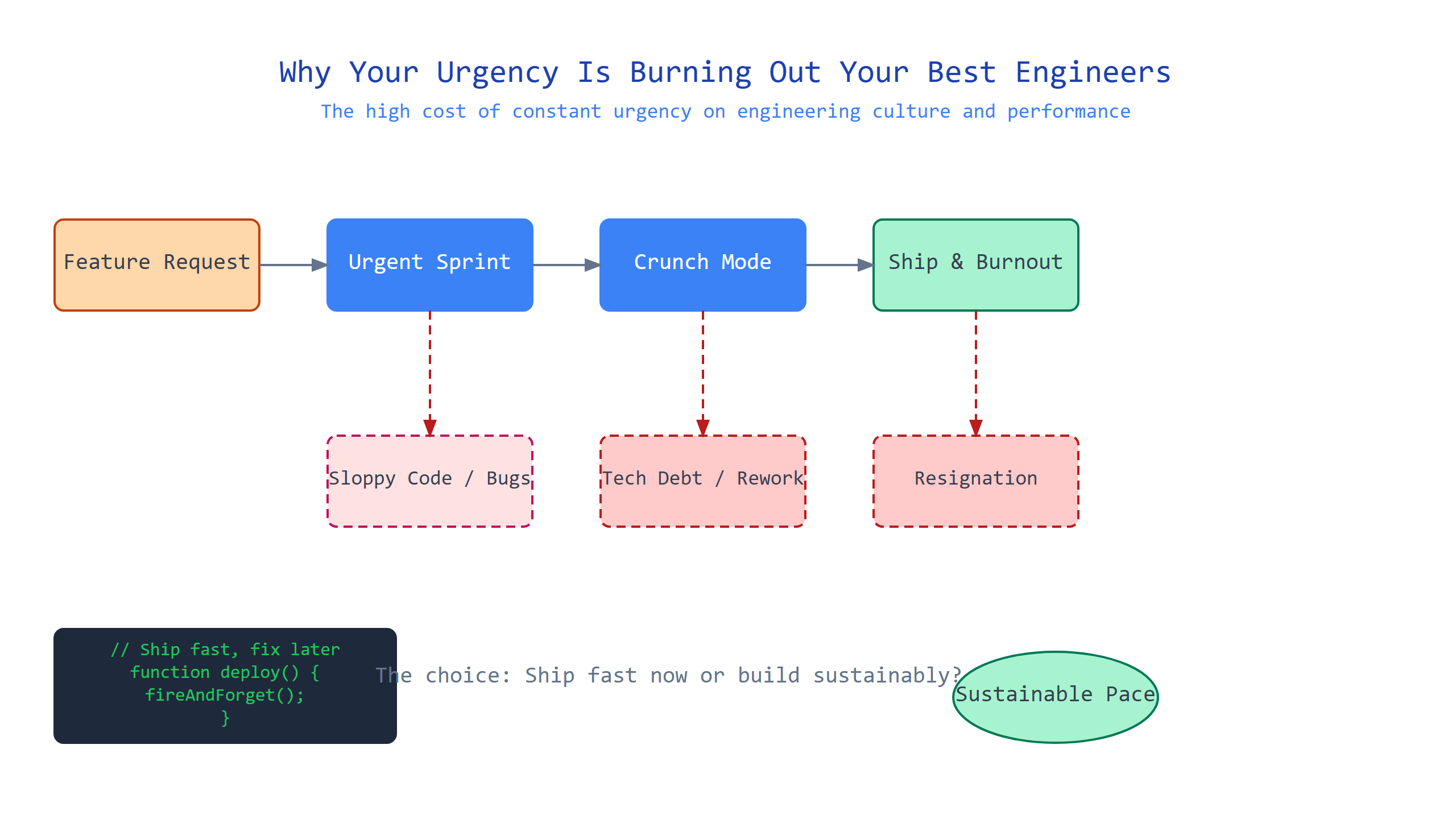
The Meeting That Broke the Sprint
Sarah stared at her calendar. Seven stand-ups this week across four different teams. Two “quick syncs” that ran forty-five minutes each. A post-mortem for a bug she hadn’t even caused. And somewhere in the cracks, she was expected to ship a critical feature by Friday.
Her Tech Lead pinged: “Can you jump on a call? Production issue.”
She closed her laptop, walked to the roof, and didn’t come back for an hour.
This isn’t a story about burnout. It’s a story about what happens when “move fast” becomes the only speed your organization knows — and why the most talented engineers are the first to stop running.
The Speed Trap Nobody Admits
“We need to move faster.” How many times have you heard that? In boardrooms, in sprint retros, in the Slack messages that arrive at 10 PM. Speed is the default answer to every problem: Ship faster to beat competitors. Iterate faster to catch bugs. Hire faster to fill gaps.
This is the ghost that haunts every engineering team. The assumption that velocity is synonymous with value.
But here’s the uncomfortable truth: Urgency is a tax on quality, and your best engineers are the ones paying it.
When everything is urgent, nothing is. Teams ship half-baked features, accumulate tech debt like credit card interest, and burn out their most conscientious people — the ones who actually care about the code they write.
I saw this play out at a Series C startup last year. The CTO mandated two-week sprints for a complex migration that needed six months. Engineers worked weekends. Code reviews became rubber stamps. The CTO celebrated “faster shipping.” Six months later, churn hit 30%, the senior staff had quit, and the migration had to be rebuilt from scratch.
The irony? The company ultimately moved slower.
What It Actually Costs
A 2022 study from the University of California found that engineers interrupted during deep work take an average of 23 minutes to fully re-engage — and that’s on a good day. Factor in the cognitive overhead of context switching between five “urgent” projects, and you’re losing hours before lunch.
But the real cost isn’t just time. It’s talent.
Your senior engineers aren’t leaving because the work is hard. They’re leaving because the noise is intolerable. The constant Slack pings. The fire drills over minor bugs. The strategic whiplash that turns last quarter’s priority into this quarter’s legacy system.
When you optimize for speed above all else, you create an environment where the only people who thrive are the ones who either don’t care about quality or don’t have the experience to recognize its absence. Everyone else — the ones who would have caught the architectural flaw, the ones who could have designed a system that scales — those people check out.
Or worse, they conform.
I watched an exceptional staff engineer at a well-known tech company slowly start to phone it in. Not because he was lazy. Because every time he tried to do the work right, he was penalized for being “too slow.” He learned that the system rewarded shipping, not shipping well. So he shipped junk. And hated himself for it.
What Actually Works
At Google, the DORA research team spent years studying what separates high-performing teams from everyone else. Their key finding: The elite teams deploy more frequently and recover faster — but they don’t achieve this through pushing harder.
They achieve it through reducing batch size. By breaking work into smaller, more deliberate chunks, they ship in less time without sacrificing quality. It’s not speed vs. deliberation. It’s smart vs. frantic.
The contrarian truth is this: Slowing down is how you actually move fast when it matters.
Consider the team at Netflix that decided to stop rewriting their entire notification system every six months. Instead, they invested six weeks in writing proper integration tests, documenting edge cases, and building a shared mental model of failure modes. Then they made their change. Once.
It deployed clean. Zero incidents.
Compare that to the startup that implemented the same feature with “move fast” energy — three rollbacks, two on-calls, and a tech lead who didn’t sleep for 48 hours.
Which one actually moved faster?
What You Can Actually Do
For engineers:
Stop accepting urgency as a given. Before you jump on the next “critical” call, ask: “Is this actually urgent, or does it just feel urgent?” If you can’t articulate the genuine consequence of delaying, neither can anyone else. Protect your deep work like it’s your most valuable asset — because it is.
Build your own slack. Intentionally carve out time each week for work that has no deadline. Code review. Documentation. Refactoring. This isn’t lazy — it’s maintenance. And without it, your systems rot.
For managers:
Reward quality, not speed. When your senior engineer catches a design flaw on Tuesday that would have cost a week of rework on Friday, that’s a win. Make sure your team sees you celebrate it the same way you’d celebrate a ship.
Make the cost of urgency visible. Track rework time. Show the correlation between “rushed” deployments and incident count. Don’t just say “quality matters” — demonstrate what happens when you ignore it.
Protect your best people from themselves. The engineers who care most about quality are the same ones who will burn themselves out trying to deliver it under impossible constraints. Your job is to set realistic constraints. Not to cheerlead their burnout.
- Your senior engineer will stop volunteering for “urgent” tasks if those tasks are never actually urgent.
- You’ll start saying no to five things so you can say yes to one thing, done well.
- Your team will begin treating technical debt as a real cost, not a moral failing.
- You’ll recognize that the engineers who push back on speed are not being difficult — they’re being valuable.
- The fire drills will still happen. But they’ll be exceptions, not the default.
The Speed That Matters
There’s a reason experienced engineers learn to be suspicious of urgency. They’ve seen the wreckage — the systems that collapse under load, the code that nobody wants to touch, the teams where everyone is busy but nothing gets done.
The alternative isn’t laziness. It’s intentionality.
Move fast on the things that matter. Plan carefully on the things that can’t be undone. And give your best engineers the space they need to do the work that made you hire them in the first place.
The company that takes this seriously won’t just have better software. It’ll have a team that actually wants to write it.
And that’s the one speed that can’t be optimized into existence.

Comments