Your Vibe Coding Productivity Gains Are Actually Training an Invisible Technical Debt Spiral
You just shipped three features this week using Claude and Copilot. Your velocity metrics are up 40% quarter-over-quarter. Your VP of Engineering just put “AI-native development” in the company slide deck. Feels great, right?
Here’s the contradiction: every one of those AI-generated code blocks is a tiny, perfectly plausible lie. Not a bug—something subtler. They’re code that passes tests, handles the happy path, and leaves a trail of implicit assumptions that will explode six months from now.
The productivity numbers are real. The technical debt? Completely invisible. And it compounds exponentially faster than human-written debt ever did.
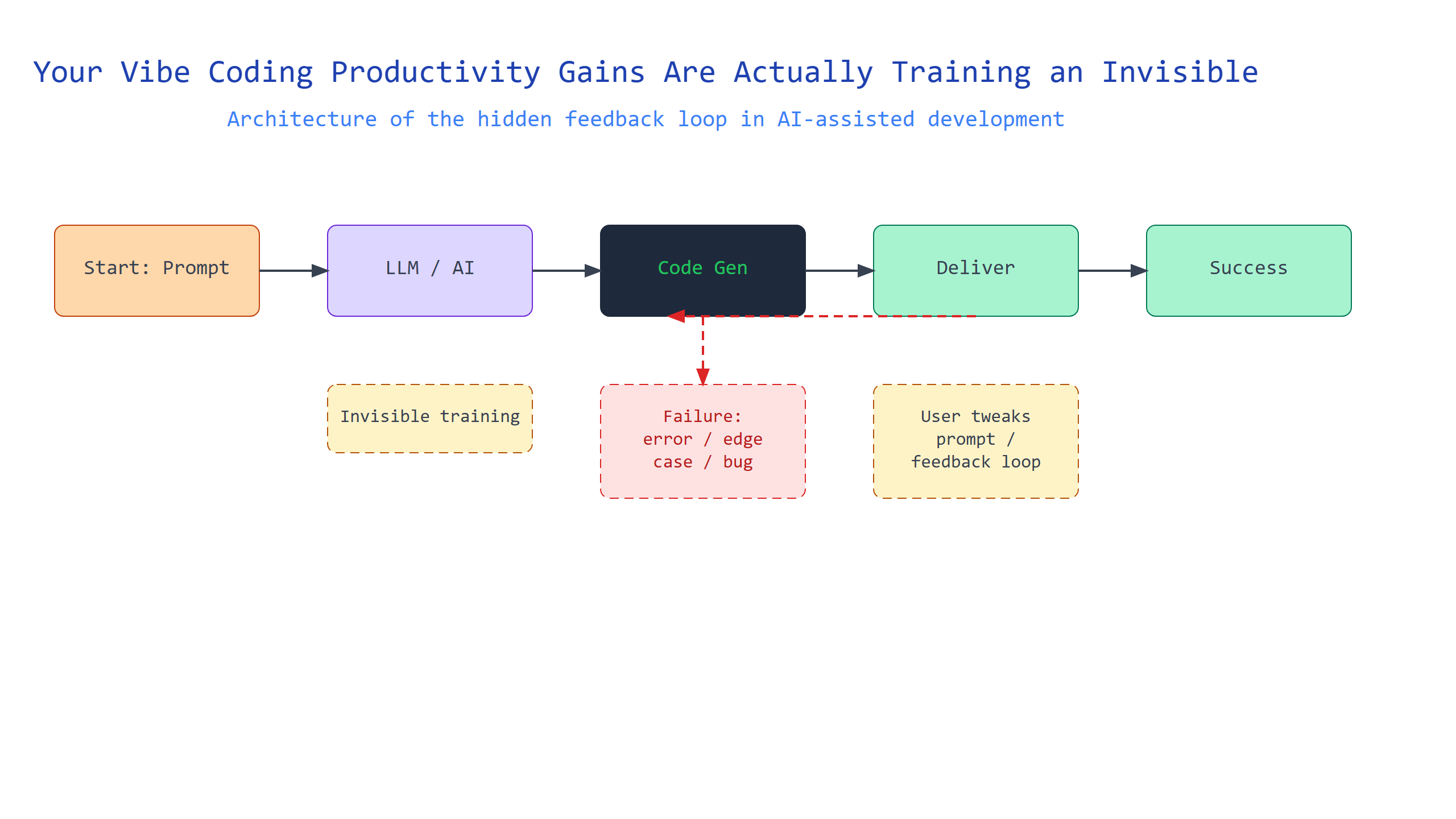
The Banana Peel Velocity Problem
The surface assumption is simple: faster code generation equals faster delivery. If you can produce 3x the lines of code in the same time, you’re 3x more productive. The industry is buying this narrative hard.
Copilot usage grew 135% year-over-year. Claude Code saw 4 million tasks completed in Q3 alone. Every major SaaS tool has an “AI co-pilot” feature shipping by end of year.
Mark Andreessen’s “vibe coding” meme went viral for a reason. The demos are seductive. You type “build a payment flow” and 400 lines of TypeScript materialize. Tests pass. PR approved. Move to the next ticket.
Here’s the banana peel: code generation velocity and code comprehension velocity are inversely correlated. A 2023 Microsoft Research paper showed that developers spend 58% of their time reading code, not writing it. Every line AI generates must be understood, validated, and maintained. But nobody tracks “time to understand a codebase” on their sprint board.
Your team is generating code faster than anyone can understand it. That’s not productivity. That’s a pipeline.
The Context Collapse Gap
Here’s what’s actually happening beneath the surface. Large language models generate code by predicting the next token from a distribution of training data. They have no persistent state, no understanding of your architecture, and crucially, no memory of the 47 decisions your team made during the last architecture review.
Every LLM invocation is a fresh start. A clean slate. A complete amnesia of context.
# Pseudocode illustrating the context collapse problem
def ai_generated_function(user_input):
    # This looks correct in isolation
    session = create_session(user_input)
    data = session.query()

    # But the calling code expects session lifecycle to be:
    # 1. Create session
    # 2. Acquire connection pool lock
    # 3. Run queries inside transaction
    # 4. Release lock and close
    #
    # AI generates step 1, 3, and 4 perfectly.
    # Step 2? Never mentioned in the prompt.
    # Result: connection pool exhaustion after 50 concurrent users.

    return process(data)
This isn’t a bug in the model. It’s a fundamental property of the architecture. Transformers process context windows, not context histories. Every prompt is an island.
The industry calls this “hallucination.” That’s a euphemism. It’s actually context collapse — the model’s inability to maintain causal chains across invocations. Human developers build mental models of the system. They know why module A depends on B in that specific, weird way. The AI doesn’t. It can’t. And every time it generates code without that context, it erodes the architecture’s coherence.
A single session with a model can produce output that violates invariants your team spent three months establishing. And you’ll never know until the pager goes off at 2 AM.
Why You Can’t See the Invisible
The blind spot isn’t the AI’s fault. It’s yours. And mine.
We measure what’s easy to measure: lines of code, PRs merged, deployment frequency. These are activity metrics, not outcome metrics. But activity metrics are seductive because they go up. They always go up. And our brains reward upward-trending graphs with dopamine.
Here’s the uncomfortable truth: code quality is degenerate under rapid generation. Every AI-generated function that works is a function your brain skips reading. You trust the tests. You trust the model. You merge and move on.
But each skipped review is a debt compounding event. You’re not checking for:
- Hidden dependencies on implicit global state
- Assumptions about error handling patterns
- Violations of your team’s architectural conventions
- Security boundaries that the model didn’t know existed
A 2024 Stanford study found that AI-assisted code introduced 41% more security vulnerabilities than human-written code, with no statistically significant difference in test pass rates. The tests passed. The code was broken. The metrics looked great.
You’re optimizing for the wrong graph.
Breaking the Spiral Without Firing the Model
Going forward, the winning teams won’t be the ones generating the most code. They’ll be the ones generating the least code per unit of value delivered.
The playbook is counterintuitive:
-
Treat AI as a junior developer, not a senior. Review every line. Assume every output is wrong until proven correct. This kills your “velocity gains” — but it’s the only way to prevent debt compounding.
-
Write prompts that encode constraints, not requests. Instead of “build a payment flow,” try: “implement a payment flow that reuses the existing transaction retry logic from
lib/utils/transaction.ts, validates against the same schema asUserPaymentmodel, and doesn’t introduce new dependencies.” This forces context preservation. -
Instrument your codebase for coherence. Measure and track “architecture violation density” just like you track test coverage. Tools like Structure101 or jqAssistant can surface when generated code breaks established patterns.
-
Limit generation to bounded, well-understood domains. Use AI for boilerplate, serialization, documentation, and test generation. The high-value, high-complexity architectural decisions? Those still need human context.
- Code generation velocity and comprehension velocity are inversely correlated. You’re generating code faster than your team can understand it.
- LLMs suffer from context collapse: every invocation is a fresh start with no memory of architectural decisions.
- Activity metrics (LOC, PRs merged) are deceptive. They go up while code quality degrades silently.
- The fix: slower generation with stronger constraints, rigorous code review, and architectural coherence instrumentation.
Why this matters: The teams that recognize this pattern early will build sustainable AI-assisted workflows. The rest will drown in codebases nobody understands, debugging issues that shouldn’t exist, wondering why their “10x productivity” turned into “10x maintenance burden.”
The Uncomfortable Truth
The irony is exquisite. We built tools to generate code faster, and in doing so, we made writing code the easy part again. The hard part — understanding, maintaining, and evolving a coherent system — just got harder.
The developers who thrive in this new world won’t be the best prompt engineers. They’ll be the ones who can look at an AI-generated codebase and say: “This looks efficient. But I’m not going to merge it until I understand every assumption it’s making.”
Because the code works. That’s not the problem.
The problem is that working code, generated without context, is just carefully optimized chaos. And chaos compounds.

Comments