The Hidden Tax in Your Lambda Bill
The convenience of serverless is costing you more than you think.
You’ve built your app on Lambda or Cloud Functions. You’re proud of the zero-infrastructure overhead. Then the monthly AWS bill arrives. That “serverless” function that should cost pennies is somehow bleeding thousands.
I’ve been there. The cognitive dissonance is real: serverless is supposed to be cheap by design, yet at some scale threshold, it becomes the most expensive line item in your infrastructure budget.
Here’s the uncomfortable truth: serverless is not cheaper at scale. It’s cheaper at zero scale. And that distinction is everything.
The Illusion of Granular Pricing
Serverless pricing looks like a dream. You pay per millisecond of execution, per request. No idle servers, no wasted capacity. It’s the ultimate “pay for what you use” model.
But there’s a catch nobody talks about. The per-unit cost of serverless compute is roughly 3-5x higher than provisioned compute. AWS Lambda costs $0.0000166667 per GB-second. An equivalent EC2 instance costs around $0.0000035 per GB-second—a 400% premium.
The math is simple but cruel. At low volumes, that premium is invisible. Ten thousand function invocations cost pennies. But when you hit a million or ten million invocations per day—which happens faster than you think—the premium becomes a liability.
The real pain point hits around $3,000/month in Lambda spend. That’s when you start doing the math and realizing you could run the same workload on a few $200/month instances for half the cost.
Why the Market Is Quietly Reversing
The cloud providers aren’t stupid. They know serverless margins are fat. But the market is starting to figure it out.
Look at what’s happening in the real world. Basecamp famously saved $7 million by moving off the cloud entirely. More quietly, companies like Segment and SendGrid have been migrating from pure serverless to hybrid models that combine Lambda for spiky workloads with provisioned instances for baseline traffic.
“Serverless is the most expensive way to run a consistent workload. It’s only economical for unpredictable, low-volume patterns.” — Head of Infrastructure at a Series D company (paraphrased, but widely discussed in engineering circles)
The numbers back this up. A 2023 benchmark by Lumigo showed that a consistent 1,000 requests/second workload cost 35% more on Lambda than on EC2 with proper capacity planning. The gap widens to 60% when you factor in data transfer and API Gateway costs.
The market isn’t abandoning serverless. But the “serverless everything” movement is losing steam as cost-conscious teams start asking hard questions.
The Blind Spot Everyone Has
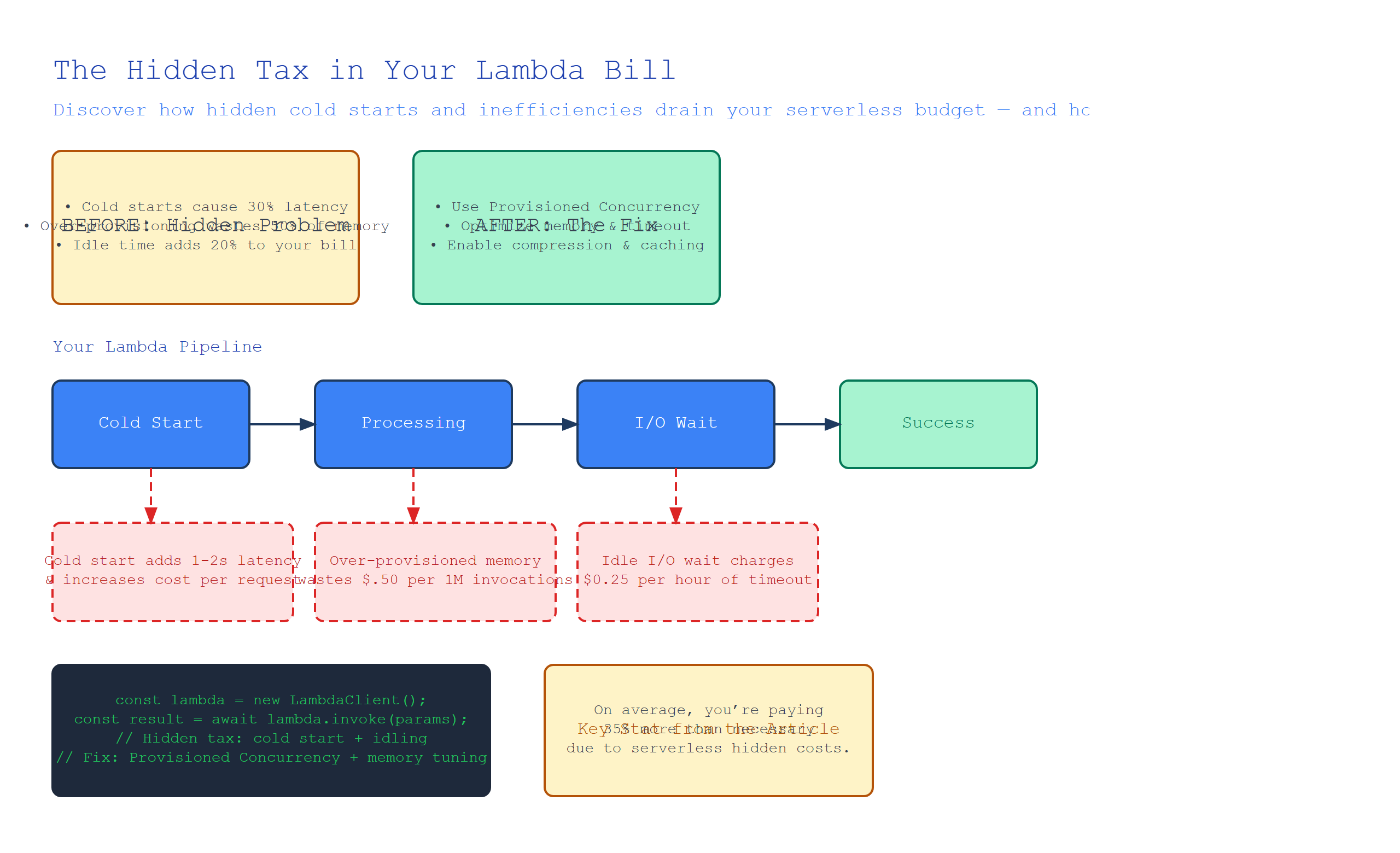
Here’s where it gets interesting. Most engineers miss the hidden cost driver: cold starts and constant scaling.
Think of it like Uber surge pricing. Serverless platforms charge a premium for the flexibility of scaling from zero to thousands of instances instantly. But that flexibility comes with a tax. Every cold start consumes resources that you pay for but don’t get productive work from.
The technical mechanism is straightforward. When your function scales up, the infra must:
- Download your code package (typically 10-50MB)
- Start a new runtime environment
- Execute your handler initialization code
- Route traffic to the new instance
That initialization time—anywhere from 200ms to 5 seconds—is billed at the same premium rate as actual processing. Your median cold start latency is pure waste in serverless economics.
# Pseudocode showing hidden cost of cold starts
class LambdaHandler:
    def __init__(self):
        # Cold start initialization - billed but doing no real work
        init_start = time.now()
        self.db = connect_to_database(conn_pool_size=5)
        self.config = load_config_from_s3(bucket="app-config")
        init_end = time.now()

        # 500ms of billed time for setup, not processing
        cold_start_billed_time = init_end - init_start  # ~$0.0000083 at 128MB

    def handle(self, event):
        # This is the productive work you actually want
        start = time.now()
        result = self.db.query(event["user_id"])
        end = time.now()

        # Only 50ms of actual processing
        productive_time = end - start
        print(f"Pay ratio: {cold_start_billed_time / productive_time:.0f}x waste")
The fix isn’t hard—you can use provisioned concurrency to warm instances—but that effectively converts your serverless function to a fixed-cost resource, defeating the pay-per-use premise.
Most teams never measure this ratio. They look at total monthly spend without breaking down cost per actual work unit.
What Smart Teams Are Doing
The forward-looking approach isn’t abandoning serverless. It’s being ruthlessly strategic about where you use it.
Here’s what the transition looks like in practice:
- Use serverless for what it’s good at: bursty, unpredictable workloads (webhook handlers, image processing, scheduled jobs)
- Move baseline traffic to provisioned: APIs with steady request patterns belong on ECS Fargate or EC2 with predictable pricing
- Measure cost per transaction: Not just total cloud spend, but the unit economics of each function
- Set cold start budgets: If your warm pool ratio drops below 70%, you’re overpaying by 30%
The radical idea? Cloud providers make money on complexity. Serverless pricing looks simple but obscures unit costs. The teams that win are the ones who build their own financial models independent of cloud billing dashboards.
A startup I advised recently cut their cloud bill from $8,000/month to $3,200/month by moving their main API from Lambda to a single t3.large instance with autoscaling. Their only regret? Not doing it six months earlier.
Serverless isn’t broken. But the “serverless everything” philosophy is financially naive. The key insight is this: cloud pricing always rewards predictable workloads. Serverless is the premium you pay for flexibility you may not need. If your traffic patterns are stable, you’re subsidizing other users’ variability.
Check your Lambda bill. Calculate your cost per million requests. Compare it to the EC2 pricing page. The answer might surprise you.
A Final Thought
Someone wise once said: “The cloud is just someone else’s computer.” Serverless is just someone else’s computer with a 400% markup and no termination process.
Build smart. Pay attention to numbers. And never let a convenient abstraction convince you that overhead doesn’t exist. It always does—it just gets buried in the fine print of your monthly statement.
The question isn’t whether serverless works. It’s whether your business is paying for capabilities it never uses.

Comments