Your “Open Source” Startup’s License Isn’t Open Source—And the Community Is Building a Legal Wall Around Your Code
layout: default
title: Your “Open Source” Startup’s License Isn’t Open Source—And the Community Is Building a Legal Wall Around Your Code
date: 2024-01-15
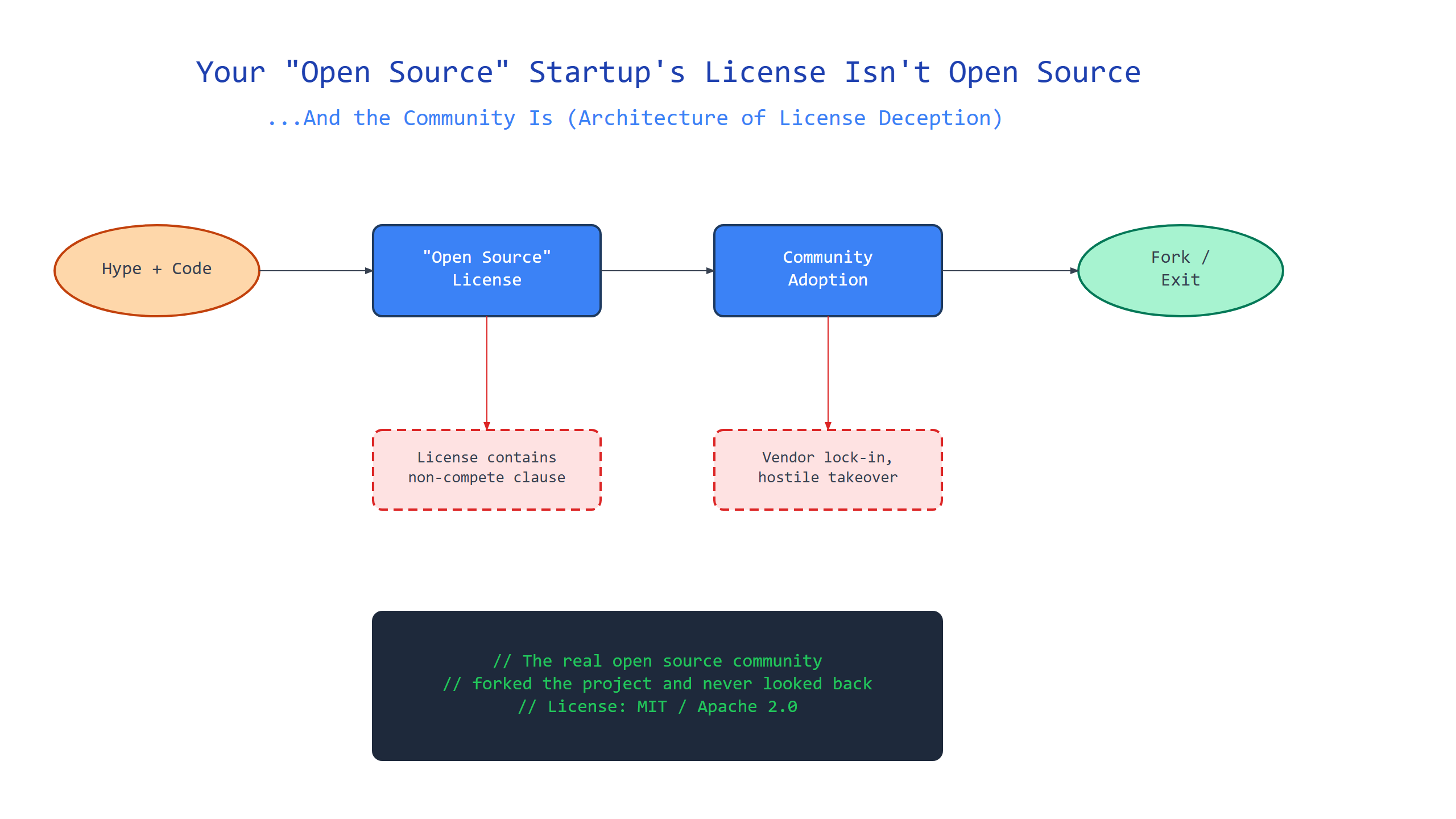
You launched your startup with “open source” code. Investors love it. Developers flock to it. Then you add a clause: “No competition allowed.” Suddenly, you’re not open source — you’re source-available. And the open source community is building legal walls around your code, one license at a time.
Here’s the uncomfortable truth: calling your project “open source” doesn’t make it open source. The Open Source Initiative (OSI) has strict criteria. Break them, and the community will use something called copyleft to ensure nobody can pull what you pulled.
In this guide, we’ll demystify:
- The difference between open source and source-available
- How copyleft licenses actually work
- Why permissive licenses exist and when to use them
- The role of the Open Source Initiative (OSI) in defining “open source”
- How license compatibility can trap you
Let’s tear down the walls — legally.
What Makes a License “Open Source”?
Plain-English definition: An open source license gives anyone the right to use, modify, and share your code — without asking permission — as long as they follow a few simple rules.
How it works: The OSI maintains a list of approved licenses that meet ten criteria. The big ones: free redistribution, access to source code, and no discrimination against people or projects. If your license says “You can’t compete with us,” it fails criterion #6 — no discrimination.
Analogy: Think of it like a public park. Anyone can walk in, play, or host a picnic. You can’t say “No baseball teams allowed” — that violates the park’s purpose.
Concrete example:
# MIT License (true open source)
# You can use this code in a competing product. No problem.

def calculate_profit(revenue, costs):
    return revenue - costs

# The MIT License: Do anything you want, just include the copyright notice.
# Your competitor can copy this function exactly. That's the deal.
Non-obvious insight: Just slapping an MIT or Apache 2.0 license on your code doesn’t guarantee it’s open source. The license text must be OSI-approved. Some companies write custom licenses that sound open but aren’t. Always check the OSI list.
Copyleft: The Legal Wall the Community Builds
Plain-English definition: Copyleft says “You can use my code, but any changes you make must also be shared under the same license.” It’s a wall that ensures code stays open forever.
How it works: The GNU General Public License (GPL) is the most famous example. If you modify GPL-licensed code and distribute it, you must release your entire project under the GPL. No exceptions. This prevents companies from taking open code, adding features, and closing it up.
Analogy: Imagine a library where you can borrow any book, but if you write notes in the margins, you must put that annotated copy back on the shelf for others. Copyleft ensures knowledge flows forward.
Code example:
# GPL-licensed function
def encrypt_data(data, key):
    # This function is GPL-licensed
    # If you modify and distribute it, your whole project must be GPL
    return xor_encrypt(data, key)

# If you use this in your SaaS, you're fine (no distribution).
# But if you ship it to customers, your entire codebase must go GPL.
# Surprise! Most developers miss this distinction.
Non-obvious insight: Copyleft only triggers on distribution. Run your modified GPL code on your own server (SaaS) and you’re fine. Give it to a customer? Now you must open your whole project. This is the AGPL loophole — specifically designed to close that SaaS gap.
Permissive Licenses: The Open Door Policy
Plain-English definition: Permissive licenses let others use your code however they want — even in proprietary, closed-source products. They just need to give you credit.
How it works: The MIT and Apache 2.0 licenses are permissive. You can take MIT-licensed code, wrap it in a proprietary app, and sell it. The only requirement is keeping the original copyright notice somewhere in your codebase.
Analogy: It’s like sharing a recipe. You can use it in your restaurant, sell the dish, and even change the ingredients. Just put a card on the table saying “Original recipe by Grandma.”
Real-world decision: | What You Want | Pick This License | |—|—| | Maximum adoption, even by competitors | MIT | | Patent protection for contributors | Apache 2.0 | | Force all changes to be shared | GPL | | Prevent closed-source use | AGPL |
Non-obvious insight: Permissive licenses can actually hurt you when a big corporation takes your code, improves it, and doesn’t contribute back. That’s why many startups start with AGPL to force contributions, then offer commercial licenses for enterprises.
License Compatibility: The Invisible Trap
Plain-English definition: License compatibility means different open source licenses can’t always be mixed in the same project. Their rules might contradict each other.
How it works: The GPL requires all code in a project to be GPL-compatible. If you include MIT-licensed code (compatible) and Apache 2.0 code (also compatible, with exceptions), you’re fine. But include code under the Common Public License? Conflict. You can’t legally distribute your project.
Analogy: Think of it like incompatible electrical plugs. A US plug won’t fit a European socket without an adapter. Some licenses are designed to work together; others are designed to prevent mixing.
The compatibility matrix:
# License Compatibility Checker (simplified)
licenses = {
    'MIT': {'compatible_with': ['GPL', 'Apache', 'BSD']},
    'Apache 2.0': {'compatible_with': ['GPLv3', 'MIT']},
    'GPLv3': {'compatible_with': ['MIT', 'Apache 2.0']},
    'MPL': {'compatible_with': ['GPL', 'MIT']}
}

# The trap: GPLv2 and Apache 2.0 are NOT compatible.
# If you mix them, you can't legally distribute your software.
# Most developers discover this during a security audit. Ouch.
Non-obvious insight: Many developers assume “open source” means “can use together.” Wrong. The Linux kernel uses GPLv2. Apache 2.0 code can’t be included directly. That’s why your Linux-based project might have legal issues — and why companies use tools like FOSSA or WhiteSource to check compatibility.
You wanted to build community trust. You used “open source” as a marketing label. But when you added that competitive restriction, you created a source-available license — which your community sees as betrayal.
The open source community will respond by using copyleft licenses to wall off their work from you. They’ll build solutions that explicitly forbid your “non-compete” clause. Your developer adoption drops. Your hiring pipeline dries up.
The insight? Honesty about licensing builds long-term trust. Call it what it is: source-available. Respect the OSI’s definition. And if you want truly open source, pick a real license — warts and all.
The legal walls around your code aren’t built by lawyers. They’re built by developers who’ve been burned by startups promising “open source” while locking the back door. Your move? Pick a real license, understand its implications, and be honest with your community. The open source ecosystem has room for both permissive and copyleft approaches — just don’t pretend your wall is a door.
Your next step: Download the OSI-approved license list and read the full text of your chosen license. Then delete that “open source” badge from your README if your license doesn’t belong. The community will respect you more for it.
Key Takeaways
- Open source has a strict definition (OSI-approved). Anything else is source-available.
- Copyleft (GPL, AGPL) ensures derivative works stay open by requiring same-license distribution.
- Permissive (MIT, Apache) allows closed-source use — great for adoption, risky for control.
- License compatibility determines which licenses can be mixed — ignore this and face legal hell.
- The OSI is the gatekeeper. If your license isn’t OSI-approved, don’t call it open source.
- Honesty beats marketing. The community will support honest licensing decisions, even commercially restrictive ones.

Comments