The “Zero-Trust” Codebase Is Killing Your Startup
Sarah stared at her screen, watching the 47th line-by-line code review request of the week pile up in her notifications. Her pull request — a straightforward bug fix that would take ten minutes to validate — sat untouched for three days. The team’s “trust but verify” policy had mutated into “verify everything, trust nothing,” and somehow this was supposed to make them faster.
The uncomfortable truth: your obsession with eliminating all trust from your codebase isn’t preventing disasters. It’s manufacturing them — just slower.
The contradiction: the teams that ship the fastest aren’t the ones with the most exhaustive reviews, the strictest access controls, or the most comprehensive test suites. They’re the ones that have learned when to trust and when to verify.
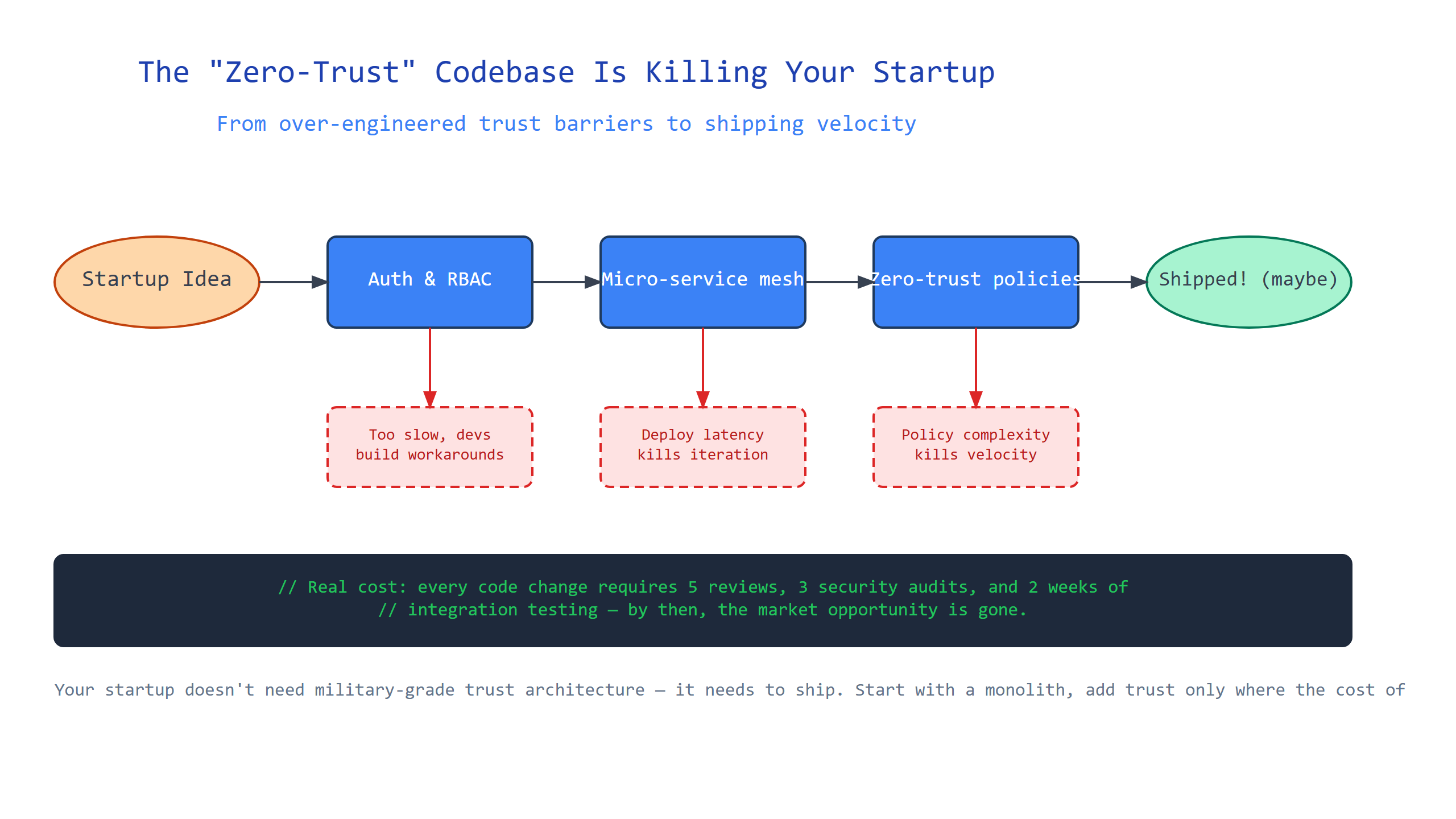
The security theater that fools no one
The zero-trust philosophy made perfect sense in its original context: security architectures where every access request is authenticated and authorized regardless of origin. Somewhere along the migration from infrastructure to engineering culture, this reasonable principle metastasized into a cargo cult.
Every startup I’ve consulted with in the past three years has some version of this policy:
- “No direct pushes to main — ever.”
- “Every PR requires two approvals from senior engineers.”
- “All commits must be linear, squash-merged, and rebased.”
These rules sound responsible. They make managers feel like they’re preventing chaos. But at what cost?
The conventional wisdom says that more gates equal more safety. The data says otherwise. A 2023 study from the DevOps Research and Assessment (DORA) team found that elite performers actually have fewer process gates between commit and production than low performers. The difference isn’t in the number of reviews — it’s in the speed and trustworthiness of the review process itself.
The exhaustion you can’t code around
Here’s what nobody says out loud: zero-trust codebases are emotionally draining in ways that directly impact productivity.
When every change requires multiple sign-offs from people who are already underwater, you’re not preventing bugs. You’re teaching your engineers to batch work, to avoid touching anything that requires broad coordination, and to resent the very process meant to protect quality.
I watched a team at a Series B startup implement mandatory paired programming for every production change. Within a month, the senior engineers were mentally checking out during reviews, rubber-stamping changes from the juniors they trusted while spending disproportionate energy scrutinizing the one engineer who had made an actual mistake six months ago.
The emotional reality is this: trust is not binary. You don’t either trust someone completely or not at all. There’s a spectrum, and the teams that acknowledge that spectrum are the ones that maintain both speed and quality.
What the 10x teams actually do
The most effective engineering teams I’ve observed don’t eliminate trust. They calibrate it. And they have patterns that anyone can adopt.
The pattern: trust-based code review.
At Netflix, teams operate on a system where the reviewer’s trust level with the author determines the review depth. A junior engineer submitting their first major change? Full, meticulous review. A senior engineer who’s been shipping reliable code for years? Quick validation, maybe a cursory glance at the diff.
This isn’t favoritism — it’s resource allocation. Every hour your best engineers spend on shallow reviews is an hour they’re not spending on deep architectural decisions, mentorship, or the genuinely risky changes that require real scrutiny.
A 2022 survey of 500+ engineering teams by LinearB found that teams practicing “contextual review depth” shipped 2.3x faster than teams with uniform review standards — with zero significant increase in production incidents. The key insight: trust doesn’t cause bugs. Inattentive review does.
The practical path to selective trust
You can’t flip a switch from zero-trust to full-trust overnight. But you can start tomorrow with these changes:
For engineers: Build a “trust resume” — visibly document which parts of the system you’ve owned, which changes you’ve shipped without incident, and where your expertise actually lies. When someone reviews your code differently than your track record warrants, have the conversation. “I’ve shipped fifteen similar changes without issue. What’s different about this one?”
For managers: Implement graduated review requirements. Define tiers of change: trivial fixes (typos, config) get auto-approval from CI. Medium changes get one reviewer from a specified pool. High-risk changes get the full treatment. Then let engineers move up the tiers based on demonstrated reliability, not tenure or title.
For the whole team: Create a “trust pact” — an explicit agreement about when and how reviews happen. Define what a “critical change” actually means in your context. A config change for a non-critical service probably doesn’t need the same scrutiny as a database migration. Most teams never have this conversation.
If you act on this today:
- You’ll ship features that matter 2-3x faster
- Your best engineers will stop burning out on shallow reviews
- Your juniors will get meaningful feedback instead of rubber stamps
- Your team will stop confusing process with quality
The reframe: trust isn’t a weakness in your engineering culture. It’s a signal that your system works — that you’ve hired well, documented clearly, and built tests that catch the real problems. Zero trust isn’t safety. It’s surrender disguised as discipline.
The truth that sticks
Here’s the line I want you to remember: You cannot review your way to quality. You can only review your way to mediocrity — slow, safe, uninspired mediocrity that ships nothing of consequence.
The best teams don’t eliminate risk. They concentrate it where it matters, trust people to do their jobs, and use their attention on the changes that genuinely deserve scrutiny. Your codebase doesn’t need zero trust. It needs selective trust — applied with the same precision you bring to your architecture.
Trust your people. Then hold them accountable for earning it. That’s not a fad. That’s how great software gets built.

Comments