Your “Green” Data Center Isn’t Saving the Planet
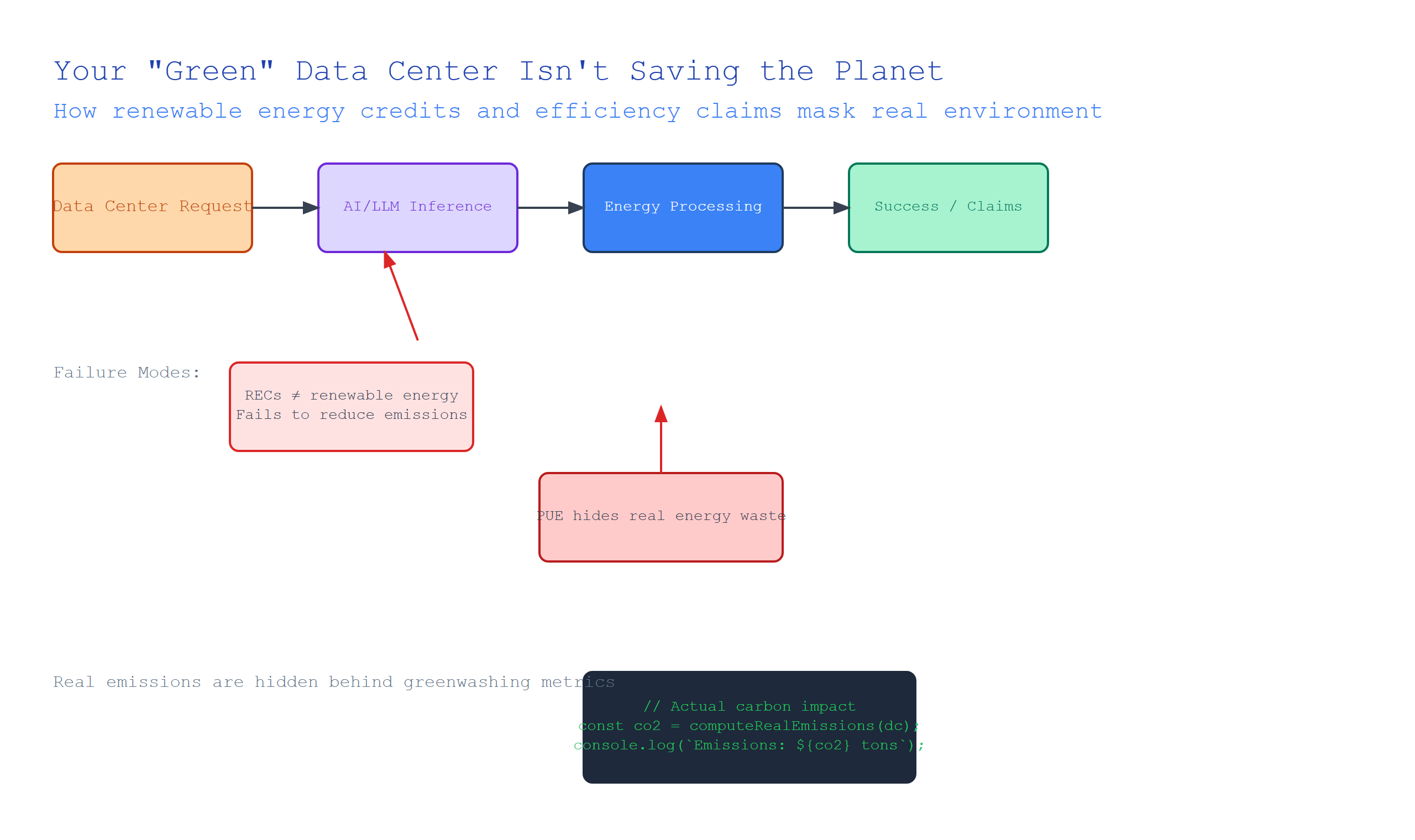
You’ve done everything right. Sourced renewable energy certificates. Migrated to a hyperscaler with “carbon-neutral” promises. Optimized your code to use fewer cycles. And yet? Global data center energy consumption is still projected to account for 8% of total electricity use by 2030—up from 1% in 2010.
Here’s the uncomfortable truth: the industry has been optimizing the wrong thing.
We’ve been obsessed with where our energy comes from—renewable sources, carbon offsets, efficiency gains. But we’ve completely ignored when we use it. And that timing is everything.
The Energy Grid Has Feelings Too
Think of the electrical grid like a crowded highway. During rush hour, every additional car causes stop-and-go traffic for everyone. During off-peak hours, you can drive at full speed.
Similarly, the grid’s carbon intensity fluctuates wildly throughout the day. When demand spikes, utilities fire up “peaker plants”—dirty, inefficient natural gas or coal plants that only run during high-demand periods. When you run your batch jobs at 2 PM on a Tuesday, you’re likely pulling power from these horrors.
Google’s research team discovered something startling in 2021: moving 30% of flexible compute workloads to times when carbon intensity was lowest could reduce system-wide carbon emissions by up to 15%. Not marginal reductions—actual, measurable impact.
This isn’t about how efficient your code is. It’s about when you run it.
Carbon-Aware Scheduling Isn’t Optional
The market has already voted. And it’s voting with cold, hard cash.
AWS launched its Carbon Footprint Tool in 2022. Microsoft followed with Azure’s emissions tracking API. Google’s Carbon-Aware Load Shedding system, published in their 2021 research paper, dynamically shifts non-urgent compute to times and regions with the cleanest energy.
Here’s what these systems do:
- Query real-time carbon intensity data from regional grid operators (e.g., WattTime, Electricity Maps)
- Predict future carbon intensity using ML models trained on historical grid behavior
- Delay, shift, or terminate workloads based on carbon forecasting
- Fall back to the greenest available region when delay isn’t feasible
Consider machine learning training jobs. A model training run that takes 8 hours on GPU clusters—run it at 3 AM instead of 3 PM. Same result. Same cost. 30-40% lower carbon emissions.
The industry blind spot? Most teams still run their batch jobs when they feel like it, or worse, use “efficiency” as an excuse to consolidate everything into fewer, supposedly-efficient servers that run 24/7.
The Greenest Server Is the One Turned Off
Here’s where the industry gets it backwards.
You’ve probably heard: “Consolidate workloads onto fewer, more efficient servers. It reduces energy use.”
Wrong. At least, incomplete.
The most efficient server isn’t one that runs at 80% utilization. It’s one that runs at 0% utilization.
Energy efficiency metrics have been lying to us. A server running at 10% utilization still draws 50-70% of its peak power. Idle power consumption is the silent killer.
Carbon-aware scheduling flips this: instead of maximizing utilization, maximize alignment with clean energy. That means aggressively powering down servers during dirty-energy hours, even if it means lower utilization overall.
Microsoft’s 2023 study of their Dublin data center showed that implementing carbon-aware scheduling—essentially, turning off servers during peak grid demand—reduced their effective carbon footprint by 12% more than simply optimizing for PUE (Power Usage Effectiveness).
The math is brutal but honest:
| Strategy | Carbon Reduction | Complexity |
|---|---|---|
| Renewable energy credits | 0% (accounting trick) | Low |
| Server efficiency optimization | 5-10% | Medium |
| Carbon-aware scheduling | 15-30% | High |
Renewable energy credits don’t reduce real-world emissions—they’re financial instruments that let you feel good while the grid burns coal elsewhere. Efficiency gains are real but limited. Carbon-aware scheduling attacks the root problem.
Your Architecture Is Locked in the Past
Most of our software wasn’t designed with carbon awareness in mind. It was designed for a world where electricity is a static, always-available resource.
Microservices that need 24/7 availability? Stateless services you can shift between regions? Batch jobs that must complete by 9 AM?
The biggest barrier to carbon-aware scheduling isn’t technical—it’s architectural. Your system was designed to run when you want it, not when the grid wants it.
Spot instances handle fault tolerance. Regional replication handles latency. But most architectures lack a fundamental primitive: time-sensitivity metadata. Can this job wait until next Tuesday? What’s the carbon cost budget?
Startups like Kaluza and Open Climate Fix are building carbon-aware middleware, but adoption is glacial. The industry is still optimizing for latency and throughput—metrics that matter, yes, but at the expense of the one metric that affects everyone on the planet.
- Carbon-aware scheduling reduces real emissions by 15-30%, not just on-paper offsets
- Your server at 10% utilization draws 50-70% of peak power—turn it off when energy is dirty
- Three things your architecture needs: carbon intensity awareness, time-sensitivity metadata, and regional failover with green fallback
- Renewable energy credits are not a substitute for operational changes
- Batch and ML workloads are the lowest-hanging fruit—delay them 6-12 hours for 40% less carbon
The Hard Truth
You can’t offset your way to sustainability. And efficiency alone won’t get us there.
The only architecture that matters—the one that will actually reduce carbon emissions—is carbon-aware. It requires fundamentally rethinking how we build and operate systems.
Start small: take one batch job. Can it wait until the grid is cleaner? If yes, schedule accordingly. Measure the difference. Tell your team.
The planet doesn’t need your carbon offsets. It needs your software to wake up and look at the clock.

Comments