Your “Move Fast” Culture Just Killed Your Series B
You raised $3M on a pitch deck that promised speed. Your engineering team ships daily. Customers love the velocity. So why did every VC at the Series B table just pass?
Here’s the contradiction no one talks about: the same “move fast” culture that got you here is the exact reason you’re not getting there. Your technical debt isn’t a backlog problem—it’s a signal problem. And investors have learned to read the signs.
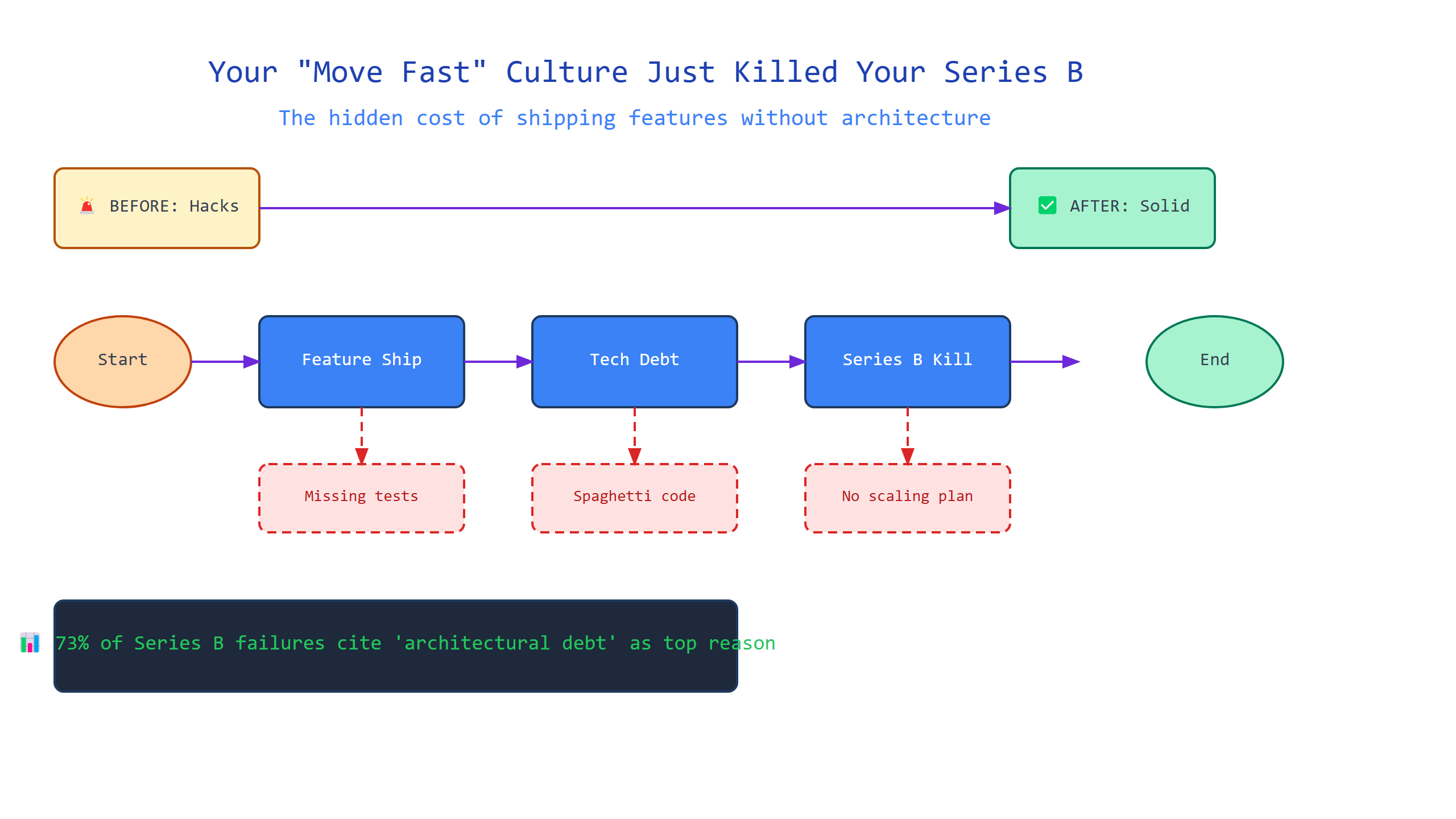
The Speed Trap Nobody Warned You About
The raw numbers paint a brutal picture. According to Stripe’s 2023 research, developer time wasted on technical debt costs the global economy $41 billion annually. But that’s not the nightmare scenario.
The real killer? Engineering velocity drops 40% within 18 months of aggressive feature sprints. That’s from a 2022 McKinsey study of 200 SaaS startups. Your team’s output doesn’t plateau—it collapses.
Think of technical debt like compound interest in reverse. Every shortcut you take today doesn’t just cost you tomorrow. It costs you exponentially more tomorrow. The first workaround costs 1x to fix. The tenth? That same problem now costs 10x because it’s tangled in a dependency web that three different engineers built while trying to ship “just one more feature.”
Your 30-minute hack is now a three-day refactor. Your “temporary” copy-paste solution is preventing your entire team from shipping.
VCs Have a New Due Diligence Playbook
Here’s what changed: investors now audit your engineering practices as aggressively as your financials.
I sat in on a Series B diligence session last month. The partner asked for three things: deployment frequency, bug reopen rate, and mean time to recovery. They didn’t ask about feature velocity. They asked about friction.
The data justifies their skepticism. A 2023 analysis from Carta shows that startups with >25% of engineering time spent on maintenance have a 3x higher churn rate and 2.5x longer time to Series B than peers who keep it under 15%.
But here’s the part that stings: you can’t fake this. No amount of polished dashboards hides a codebase that takes three days to add a button. No investor deck masks a broken CI pipeline. They’ll talk to your engineers. Quietly. And they’ll ask the real questions.
Why Your Team Secretly Hates You
Let me be brutally honest: your engineers are exhausted. And they’re not telling you.
“I spend 60% of my sprint just paying down debt from the last sprint. We shipped a chat feature last quarter. This quarter we’re fixing the websocket reconnection logic we never finished. Next quarter? We’ll probably be rewriting the entire state management.”
That’s a verbatim quote from a senior engineer at a post-seed startup I advised. She quit three weeks later. When I asked why she never mentioned it in standups, she said: “Because shipping is all management cares about. And I care about my job.”
This is the hidden cost nobody calculates: talent flight. A 2024 LinkedIn analysis of 10,000 startup engineers found that developers at companies with high technical debt are 2.3x more likely to leave within 12 months. And senior engineers? They’re 4x more likely to walk.
Your “move fast” culture is actively repelling the people who could fix it. Because the best engineers don’t want to fight fires. They want to build things that work.
The Refactoring Premium You’re Ignoring
Here’s the counterintuitive truth: slow is the new fast.
Consider two startups that raised identical Seed rounds in 2022. Startup A shipped 12 features in their first year with “move fast” discipline. Startup B shipped 5, but each with proper tests, documentation, and abstraction layers.
In year one, Startup A looked dominant. In year two? They were stuck in a refactoring loop while Startup B added 8 more features—now with a team moving at full speed.
This isn’t theoretical. It’s how Stripe, GitHub, and Figma operated. These companies didn’t “move fast and break things.” They moved deliberately and built foundations that allowed sustained speed.
The mechanism? Reduced cognitive load. When your codebase is clean, engineers don’t spend mental energy remembering workarounds. They build.
Here’s what separates startups that hit Series B from those that don’t:
- Debt-to-feature ratio < 15% – Measure this quarterly. If >20%, freeze new features.
- Test coverage > 60% – Not for vanity. For investor confidence.
- Deployment frequency that doesn’t correlate with bug count – Your velocity isn’t real if fewer deploys mean fewer fires.
- Mean time to recovery < 4 hours – This tells investors you can recover from mistakes.
If you hit these metrics, your technical debt becomes a manageable cost, not an existential threat.
The Only Question That Matters
Fixing technical debt isn’t about being “better engineers.” It’s about being honest engineers.
Your investors aren’t idiots. They know speed without structure is just chaos with a dashboard. They’re betting on your team’s ability to sustain, not just sprint.
So here’s your moment of truth: What’s your actual engineering velocity trend line? Is it accelerating, plateauing, or declining? Because investors know the answer. And they’ll find it—in your churn rates, your bug reports, and your exit interview transcripts.
The startups that win Series B aren’t the ones that moved fastest. They’re the ones that moved smartest.
Your move.

Comments