The Brag Document Isn’t Ego — It’s Your Career Insurance
I was three months into a new role when my manager said something that stopped me cold: “You know, your impact this quarter was visible, but your promo packet didn’t have enough weight.” I had shipped four features, unblocked two teammates, and documented a system that saved the on-call team hours each week. But I never wrote it down. In a company of 5,000 engineers, if you don’t write it down, it didn’t happen.
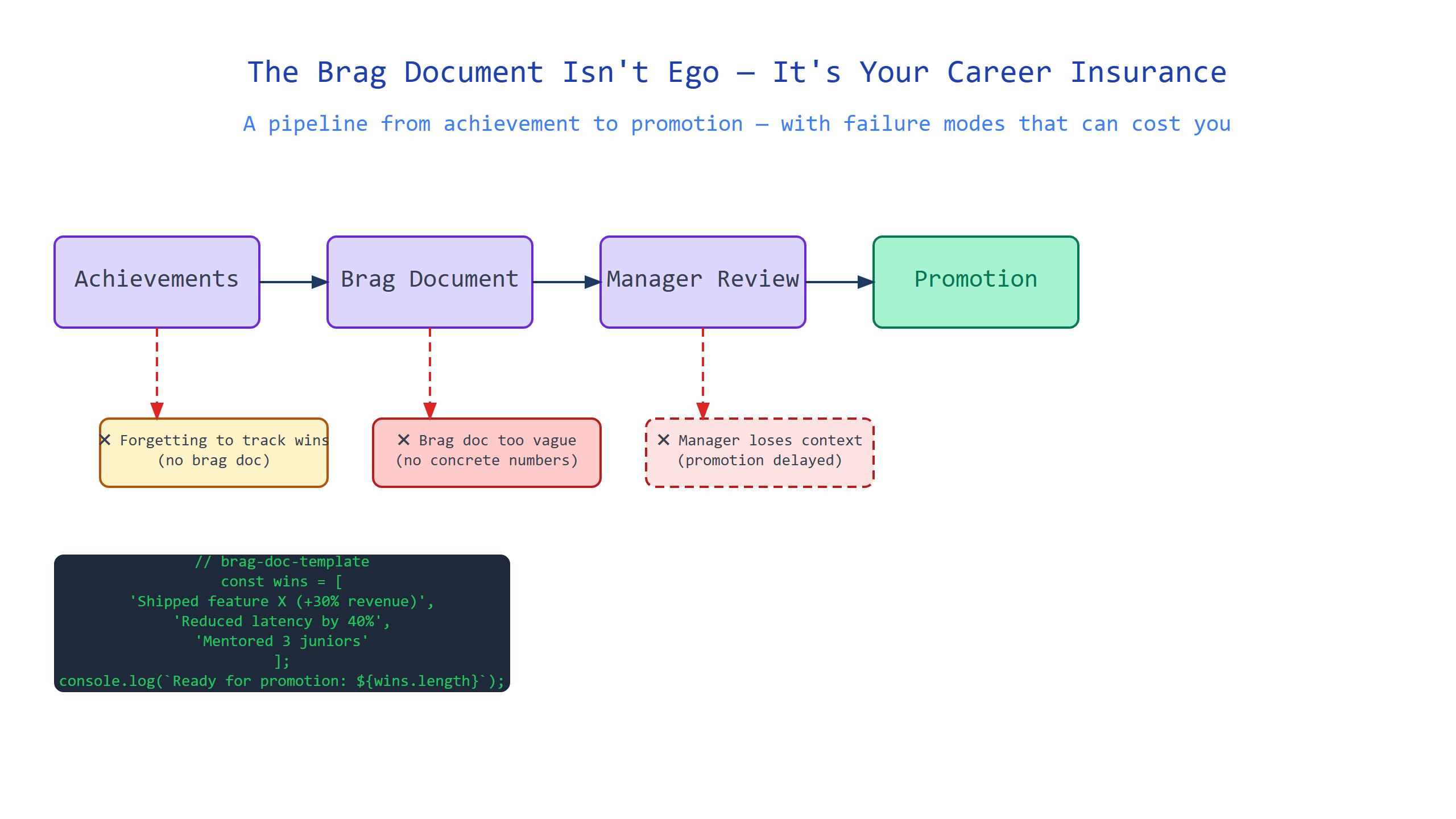
The myth of self-evident work
The conventional wisdom in engineering culture is simple: let your code speak for itself. Senior engineers who keep “brag documents” are seen as self-promoters, playing politics instead of building. Managers nod along when they say “we notice good work” while their teams burn out trying to be seen.
This isn’t just naive — it’s actively harmful. A 2021 survey of 1,200 engineers at mid-to-large tech companies found that 68% believed their most impactful work from the previous year was either partially or completely invisible to their manager. Not because they hid it. Because nobody asked.
The reality is that engineering organizations run on narrative, not just code. Your pull request history shows what you did. It doesn’t show the design conversation where you steered the team away from a costly mistake, the mentoring session that unblocked a junior dev for a week, or the cross-team coordination that prevented a production incident.
The quiet career killer
Here’s the part nobody tells you: the engineers who get promoted aren’t always the best technical contributors. They’re the ones who can articulately explain their impact. This isn’t a conspiracy — it’s a structural limitation.
I once worked with a senior engineer named Priya who rebuilt an entire data pipeline, cutting latency by 40% and reducing costs by $200K per year. She didn’t mention it in her performance review because she thought “the numbers speak for themselves.” Her manager, juggling 12 direct reports, missed it entirely. She watched a peer who wrote half the code but presented at three all-hands meetings get the promotion.
Research from Google’s Project Oxygen shows that one of the strongest predictors of manager-rated performance is the engineer’s ability to “communicate and influence” — not raw technical output. The gap between impact and visibility isn’t a bug in the system. It’s a feature of how organizations scale.
Your memory is lying to you
Even if your manager has the best intentions, they’re fighting against psychology. Recency bias means your work from six months ago is a blur. The negativity bias means one production incident erases ten quiet wins. And the simple math of span of control — a manager with 10+ reports cannot track every contribution.
A study from CEB (now Gartner) found that managers who rely on their own observations alone capture only about 30% of an individual’s actual contributions during performance reviews. The rest comes from what the employee themselves brings forward.
This isn’t about ego. It’s about closing the gap between what you do and what your organization knows you do.
What actually changes things
So what do you do? Not for your manager — for yourself.
Start a brag document on day one of the quarter. Not as a draft for your review, but as a living journal. Every time you ship something that made your team better, write a sentence. Every time someone thanks you for help, add it. The goal isn’t to impress — it’s to capture what your brain will forget.
Track outcomes, not just activities. “Fixed five bugs” tells me nothing. “Reduced P1 incidents by 30% by instrumenting our error tracking” tells me your impact. The difference is the result, not the effort.
Share it selectively. Most engineers hate this because it feels self-serving. But research from Harvard Business Review shows that the most respected engineers in an organization share “work narratives” — short summaries of what they accomplished and why it mattered — at twice the rate of peers with similar output.
As a manager, build this into your team’s rhythm. Block 30 minutes every other week for your direct reports to update their impact log. Ask questions that surface invisible work: “What problem did you prevent?” “Who did you unblock?” Make it part of your 1:1 agenda, not an afterthought.
- Start a brag document today. Not next quarter. Before you forget this conversation.
- Write one sentence per accomplishment. You’ll thank yourself in six months.
- Track outcomes, not hours. Impact is what you changed, not what you did.
- Share your narrative once a month. A Slack message to your manager. A slide at standup. Whatever works.
The engineer who keeps a brag document isn’t arrogant — they’re realistic. They understand that every organization has more work than attention. The work you do matters. But if nobody can see it, it doesn’t help your career.
Write it down. Not because you need to prove yourself. Because your future self deserves the truth about what you built.

Comments