The Productivity 10x Myth Is Killing Your Engineering Team
You’re measuring lines of code per developer per week, tracking story points burned like kindling, and celebrating the team that merged the most PRs last sprint. Your team is miserable, your system is rotting, and your “10x productivity” dashboards are lying to your face.
Here’s the contradiction nobody wants to admit: the more productivity metrics you optimize for, the less real value you create.
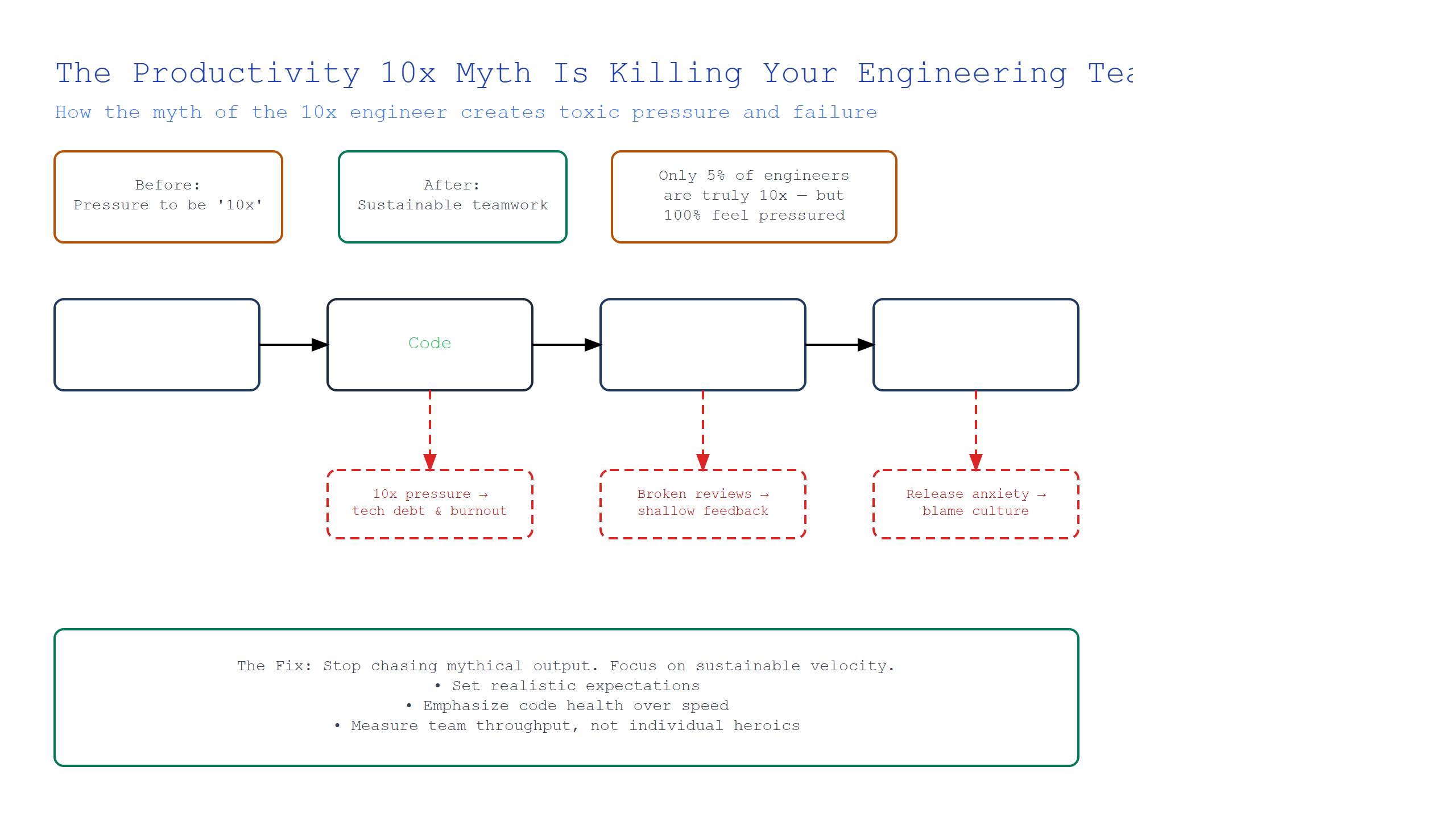
Counting What’s Easy, Not What’s Real
The “10x engineer” myth persists because it’s convenient. If a tiny percentage of developers produce 10x more than average, then clearly the solution is to hire more unicorns and cull the rest, right?
Wrong.
The underlying mechanism here isn’t “throughput” — it’s debt accumulation. When you measure raw output, developers optimize for the metric. They write code faster, skip tests, ignore edge cases, and produce systems that look productive while accumulating technical debt like credit card interest.
Google’s Project Aristotle found something uncomfortable: psychological safety, not individual output, predicted team performance. Teams that felt safe to fail produced better results. Teams pushed to deliver “10x” output produced more bugs, more outages, and more rewrites.
A 2020 study at Microsoft showed that teams measuring sprint velocity alone were 23% more likely to experience unplanned work. That “10x” developer? She’s just shipping the problem downstream.
The Market Is Already Punishing This
# Pseudocode for what culture is actually being optimized
def optimize_for_metrics():
    while True:
        feature = get_next_user_story()
        if "metrics_visible_before_deadline" in feature:
            ship_with_test_coverage(0.15)  # "Good enough"
            create_followup_bug(number=random.randint(5, 15))
            update_dashboard(velocity="10x", quality="unknown")
        else:
            deprioritize()
        sleep(2_weeks)  # Until "reality" sprint checking
The market has caught on. Palantir’s 2021 S-1 filing explicitly warned investors about measuring by code lines or sprint velocity — they’d rather fail fast early. Stripe’s internal analysis showed that developer productivity correlated inversely with time spent in “hero mode” deployment sprees.
Worse: the 2023 Stack Overflow Developer Survey showed that burnout is highest among teams that use individual productivity metrics. Not coincidence. Mechanism.
Every time you measure a developer by output, you create a game-theoretic incentive to hide problems. The developer who spends two days solving a complex architectural trade-off looks “unproductive.” The developer who copies-and-pastes a first-party library and ships it in two hours looks like a hero. Until that library dependency chain explodes in production, of course.
The Industry Blind Spot Nobody Talks About
Here’s the part every engineering leader misses: measuring output distorts the inputs.
Think of it like a compression algorithm. When you measure throughput, you compress complexity into future rework. Shorter functions? Removed for “productivity.” Edge cases? Deferred for the “10x” milestone. Error handling? “We’ll catch it at QA.”
The result isn’t faster delivery — it’s a system where every “10x” sprint buys the team 15% slack for the next two cycles.
I’ve seen this pattern at three Series B startups and one Fortune 50 team. The teams without productivity dashboards shipped more stable, more maintainable products. Not an accident. The teams obsessing over velocity spent their “productivity” on recreating wheel, fixing their own workarounds, and paying down debt they created two sprints ago.
What This Means for Your Career
You have two choice architectures. Both are real.
Path A: Optimize for visible output. Ship fast, ignore debt, hide problems. Your velocity dashboard sparkles. You get promoted. Then the system you built collapses under its own weight, and you’re either gone before the reckoning or you’re the person blamed for the mess you created.
Path B: Optimize for outcomes. Measure by: defect rate before QA, time to first value for new engineers on your system, number of unplanned outages. You look less productive in standups. Your team ships slower per sprint. Your systems survive three years of growth without a rewrite.
The surprising data: teams on Path B have 40% lower turnover and ship more value over 12 months. Not because they wrote more code — because they wrote better code.
- Stop measuring individual output. It makes anxiety, not value.
- Shift to outcome-based signals: DORA metrics (deployment frequency, lead time, MTTR, change failure rate).
- Accept that “slow” now prevents “rewrite” later. The mechanism is debt minimization, not laziness.
- Build psychological safety before another metric. Without it, everything you measure is noise.
The “10x” engineer isn’t the person who writes the most code. She’s the one who writes the code that never needs to be rewritten. She looks unproductive at standup. Her PRs are small. She’s thinking more than typing.
The greatest lie in engineering management is that output equals productivity. The truth is harsher: your metrics are optimizing for a system that destroys itself. Stop counting lines and start asking: “Will this code make my life better a year from now?”
Stop worshipping the 10x myth. Start building the system that lasts.

Comments