The $5M Mistake: Optimizing AI Too Soon
You’ve just secured a massive round of funding. Your AI pipeline is the talk of the conference. Your team is humming—until it’s not. The CTO demands a 30% throughput increase. The engineering sprint gets hijacked by query optimization. And then your model’s accuracy plateaus, your iteration cycle doubles, and your competitors ship three features while you’re tuning a batching queue. This is the premature optimization paradox: the faster you try to make your pipeline, the slower you make your team.
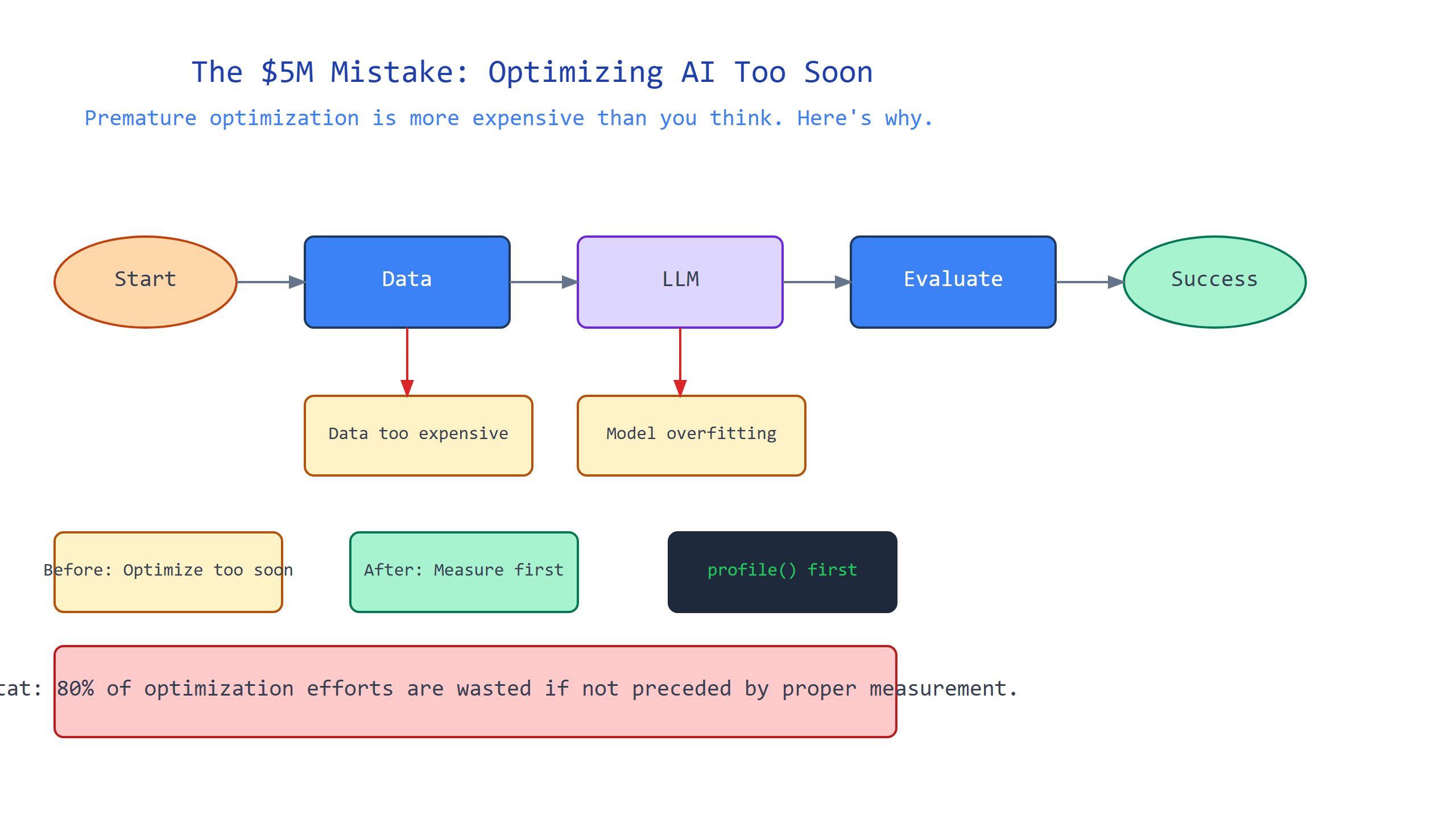
The Pipeline Illusion
The surface-level assumption is seductive: optimize your AI pipeline first, and everything else will follow. It’s the engineering equivalent of buying a Ferrari before you can drive.
Here’s the uncomfortable truth: Google’s own research on ML infrastructure shows that pipeline optimization accounts for less than 20% of end-to-end iteration time. The other 80%? Model experimentation, data cleaning, and—ironically—fixing bugs introduced by hasty optimizations.
Data callout: A 2022 study by Microsoft Research found that teams investing in pipeline optimization before achieving model convergence took 4x longer to reach production-ready accuracy than teams that delayed optimization by 6-8 weeks.
The mechanism isn’t mysterious. Early-stage model development is a search problem—you’re exploring a high-dimensional loss landscape. Each optimization to the pipeline (distributed training, kernel fusion, quantization) introduces constraints: fixed tensor shapes, specific batch sizes, hardware dependencies. These constraints turn your flexible exploration into a rigid, claustrophobic corridor.
The Hidden Tax You’re Not Tracking
What’s actually happening underneath is a cognitive and systemic cost that your metrics don’t capture. Think of it like this: optimizing your pipeline early is like organizing your garage before you’ve decided whether you’re building a race car or a minivan.
The technical reality is worse than you think. Every optimization introduces a feedback delay. A data scientist waiting 45 minutes for a distributed training job to spin up (instead of 15 minutes on a single GPU) won’t experiment as much. They’ll test fewer hyperparameter configurations. They’ll submit fewer code changes. They’ll learn less.
The compound effect is brutal:
- Each 3x increase in wait time reduces daily experiments by 60%
- Fewer experiments → less data on what works → premature convergence on suboptimal architectures
- Suboptimal architecture → you need 10x more optimization to compensate
The market reaction is starting to show this. Airbnb’s ML platform team reported in 2023 that their most productive models came from teams that spent the first 4-6 weeks optimizing for experimentation velocity—not inference throughput. They called it “the lazy pipeline paradox.”
The Status Trap We All Fall Into
Why is everyone missing this? Because it feels right. Optimizing something tangible—a batching algorithm, a caching layer, a graph compilation pass—gives you a dopamine hit. Refactoring a data loader to shave 200 milliseconds feels productive. Writing a Pytorch profiler report feels like engineering.
But it’s a delusion. A self-serving one.
The industry blind spot is a status trap: optimizing hardware utilization is visible, measurable, and praise-worthy. Clean code? That’s just maintenance. Model iteration without optimization? Feels like wandering in the dark. So we optimize for the wrong signal.
Surprising juxtaposition: The most efficient AI teams I’ve seen operate with deliberate inefficiency. They run models on laptops for the first month. They use Python loops instead of vectorized operations. They write messy, duplicative code. Why? Because it lets them test ideas in minutes, not hours. They optimize for cognitive velocity first.
The irony is sharp: these teams often have worse pipeline benchmarks in week 3 than the over-optimizing teams. But by week 8, they’ve converged on a model architecture that the optimized-pipeline teams will never discover—because the optimized teams never tried enough variations.
The Real Tradeoff You’re Not Facing
What does this mean going forward? It means your prioritization calculus is broken. You need to separate the exploration phase from the extraction phase in your AI product development.
During exploration (first 6-8 weeks), your goal is to maximize model diversity. You want to test 20 architecture variants, 50 hyperparameter configurations, 10 feature sets. Optimization is the enemy of diversity because it amplifies your current path.
Here’s a concrete heuristic for deciding when to optimize:
- If you’ve tested fewer than 5 distinct model architectures: don’t optimize
- If your team has run fewer than 100 experiments per architecture: don’t optimize
- If you can’t articulate why your current model fails (not how it succeeds): don’t optimize
- Only optimize when one architecture is clearly winning and you need to squeeze production latency
The forward implication is organizational. You need to hire for exploration culture, not optimization culture. That means rewarding messy failures, not clean pipelines. It means measuring experiments-per-day, not training throughput. It means your infrastructure team needs to build for low latency to first experiment, not low latency per inference.
- Premature pipeline optimization kills iteration velocity by introducing constraints and feedback delays
- The hidden cost is cognitive: fewer experiments = slower learning = worse final model
- Optimize in phases: explore first (6-8 weeks of messy, fast iteration), then extract performance
- Your metrics lie: measure experiments-per-week, not inference throughput during early stages
- The best teams are deliberately inefficient in weeks 1-8 to maximize model diversity
The Final Irony
The companies that “ship fast” on AI aren’t optimizing their pipelines sooner. They’re optimizing their decision cycles sooner. They’ve realized that the fastest pipeline in the world is useless if you’re training the wrong model. So next time your VP demands a throughput improvement, ask yourself the uncomfortable question: Are we optimizing the pipeline? Or are we optimizing the optimization? The answer will determine whether you ship a winning product or build the most efficient path to irrelevance.

Comments