“Just Ship It” Is Quietly Breaking Your Best Engineers
Sarah stared at her screen for twenty minutes. The pull request was two years old—her first major refactor at a well-known fintech startup. She knew the code was fragile. She knew the tests were thin. She knew, with the certainty of a dev who’d been burned before, that shipping this without addressing the underlying design debt would haunt the team for months.
Her manager pinged: “Can we get this out today? Business needs it.”
She clicked merge.
Three weeks later, that same code caused a production incident that took two on-call rotations and a Saturday to fix. Sarah didn’t celebrate the ship—she stared at the postmortem, wondering why nobody had asked how she was shipping, only when.
This isn’t a story about bad engineering. It’s the story of a culture that has confused speed with impact, and output with value.
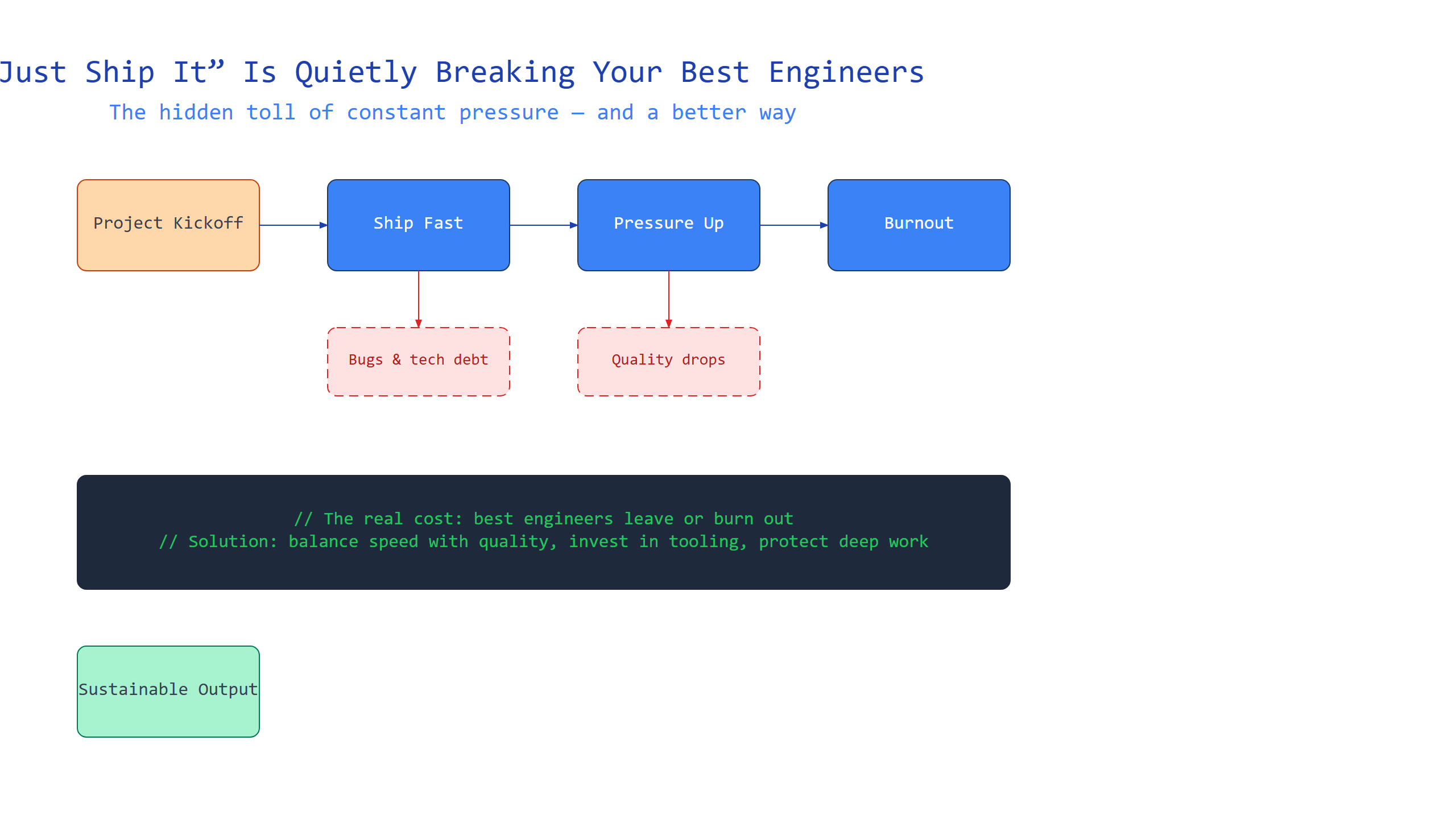
The Speed Trap We All Fell For
The “just ship it” mantra is tech’s version of “move fast and break things”—a relic from an era when software was less critical, less complex, and less connected to real human outcomes. Today, it’s the default answer to every tension between quality and delivery. Ship now, fix later. Done is better than perfect. Fail fast.
On paper, it sounds pragmatic. In practice, it creates a treadmill of technical debt, burnout, and diminishing returns.
A 2023 survey by Stripe and Harris Poll found that developers spend 33% of their work hours just managing existing code and fixing bugs—not building new features. That’s nearly a third of engineering salary burned on work that didn’t need to exist if the first iteration had been given proper attention. The “ship now” approach doesn’t accelerate delivery—it compounds it, turning short-term speed into long-term drag.
The problem isn’t shipping. It’s the belief that shipping without thinking is the same as shipping fast.
The Emotional Toll of Constant Delivery Pressure
Here’s the reality most managers don’t see: when “just ship it” becomes the default, engineers stop doing deep work. They stop refactoring. They stop asking why something is being built. They become ticket-closing machines, and their craft becomes a commodity.
The cognitive cost is real. Research from the University of California, Irvine found that after an interruption, it takes an average of 23 minutes and 15 seconds to return to the original task. The pressure to ship quickly creates constant context-switching—a Slack ping here, a last-minute requirement there—and each switch fragments an engineer’s ability to solve hard problems.
I watched this play out at a Series C company last year. The CTO proudly told a team of 40 engineers: “We don’t do code reviews on Fridays. Ship it and we’ll fix it Monday.” Within six months, the team’s deployment failure rate had tripled, and two of their best senior engineers had left for slower, more deliberate shops. They weren’t quitting because they didn’t like the work—they were quitting because they didn’t believe their work mattered anymore.
Data Says Slow Is Actually Faster
Let’s talk about the elephant in the room: the evidence doesn’t support the “ship it” cult. The State of DevOps Reports, which analyzed thousands of teams over a decade, consistently show that elite performers ship more frequently and have lower change failure rates. They don’t achieve this by rushing—they achieve it by investing in quality and process.
Netflix’s engineering culture is often cited as “move fast,” but what’s less said is their Chaos Engineering approach: they run automated tests that intentionally break their own production systems. They aren’t shipping fast—they’re building resilience into their delivery pipeline. Amazon famously mandates that all teams build their services to withstand failure, not just to ship code.
The difference is subtle but critical: deliberate speed, not reckless pace.
Teams that “just ship it” without investing in testing, code review, or design documentation end up with what I call velocity debt—the slowdown that compounds with every unaddressed shortcut. A 2022 study from the University of Cambridge found that every 10% increase in technical debt reduced team velocity by 3% per month, compounding over time until the team was moving at a crawl.
What Actually Works: Three Moves
So what do you do if you’re an engineer trapped in a “ship it” culture, or a manager trying to change it?
1. Create “safe shipping” zones. Define clear boundaries: critical path code ships fast, but refactoring and infrastructure changes get a slower lane. Google does this with their “bazel” approach—small, fast builds for safe changes, longer builds for risky ones.
2. Shift from “how fast?” to “how safely?” Replace shipping velocity as a team metric with lead time for changes and change failure rate. When you measure safety, speed follows naturally.
3. Build a cultural escape hatch. When a manager says “just ship it,” the engineer needs permission to say: “I can ship it today, but I’ll need three days to fix it next week. Or I can take two days to get it right now.” Make the tradeoff explicit—and visible.
One team I consulted for changed their standup to start with: “What won’t we ship today?” The first week, everyone was confused. The third week, they shipped more completed features than they had in the previous month. By choosing what not to rush, they created space for quality.
If you stopped shipping recklessly tomorrow, what would break? Probably nothing important. But what would change is your team’s ability to trust their own work, to sleep through on-call, and to feel proud of what they build. The cost of “just ship it” isn’t measured in deadlines missed—it’s measured in engineers lost.
The most productive teams I’ve seen don’t move fast and break things. They move deliberately, learning faster from each release, and building systems that get stronger with every deploy. The next time someone tells you to “just ship it,” ask them: Ship what, to whom, and at what cost? The answer might change how you build software—and how you feel about the code you leave behind.

Comments