The End of Kubernetes as We Know It
You’re in a postmortem for the third time this quarter. The Kubernetes cluster went down again, and you spent two hours explaining to a product manager why your “self-healing infrastructure” needed manual intervention at 2 AM. The room is quiet. Everyone knows the subtext: you’re drowning in complexity that was supposed to make you agile.
Nobody says the quiet part out loud.
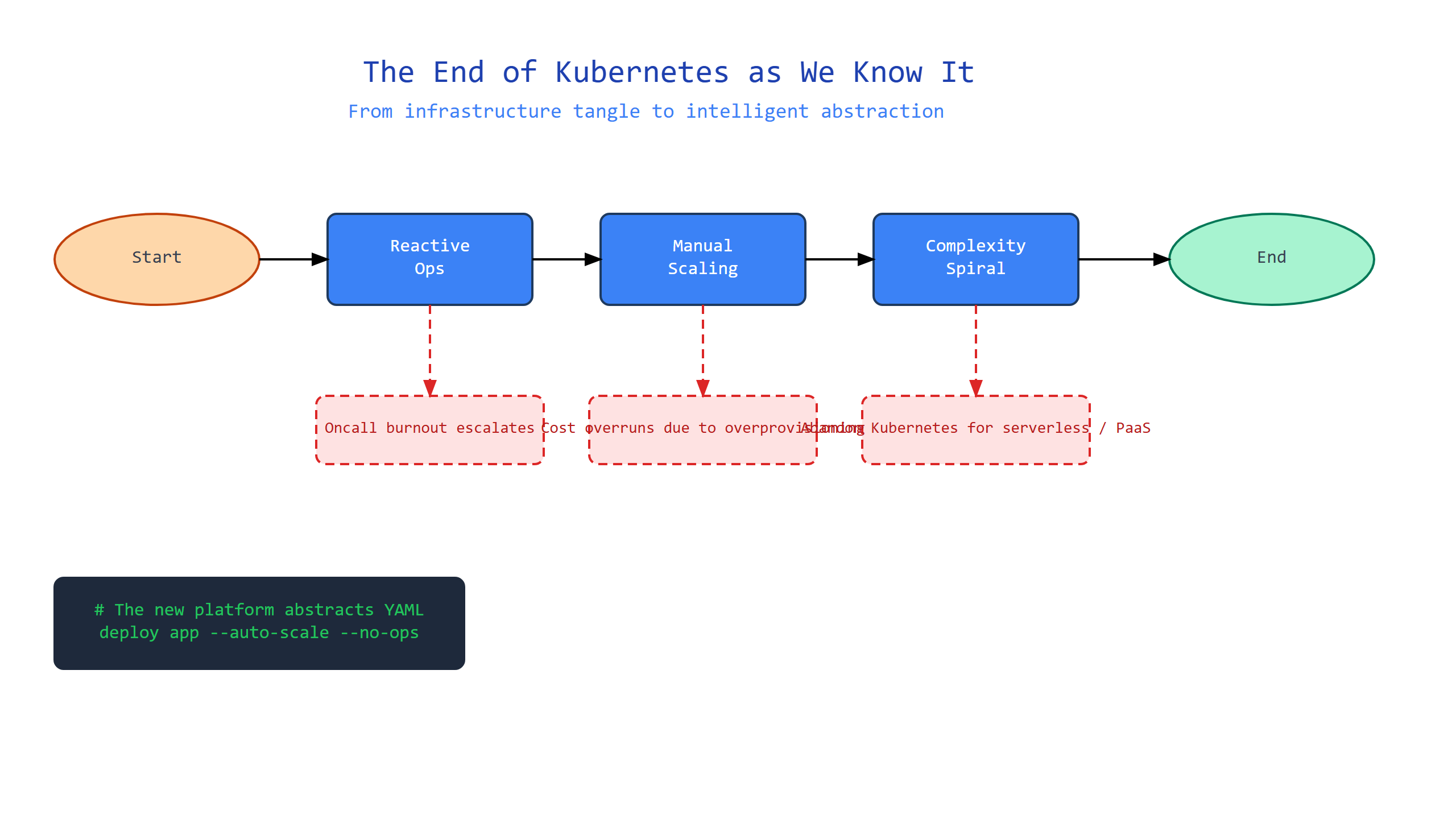
We spent seven years building this cathedral of orchestration. We automated deployments, abstracted compute, and promised engineering teams they’d never have to think about servers again. But somewhere along the way, we traded one form of complexity for another. Now the platform team has more on-call rotations than the product teams they serve. The “you build it, you run it” mantra has become “you build it, you run it, you maintain the control plane, you debug the CNI plugin, and you explain to auditors why your etcd cluster is running at 80% memory.”
The uncomfortable truth: Kubernetes gave us superpowers, but superpowers aren’t free. They come with obligations. And most teams are starting to realize the bill is due.
The Myth of Free Abstraction
Every engineering leader I talk to has the same story. They adopted Kubernetes because it promised a simpler world. One platform. One way to deploy. One set of operational patterns. The pitch was seductive: free yourself from vendor lock-in, gain portability, and let the orchestrator handle the messy bits.
But abstraction isn’t free. It’s a tax. Every layer you add between your code and the hardware creates new cognitive load. A 2022 survey by the Cloud Native Computing Foundation found that 67% of organizations running Kubernetes reported challenges with complexity, and 40% said infrastructure complexity directly impacted developer velocity.
The real story isn’t about technology. It’s about people. The platform team that was supposed to be a force multiplier becomes a bottleneck. The engineers who were supposed to write features spend their cycles debugging network policies. The CTO who wanted 10x velocity gets 2x meetings about cluster upgrades.
Kubernetes didn’t fail. It succeeded so completely that it created a new problem: the operating system for the cloud became so powerful that maintaining it became a full-time job for people who’d rather be building products.
The Invisible Tax on Your Engineers
I watched a mid-stage startup unravel over a year. Fifteen engineers, solid product-market fit, and a Kubernetes cluster that had grown organically. The platform team was three people. The product teams were twelve.
The math was simple but brutal. Every new feature required a new service. Every new service required a new deployment configuration. Every deployment configuration required a review from the platform team. The queue grew. The platform team started burning out. Feature delivery slowed to a crawl.
The CTO had a choice: hire more platform engineers or simplify the architecture. He chose both, but the simplification never happened. Kubernetes had become the company’s infrastructure identity. Admitting it was wrong felt like admitting failure.
This isn’t a startup problem. At a major fintech company, I watched a 200-person engineering org spend 30% of its total engineering hours on Kubernetes-related work. Not features. Not reliability. Just keeping the lights on.
The data backs this up. A 2023 survey by Pollak found that the average organization spends 42% of infrastructure engineering time on “undifferentiated heavy lifting” — the work of maintaining the platform rather than using it. Kubernetes is the single biggest contributor.
What Comes After the Orchestrator
The unbundling has already started. You can see it in the rise of serverless, in the resurgence of VMs, in the quiet exodus from Kubernetes at companies like Basecamp and 37signals. But it’s not about going back. It’s about going forward — to a world where the right tool for the job is the tool that causes the least organizational pain.
Consider how we use databases. We don’t use one database for everything. We pick the storage engine that matches our query patterns. We do the same for messaging, for caching, for compute. But somehow, when it comes to deployment, we insist on one orchestrator to rule them all.
The alternative looks like a return to specificity. Teams using serverless for event-driven workflows. Teams using Nomad for batch processing. Teams using Kubernetes only for the workloads that genuinely need it — stateful services, complex microservices, or where portability is a real constraint. Not because everything must be on Kubernetes, but because everything must be maintainable by the humans who will support it for the next five years.
This isn’t contrarian for the sake of it. It’s the logical conclusion of a pattern we’ve seen before: complexity grows until it becomes unmanageable, then it gets unbundled into simpler, more targeted solutions.
What to Do Starting Tomorrow
If you’re an engineer, stop treating Kubernetes as an identity. It’s a tool. Ask yourself: does this workload genuinely need orchestration, or can it run on a simpler platform? If it can, push for that. Your future self will thank you.
If you’re a manager, measure the total cost of ownership. Not just cloud bills. The engineering time spent on configuration. The cognitive load on your team. The reduced feature velocity. Run a two-week experiment where every Kubernetes-related task gets logged and quantified. You might be shocked at the real price.
If you’re a platform engineer, start planning the unbundling. Build a migration path that doesn’t require a flag day. Create tiered offerings: serverless for simple services, Kubernetes only for complex ones. Your users don’t care about your cluster topology. They care about shipping code.
Three concrete actions:
- Audit your Kubernetes usage every quarter. If 80% of your workloads are stateless web services, you’re paying too much in complexity.
- Cap platform team to product team ratio. If it exceeds 1:5, simplify the architecture before hiring more.
- Run a “Kubernetes-free Friday” every month. No cluster work, no config changes, no debugging. See what breaks. That’s the cost.
If you acted on this tomorrow, you’d stop treating your job as Kubernetes janitor and start treating it as product builder. You’d stop optimizing for the platform and start optimizing for the human experience of shipping software. The metrics that would change: not cluster uptime, not configuration coverage, but how many features your team shipped this week and how much sleep they got. That’s the only metric that matters.
The Honest Truth
Nobody’s going to give you permission to make your infrastructure simpler. The conferences celebrate complexity. The job postings demand Kubernetes expertise. The vendor ecosystem profits from keeping you confused. But the best engineers I know are the ones who ask the uncomfortable question: “Is this making our lives better or just more complicated?”
The unbundling is coming whether you’re ready or not. When it arrives, the teams that survive won’t be the ones with the most sophisticated deployments. They’ll be the ones who remembered that software exists to serve humans, not the other way around.
The question isn’t whether Kubernetes is good or bad. It’s whether you’re using it, or it’s using you.

Comments