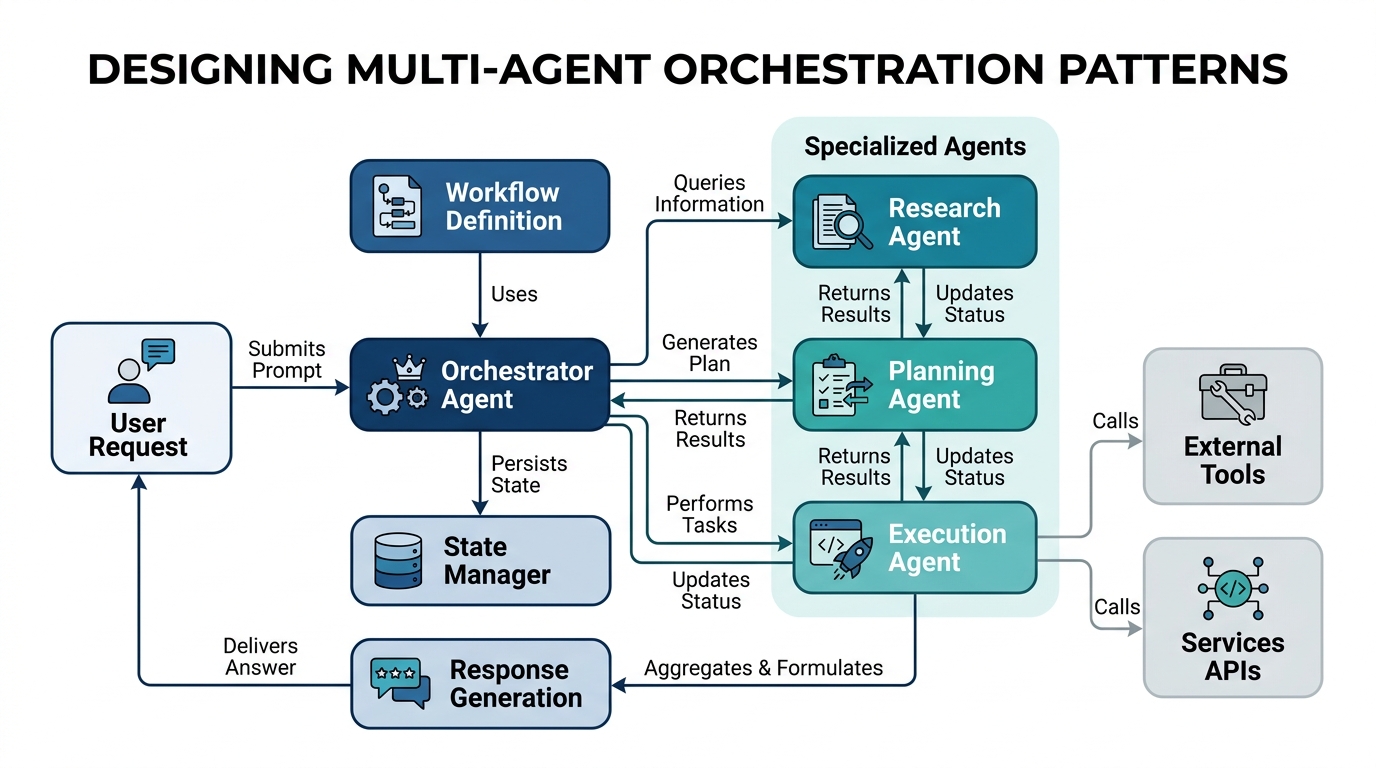
Designing Multi-Agent Orchestration Patterns
Imagine you’re managing a software project with a team of developers. You could let everyone work independently on whatever they want, but chaos would ensue. Or you could assign a project manager to break down tasks, route work to the right people, and ensure everything comes together. Multi-agent orchestration works the same way — it’s the art of coordinating multiple AI agents to solve complex problems that a single agent couldn’t handle alone.
In this tutorial, you’ll learn the core patterns for orchestrating multiple AI agents. We’ll demystify hierarchical arrangements, sequential workflows, supervisor routing, task decomposition, and modularity. By the end, you’ll understand not just what these patterns are, but when and why to use them. We’ll cover practical code examples using Python and relevant frameworks, so you can start building your own multi-agent systems today.
Hierarchical Arrangements
Plain-English definition: Hierarchical arrangements organize agents in a tree-like structure where higher-level agents manage and delegate to lower-level ones. Think of it like a corporate org chart — the CEO doesn’t write code, but they direct VPs who manage directors who manage individual contributors.
How it works under the hood: A parent agent receives a complex request, analyzes it, and delegates subtasks to child agents. Each child agent works independently and returns results to the parent, who aggregates and refines the output. The parent retains control over the overall strategy while children handle specific domains.
Real-world analogy: A restaurant kitchen. The head chef (parent agent) receives orders, decides which dishes to prioritize, and delegates prep work to sous chefs (child agents). Each sous chef specializes in a station — grill, salad, pastry — and reports back when their dish is ready.
Annotated code snippet:
import asyncio
from typing import List, Dict

class Agent:
    def __init__(self, name: str, specialization: str):
        self.name = name
        self.specialization = specialization

class SupervisorAgent(Agent):
    """Parent agent that delegates to specialized children."""
    def __init__(self, name: str, children: List[Agent]):
        super().__init__(name, "supervisor")
        self.children = children

    async def delegate(self, task: str) -> Dict[str, str]:
        results = {}
        # Decompose task and assign to appropriate children
        for child in self.children:
            if child.specialization in task.lower():
                results[child.name] = await child.execute(task)
        return results

class SpecialistAgent(Agent):
    """Child agent focused on one domain."""
    async def execute(self, task: str) -> str:
        # Simulate domain-specific work
        return f"{self.name} completed: {task}"
Non-obvious insight: Hierarchical systems introduce latency — the parent must coordinate every child. If any child fails, the parent needs a fallback strategy. Always implement retry logic and timeout handling for child agents.
Sequential Workflows
Plain-English definition: Sequential workflows chain agents in a pipeline where each agent’s output becomes the next agent’s input. Data flows in one direction, like an assembly line.
How it works under the hood: Each agent transforms or enriches the data, then passes it forward. The pipeline has a defined start and end, and agents can’t skip ahead or access data from later stages. This ensures deterministic processing order.
Real-world analogy: A car wash. Your car enters, gets sprayed (agent 1), soaped (agent 2), scrubbed (agent 3), rinsed (agent 4), and dried (agent 5). Each step depends on the previous one, and you can’t scrub before soaping.
Annotated code snippet:
from typing import Callable, Any
from functools import reduce

class Workflow:
    def __init__(self):
        self.steps: list[Callable] = []

    def add_step(self, agent_fn: Callable[[Any], Any]):
        self.steps.append(agent_fn)

    def run(self, initial_input: Any) -> Any:
        # Reduce applies each function sequentially
        return reduce(lambda x, fn: fn(x), self.steps, initial_input)

# Example: Document processing pipeline
workflow = Workflow()
workflow.add_step(lambda text: text.lower())
workflow.add_step(lambda text: text.replace("naughty", "censored"))
workflow.add_step(lambda text: f"[PROCESSED]: {text}")

result = workflow.run("This is a NAUGHTY word!")
# Output: "[PROCESSED]: this is a censored word!"
Non-obvious insight: Sequential workflows break completely if a single agent fails. Use checkpointing — save intermediate outputs so you can resume from the last successful step, not from scratch.
Supervisor Routing
Plain-English definition: Supervisor routing uses a dedicated controller agent that evaluates incoming requests and decides which specialist agent should handle them. Unlike hierarchical arrangements, the supervisor doesn’t manage long-running subtasks — it just routes and monitors.
How it works under the hood: The supervisor examines the input, applies routing rules (often based on intent classification or pattern matching), and forwards the request to the appropriate handler agent. The handler executes, and optionally reports results back to the supervisor for quality checking.
Real-world analogy: A hospital triage nurse. Patients arrive with various symptoms (inputs). The nurse assesses urgency and type (routing), then sends them to the right department — emergency, cardiology, pediatrics. The nurse doesn’t treat patients; they just direct traffic.
Annotated code snippet:
class Supervisor:
    def __init__(self):
        self.routes = {
            "weather": WeatherAgent(),
            "math": MathSolverAgent(),
            "greeting": GreetingAgent()
        }

    async def route(self, user_input: str) -> str:
        # Simple keyword-based routing
        for keyword, agent in self.routes.items():
            if keyword in user_input.lower():
                return await agent.process(user_input)
        return "No matching agent found"

class WeatherAgent:
    async def process(self, query: str) -> str:
        return f"Fetching weather for: {query}"

# Usage
supervisor = Supervisor()
await supervisor.route("What's the weather like?")  # Routes to WeatherAgent
Non-obvious insight: Supervisor routing creates a single point of failure. If the supervisor’s routing logic is wrong, every request fails. Implement fallback routing and monitor supervisor accuracy separately from agent performance.
Task Decomposition
Plain-English definition: Task decomposition breaks a complex goal into smaller, manageable subtasks that can be executed independently. It’s the “divide and conquer” strategy for AI agents.
How it works under the hood: A decomposition agent analyzes the parent task, identifies sub-problems, and generates a dependency graph. Each subtask has defined inputs, outputs, and success criteria. The orchestrator then assigns these subtasks to appropriate agents and tracks completion.
Real-world analogy: Building a house. You don’t just say “build a house” — you decompose into foundation, framing, plumbing, electrical, roofing, interior finishing. Each subtask has clear boundaries and deliverables.
Annotated code snippet:
class TaskDecomposer:
    def decompose(self, goal: str) -> list[dict]:
        # In reality, this would use an LLM or rule engine
        if "plan trip" in goal.lower():
            return [
                {"task": "Identify destination", "dependencies": []},
                {"task": "Book flights", "dependencies": ["Identify destination"]},
                {"task": "Find accommodation", "dependencies": ["Identify destination"]},
                {"task": "Plan itinerary", "dependencies": ["Book flights", "Find accommodation"]}
            ]
        return [{"task": goal, "dependencies": []}]

decomposer = TaskDecomposer()
subtasks = decomposer.decompose("Plan a trip to Paris")
# Returns structured subtasks with clear dependencies
Non-obvious insight: Task decomposition can create infinitely recursive subtasks if not bounded. Always set a maximum decomposition depth (e.g., “no more than 5 levels deep”) and provide a base case for atomic tasks.
Modularity
Plain-English definition: Modularity means designing agents as swappable, independent components with well-defined interfaces. Each agent does one thing well and can be replaced without breaking the system.
How it works under the hood: Agents communicate through standardized interfaces (e.g., input/output schemas, message formats). Internal implementation of each agent is hidden (encapsulation). You can upgrade, test, or swap individual agents without touching others.
Real-world analogy: LEGO bricks. Each brick has a standard connector (interface), but the internal shape and color vary. You can replace a red 2x4 brick with a blue one, and the castle still stands.
Annotated code snippet:
from abc import ABC, abstractmethod
from typing import Any

class AgentInterface(ABC):
    """Standard interface all agents must implement."""
    @abstractmethod
    async def process(self, input_data: dict) -> dict:
        pass

    @abstractmethod
    def validate(self, output: dict) -> bool:
        pass

class TranslationAgent(AgentInterface):
    """Concrete implementation with hidden internals."""
    async def process(self, input_data: dict) -> dict:
        # Internal implementation hidden from consumers
        text = input_data.get("text", "")
        target_lang = input_data.get("language", "french")
        # Complex translation logic here
        return {"translated_text": f"[{target_lang}]: {text}"}

    def validate(self, output: dict) -> bool:
        return "translated_text" in output

# Swapping agents is straightforward
class ImprovedTranslationAgent(AgentInterface):
    """New version, same interface — drop-in replacement."""
    async def process(self, input_data: dict) -> dict:
        # Better implementation
        return {"translated_text": "improved result"}

    def validate(self, output: dict) -> bool:
        return True
Non-obvious insight: True modularity requires versioning. When you swap an agent, ensure backward compatibility or implement a migration strategy. Otherwise, dependent agents will break silently.
Comparison Table: When to Use Each Pattern
| Pattern | Best For | Key Challenge | Example Use Case |
|---|---|---|---|
| Hierarchical | Complex problems needing strategic oversight | Parent agent bottleneck | Multi-research assistant system |
| Sequential | Deterministic data transformation | Single point of failure | Document processing pipeline |
| Supervisor Routing | Request classification and dispatch | Supervisor accuracy | Customer support ticket routing |
| Task Decomposition | Complex goals with clear sub-parts | Recursive decomposition | Automated project planning |
| Modular | Long-term maintainability | Interface design | Plugin-based AI systems |
Key Takeaways
- Multi-Agent Orchestration coordinates specialized agents to solve problems no single agent can handle
- Hierarchical arrangements use a parent agent to manage and delegate to children — great for complex, multi-domain tasks
- Sequential workflows chain agents in a pipeline where each step depends on the previous — perfect for deterministic data processing
- Supervisor routing uses a controller to classify and dispatch requests to specialists — ideal for flexible request handling
- Task decomposition breaks goals into smaller, dependency-managed subtasks — essential for handling complexity
- Modularity ensures agents are swappable through standardized interfaces — crucial for maintainability and testing
Now go build something that needs more than one brain to solve.




Comments