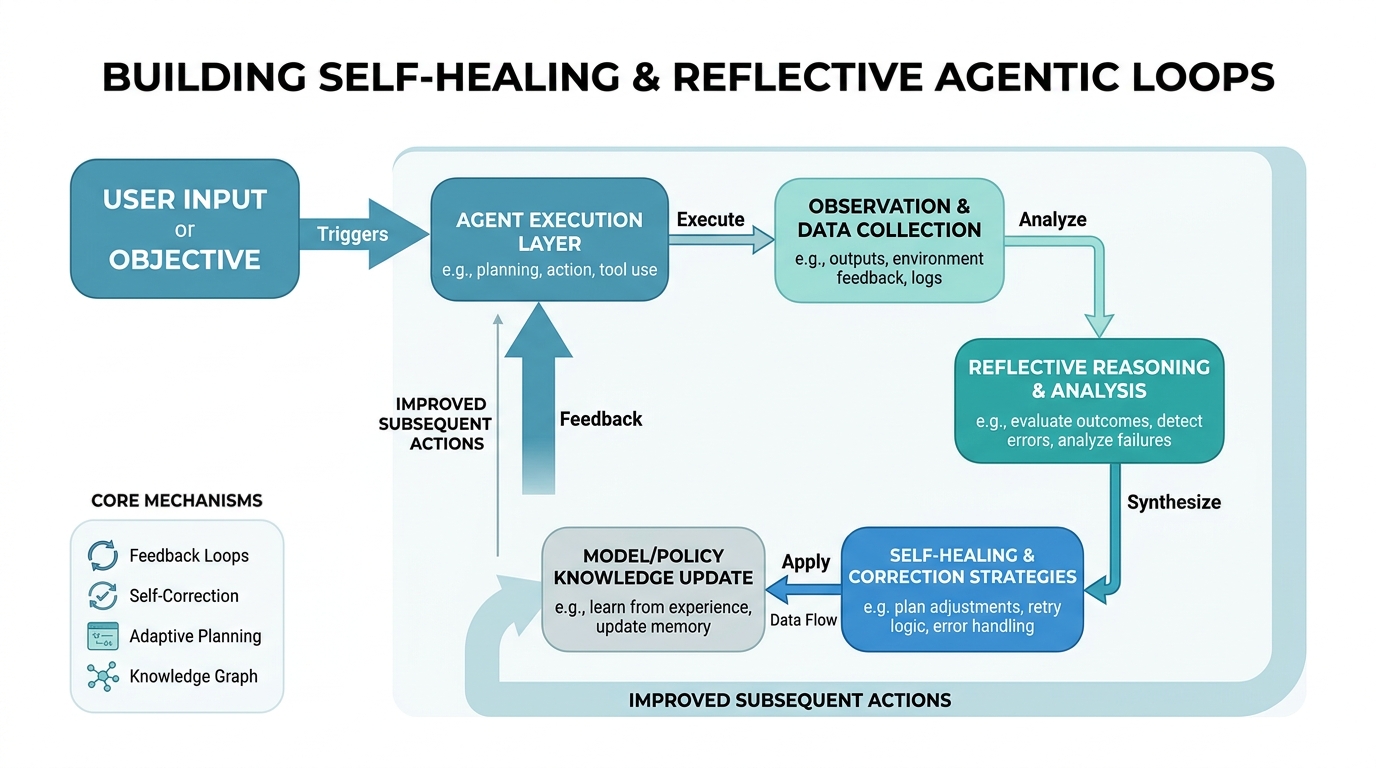
Building Self-Healing & Reflective Agentic Loops
Published on: January 15, 2025
Category: Agentic AI
Your AI agent just crashed. Again. The logs show a vague “connection timeout” message that doesn’t tell you what went wrong or how to fix it. Sound familiar?
Here’s what most tutorials won’t tell you: building agents that work is easy. Building agents that keep working when things go wrong is the real challenge. That’s where self-healing loops and reflective agents come in.
By the end of this tutorial, you’ll understand the six key concepts that separate fragile demos from production-ready agent systems: self-healing loops, reflective agents, error correction, output evaluation, algorithmic retry logic, and iterative refinement. No jargon, no fluff—just clear explanations with code you can actually use.
Self-Healing Loops: When Things Go Sideways
Plain-English Definition: A self-healing loop is code that detects when something goes wrong and automatically tries to fix itself before giving up.
How It Works: Under the hood, a self-healing loop wraps your main agent logic in a parent loop that monitors for errors. When an error occurs—say, an API call fails or a model returns garbage—the loop doesn’t just crash. It catches the error, logs what happened, and retries with a modified approach.
Real-World Analogy: Think of a self-healing loop like a GPS that recalculates when you miss a turn. Your first route might be blocked, but instead of pulling over and crying, the GPS finds an alternative path and keeps moving toward the destination.
Annotated Code Snippet (Python):
import time
from typing import Callable, Any

def self_healing_loop(
    agent_function: Callable,  # Your actual agent logic
    max_retries: int = 3,       # How many times to try before giving up
    backoff_seconds: float = 2.0  # Wait time between retries
) -> Any:
    """
    A basic self-healing loop that catches errors and retries.
    """
    for attempt in range(1, max_retries + 1):
        try:
            print(f"Attempt {attempt} of {max_retries}")
            result = agent_function()
            return result  # Success! Exit the loop

        except Exception as e:
            print(f"Error on attempt {attempt}: {str(e)}")

            if attempt < max_retries:
                # Wait before retrying (exponential backoff)
                time.sleep(backoff_seconds * (2 ** (attempt - 1)))
            else:
                # Out of retries — raise the last error
                raise RuntimeError(f"Agent failed after {max_retries} attempts")
Non-Obvious Insight: Most people make the mistake of retrying immediately. You should always add a delay between retries—your server might be overloaded, and immediate retries only make it worse.
Reflective Agents: The Power of Looking Back
Plain-English Definition: A reflective agent is an AI system that examines its own outputs and decides whether they meet quality standards before sending them to the user.
How It Works: Instead of blindly returning whatever the model generates, a reflective agent calls itself (or a separate evaluation model) to critique the output. It asks questions like: “Does this answer make logical sense?” or “Did I hallucinate any facts?”
Real-World Analogy: Before you submit a report to your boss, you read it through, catch typos, and make sure your arguments hold up. You’re being reflective. An agent that does this programmatically is a reflective agent.
Annotated Code Snippet (Python with pseudo-API):
def generate_answer_with_reflection(query: str) -> str:
    """
    An agent that generates an answer and then reflects on its quality.
    """
    # Step 1: Generate initial response
    draft = call_llm(f"Answer this question: {query}")
    print(f"Draft: {draft}")

    # Step 2: Evaluate the output (reflection step)
    reflection = call_llm(f"""
    Evaluate this answer for quality. Check for:
    - Factual accuracy
    - Logical consistency
    - Completeness

    Answer: {draft}

    Output either 'PASS' or 'FAIL' with a brief reason.
    """)

    if 'PASS' in reflection:
        print(f"Output passed self-check: {reflection}")
        return draft
    else:
        print(f"Output failed self-check: {reflection}")
        # Fall back to simpler, safer response
        return "I'm unable to provide a confident answer to this question."
Gotcha: Over-reflecting can tank performance. Each reflection call costs time and tokens. Set a maximum of 2-3 reflection rounds before accepting the output as-is.
Error Correction: Fixing What’s Broken
Plain-English Definition: Error correction is the process of identifying what went wrong and applying specific fixes, rather than just blindly retrying.
How It Works: When your agent encounters an error, instead of repeating the same failing request, error correction modifies the request based on what went wrong. If the API said “rate limit exceeded,” you wait. If the model returned malformed JSON, you ask it to re-format.
Real-World Analogy: If your car won’t start, you don’t just keep turning the key. You check the battery, the gas, and the starter. Error correction is systematic debugging applied to agent failures.
Annotated Code Snippet:
def error_correcting_agent(query: str) -> str:
    """
    Agent that analyzes errors and applies targeted fixes.
    """
    max_corrections = 3
    corrections_applied = 0

    while corrections_applied < max_corrections:
        try:
            prompt = f"Return a JSON object with key 'answer' containing: {query}"
            response = call_llm(prompt)
            data = json.loads(response)  # This might fail
            return data['answer']

        except json.JSONDecodeError as e:
            print(f"JSON parsing error: {e}")
            # Specific fix: ask for proper JSON
            query = f"Previously you returned invalid JSON. Please ONLY return valid JSON. Query: {query}"
            corrections_applied += 1

        except KeyError:
            print("Missing 'answer' key in response")
            # Different fix: explicitly request the key
            query = f"Your response must include a key called 'answer'. Query: {query}"
            corrections_applied += 1

    return "Failed after maximum correction attempts"
Output Evaluation & Algorithmic Retry Logic
Output Evaluation (Plain English): Measuring the quality of your agent’s output against some standard before accepting it.
Algorithmic Retry Logic (Plain English): An intelligent decision system that chooses how to retry based on the failure type, rather than retrying in the same way every time.
Real-World Analogy: A chef tastes the soup before serving it (output evaluation). If it’s too salty, they add water and re-season (algorithmic retry). They don’t just boil the same salty soup again.
Annotated Code Snippet:
def smart_agent_with_evaluation(query: str) -> str:
    """
    Combines output evaluation with algorithmic retry logic.
    """
    # Define quality criteria
    quality_checks = {
        'length': lambda x: len(x) > 50,
        'has_period': lambda x: '.' in x,
        'not_apologetic': lambda x: 'sorry' not in x.lower()
    }

    for attempt in range(1, 4):
        response = call_llm(query)

        # Output evaluation: check all quality criteria
        passed = all(check(response) for check in quality_checks.values())

        if passed:
            return response

        print(f"Attempt {attempt} failed quality checks")

        # Algorithmic retry: modify prompt based on which checks failed
        if len(response) <= 50:
            query = f"Previous answer was too short. Write a detailed response. {query}"
        elif 'sorry' in response.lower():
            query = f"Do NOT apologize. Just answer directly. {query}"

    return "Failed all quality checks"
Iterative Refinement: The Polish Pass
Plain-English Definition: Iterative refinement is the process of repeatedly improving an output through multiple evaluation-correction cycles until it meets quality thresholds.
How It Works: You generate an output, evaluate it, apply improvements, re-evaluate, and repeat until the quality plateaus or exceeds your threshold.
Real-World Analogy: Writing a first draft, then editing, then editing again, then asking a peer to review, then editing again. Each pass makes the output better.
Comparison Table: How All Concepts Fit Together
| Concept | Role | When to Use | Key Metric |
|---|---|---|---|
| Self-Healing Loop | Keep trying on failure | Network errors, timeouts | Success rate |
| Reflective Agent | Self-critique the output | When quality matters | Pass rate |
| Error Correction | Fix specific problems | Known error types | Recovery speed |
| Output Evaluation | Measure quality | Every output | Quality score |
| Algorithmic Retry | Choose retry strategy | All retries | Efficiency |
| Iterative Refinement | Polish the output | Complex tasks | Quality delta per pass |
Key Takeaways
- Self-Healing Loops catch errors and retry with backoff — essential for unreliable APIs
- Reflective Agents critique their own outputs using a separate LLM call
- Error Correction applies targeted fixes instead of blind retries
- Output Evaluation measures quality against predefined criteria
- Algorithmic Retry Logic selects the retry strategy based on failure type
- Iterative Refinement improves outputs through successive evaluation-correction cycles
Ready to build agents that survive production? Start with a self-healing loop, add output evaluation, then layer in reflection. Your users (and your mental health) will thank you.

Comments