The Cloud Migration Hangover: Why We’re Moving Workloads Back to Bare Metal in 2025
You know that sinking feeling when you realize your “cloud-first” strategy is costing three times more than your on-premise setup ever did? Welcome to 2025, where the industry’s biggest heist isn’t crypto—it’s your cloud bill. After a decade of relentless cloud migration, something strange is happening: workloads are coming back home.
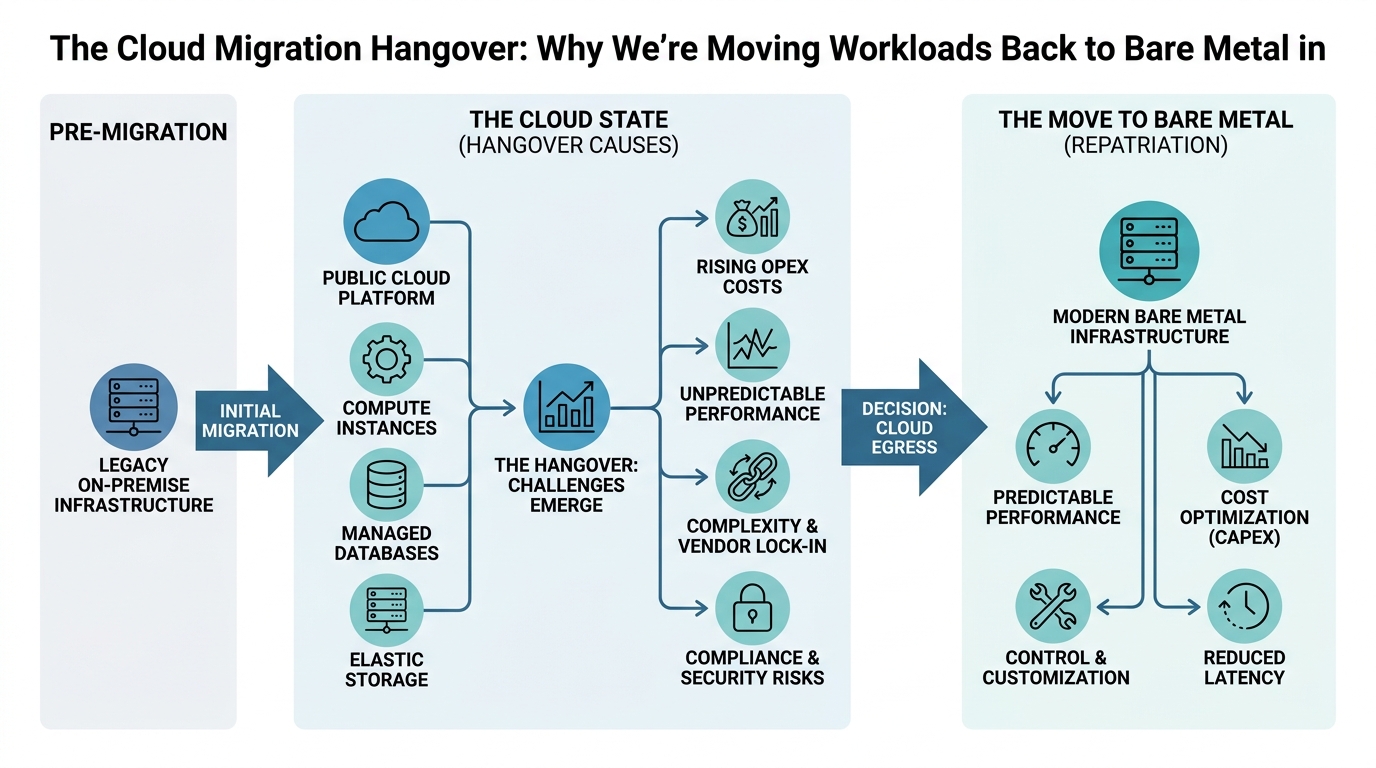
The Great Reverse Migration
Here’s the contrarian truth: AWS, Azure, and GCP aren’t necessarily cheaper than bare metal. In fact, for predictable, high-throughput workloads, they’re a financial trap. Consider this: a 2024 study by Andreessen Horowitz found that companies spending over $100M annually on cloud could save 30-50% by repatriating half their workloads. Dropbox famously saved $75M over two years by moving off AWS. The cloud’s “pay-as-you-go” model, seductive at small scale, becomes punitive at enterprise scale. It’s like renting a car for a cross-country road trip when you already own a reliable truck—convenient at first, but financially absurd by mile 10,000.
What Actually Happens Underneath
The mechanism behind this hangover is deceptively simple: virtualization overhead. Every time your code touches a cloud VM, you’re paying for a hypervisor layer that steals 5-10% of your CPU cycles. Your AWS EC2 instance isn’t a real server—it’s a timeshare. Multiply that across thousands of cores, and you’re paying for compute you never actually get.
# Concrete example: batch processing cost comparison
cloud_cost_per_core_hour = 0.05  # AWS c5.large on-demand
bare_metal_cost_per_core_hour = 0.02  # Power costs + amortized hardware
cores_needed = 1000
job_hours = 720  # 30 days

cloud_total = cloud_cost_per_core_hour * cores_needed * job_hours
bare_metal_total = bare_metal_cost_per_core_hour * cores_needed * job_hours

print(f"Cloud: ${cloud_total:,.0f}")           # $36,000
print(f"Bare metal: ${bare_metal_total:,.0f}")  # $14,400
print(f"Savings: ${cloud_total - bare_metal_total:,.0f}")  # $21,600
But wait—it gets worse. The real hidden cost isn’t compute. It’s data egress. Cloud providers charge $0.05-0.12 per GB to move data out of their ecosystems. For data-intensive workloads (ML training, video processing, analytics), egress can dwarf compute costs. Google’s own benchmarks show that for a three-year commitment on a steady workload, bare metal costs 40-60% less than cloud.
Why Everyone Missed This
We were drunk on the cloud’s convenience. The ability to spin up a cluster in minutes felt like magic. DevOps teams worshiped at the altar of “serverless” and “auto-scaling.” But we forgot something fundamental: abstraction has a tax.
The industry’s blind spot is the “predictable workload fallacy.” Most cloud proponents assume all workloads are spiky and unpredictable. They’re wrong. According to a 2024 Cloud Pragmatism study, 60-70% of enterprise workloads are steady-state: databases, batch processing, CI/CD pipelines, internal APIs. These workloads run 24/7, 365 days a year. They gain zero benefit from cloud elasticity but pay the full cloud premium.
Real data point: Netflix, the cloud poster child, famously runs 99% of their streaming infrastructure on AWS. But they engineered around it—their Chaos Monkey and Shuffle Sharding are hacks to make cloud work at scale. Most companies don’t have Netflix’s engineering talent. They’re paying for enterprise-grade infrastructure but getting startup-level complexity.
The emotional reality? It hurts to admit you made a mistake. Especially when that mistake was shepherded by the world’s most powerful tech companies. Cloud vendors marketed “digital transformation” but delivered “budget transformation”—just in the wrong direction.
What This Means Going Forward
Repatriation in 2025 isn’t about going back to 2005. It’s about hybrid intelligence. Here’s what the smartest companies are doing:
- Data gravity analysis: Compute goes to data, not the other way around. If your data is on bare metal, your compute should be too.
- Cold workload repatriation: Batch processing, backups, archives—these scream “bare metal.” Hot workloads stay cloud.
- Cloud for burst, bare metal for base: Use cloud elasticity for spikes (Black Friday, product launches) but own your baseline compute.
- Hardware leasing over buying: Companies like OVHcloud and Hetzner offer bare metal with cloud-like provisioning flexibility, without the egress tax.
The forward implication? Cloud providers are already responding. AWS’s Outposts, Azure’s Stack, and GCP’s Distributed Cloud are essentially “cloud in a box”—Google’s admission that the data center isn’t going away.
Stop treating cloud as binary. It’s not “all in” or “all out.” The smartest architects optimize for workload, not dogma. If your cloud bill makes you wince, run the math. You might find your “digital transformation” was really just “cloud hospitality”—paying a premium for the pleasure of someone else’s ecosystem.
The cloud migration hangover is real because we drank the Kool-Aid without checking the label. In 2025, the winners won’t be cloud-native purists or on-premise dinosaurs. They’ll be hybrid pragmatists who know when to rent and when to own. Your next architecture decision: are you optimizing for convenience or cost? Because you can’t have both—not anymore.

Comments