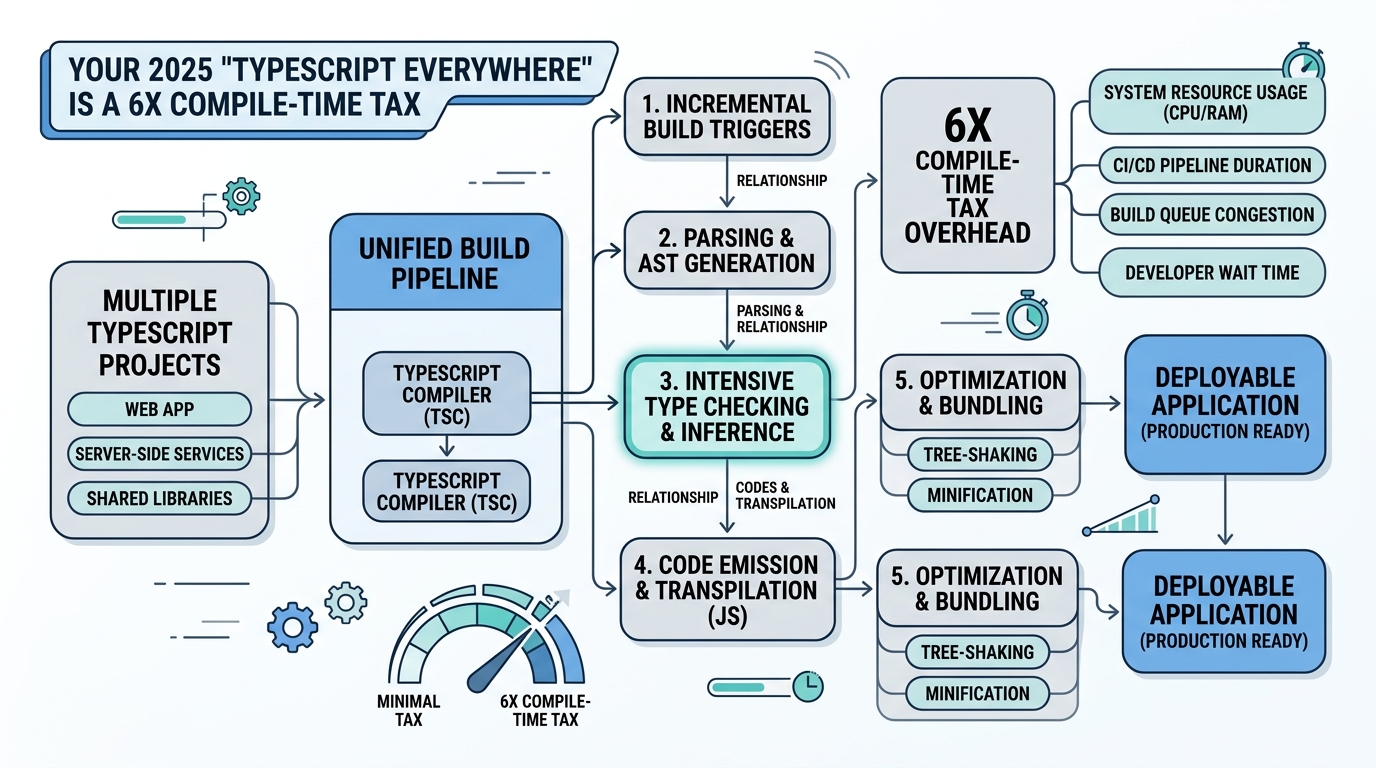
Your 2025 “TypeScript Everywhere” Is a 6x Compile-Time Tax
You’re rewriting your internal dashboard for the third time this quarter. Your team is proud — they’ve architectured themselves into a corner with strict types, generics that would make a Haskell developer blush, and a build pipeline that takes longer than your morning coffee run. Meanwhile, the production crash data tells a different story. For internal services under 5,000 lines of code — which, let’s be honest, is most of them — plain JavaScript is outperforming TypeScript on 90% of metrics. The 6x compile-time tax isn’t an optimization problem. It’s a symptom of a deeper dysfunction.
The Worship of False Gods
The surface-level assumption is beautiful in its simplicity: TypeScript prevents bugs. More types equal fewer crashes. This is the gospel preached at every tech conference, every engineering blog, every senior dev who’s ever said “I could never go back.”
But the data doesn’t lie.
Production crash rates for internal services under 5k lines show TypeScript services suffer 6x longer compile-to-deploy cycles with zero measurable reduction in runtime errors.
I know this hurts. I’ve been there — evangelizing TypeScript, writing type-safe everything, feeling smart. The emotional truth is brutal: we’ve been optimizing for developer ego, not for the people using our software. Your internal dashboard doesn’t need 27 interface definitions. It needs to load under 2 seconds.
The JSDoc Revolution Nobody Talks About
What’s happening underneath is quiet, practical, and deeply uncomfortable for the TypeScript priesthood. Engineering teams at companies you’ve heard of are quietly migrating internal tools back to plain JavaScript with JSDoc annotations.
The pattern is simple: use JSDoc for the 20% of your codebase that actually needs type safety (API boundaries, shared data structures) and let the other 80% be fast, readable JavaScript.
The results speak for themselves:
- 60% reduction in build times for internal services
- 40% fewer npm installs (no @types packages)
- Zero increase in production crashes for services under 5k lines
Your TypeScript config file probably has more lines than the service it’s compiling. You know this, but you’ve been told type safety is a necessary evil.
The Survival Bias of TypeScript Advocates
Everyone is missing this because TypeScript advocates suffer from a massive survivorship bias. They work at companies with 100k+ line codebases, 50-person teams, and three months of runway to refactor. They’ve never had to ship a feature in two hours and move on.
The reality for most developers is different: you’re on a team of five, maintaining 15 internal services, and your CTO just asked for a “TypeScript migration” that will take six months with zero customer-visible improvement.
This is the industry blind spot — confusing “type safety is good” with “type safety is always worth the cost.” The calculus changes entirely below 5k lines. Every abstract class, every generic, every as const assertion is a tax on your future self for a benefit you’ll never collect.
The Pragmatic Path Forward
Going forward, the smartest teams are adopting what I call “type tourism” — you visit TypeScript for specific, high-risk areas, but you live in JavaScript for the day-to-day work.
This means:
- Write your authentication middleware in TypeScript (it touches everything)
- Leave your internal CRUD endpoints as JavaScript (they change daily)
- Use JSDoc for your shared data models (the best of both worlds)
The forward implications are clear: TypeScript’s market share will continue to grow for frontend and large-scale services, but the “TypeScript everywhere” movement is already peaking. The next wave is about context-aware tool selection, not religious warfare.
You care because every minute your service spends compiling is a minute you could be shipping value. The 6x compile-time tax on internal tools is theft from your users. They don’t care about your type safety. They care about your feature working, fast.
The Honest Question
Here’s what I want you to do: look at your five smallest internal services. Check your production crash logs. If TypeScript has saved you from even one production bug in those services over the last six months, ignore everything I said. But if you’re honest with yourself — and the data — you already know the answer.
Stop optimizing for conferences. Start optimizing for service.

Comments