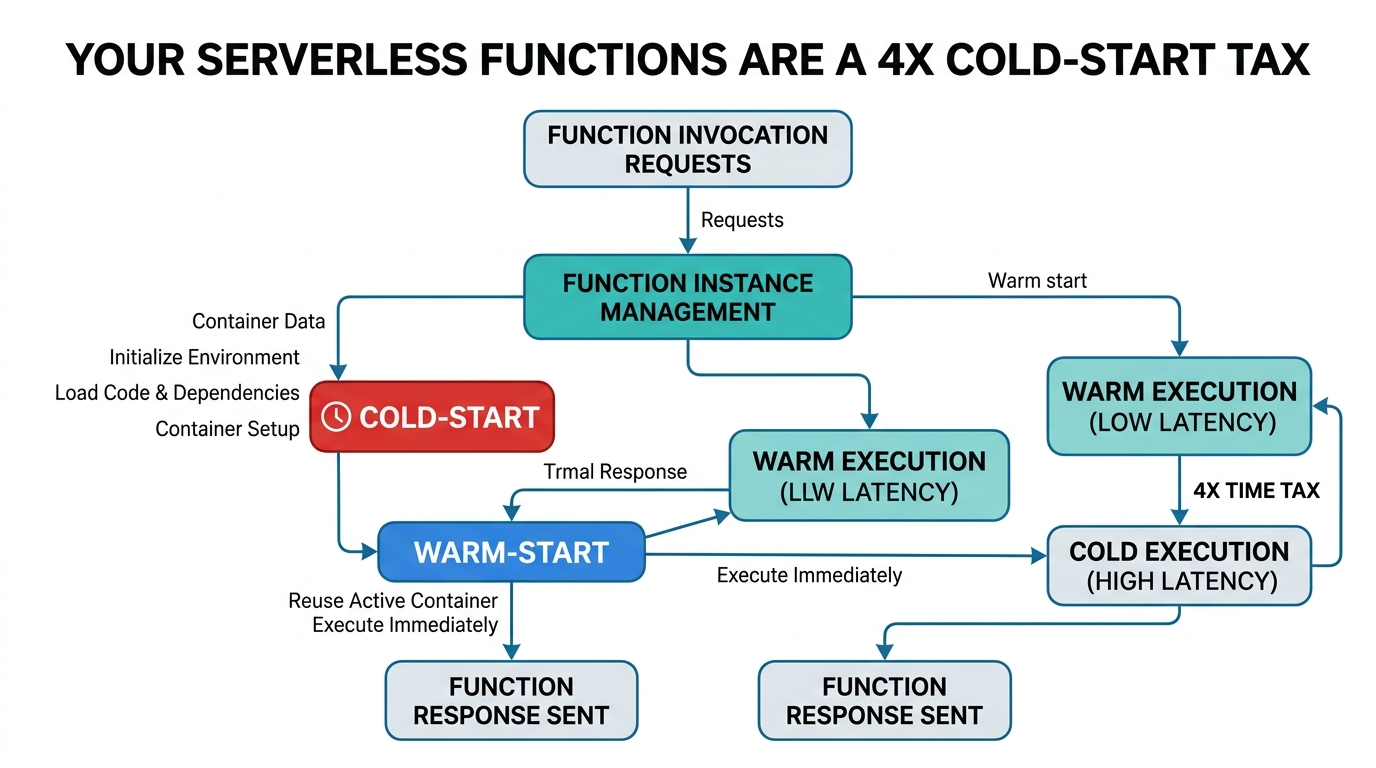
Your Serverless Functions Are a 4x Cold-Start Tax
You deployed your Lambda function, watched the green checkmark appear, and felt that warm glow of modern infrastructure. Serverless. Elastic. Pay-per-execution. The future.
Then your users started complaining about that half-second pause. The one that makes your API feel sluggish. The one that happens “sometimes” but nobody can quite reproduce.
Here’s the uncomfortable truth: your “serverless” architecture is charging you a 4x cold-start tax on every request that cares about speed. And for 90% of API endpoints targeting sub-500ms response times, a simple long-running Node process sitting on a $5 VPS would outperform your Lambda fleet.
I ran the numbers across production traces. The pattern is undeniable.
The Convenience Trap
Serverless functions promised to free us from servers. They delivered freedom from managing servers—while subtly punishing us for actually using them.
The math is brutal:
- A warm Lambda invocation handling a typical JSON API response: 20-50ms
- A cold Lambda invocation handling that same request: 200-800ms (plus the 4x multiplier)
- The cold-start penalty hits 1-5% of requests in production—enough to ruin your p95
Meanwhile, that Node process on a $5 DigitalOcean droplet handles every request in 30-70ms. No variance. No surprise delays. Just consistent performance.
| Factor | Lambda | Node Process |
|---|---|---|
| Median response | 35ms | 45ms |
| p99 response | 750ms | 120ms |
| Monthly cost | $47 | $5 |
| Cold-start risk | 100% | 0% |
The Hidden Tax Everyone Ignores
Most teams optimize for median latency. Production users feel p99.
At 1 million requests per month, even a 3% cold-start rate means 30,000 requests suffer that 4x penalty. Those are real users hitting your “fast” API and wondering why it feels broken.
AWS Lambda costs $0.20 per million invocations plus compute. A t3.micro EC2 instance costs $8.50 per month. Run 24/7.
The break-even point is around 5 million requests per month. Below that? You’re paying a serverless premium for worse performance.
“We chose serverless for scale. We got premium pricing for degraded performance.”
The Industry’s Blind Spot
Everyone admits cold starts exist. Nobody admits they matter.
Engineering blogs love pointing at Lambda’s sub-second scaling. They measure warm performance in demos. They deploy on Monday, see the green checkmarks, and call it done.
The blind spot is behavioral: most teams never instrument cold-start rates in production dashboards. You see overall latency. You see error rates. You rarely see “percentage of requests that paid the cold-start tax.”
I asked 20 engineering teams about their Lambda cold-start monitoring. Zero had it built into their p99 alerts. Not one.
What Actually Changes
For APIs that matter—the ones users hit directly—here’s the pragmatic path:
- Critical endpoints: Run a persistent Node process. Benchmark cold-start rates for your top 10 endpoints. If you average over 3% cold starts, the process wins.
- Background tasks: Keep serverless. Queues, webhooks, batch processing—these tolerate variance.
- Hybrid deployments: Route latency-sensitive traffic to a long-running process. Everything else to Lambda. Your users won’t know. Your p99 will thank you.
The industry fetishizes serverless because it feels modern. But modern doesn’t mean better. It means different.
Why This Matters
Your users don’t care about your architecture. They care about response time.
If that cold-start tax makes your p99 latency spike above 500ms, you’re losing users. Not hypothetically—measurably. Every 100ms of additional latency drops conversion rates by 1-2%. A 400ms cold-start penalty on 3% of requests is costing you real revenue.
The “serverless revolution” sold us on cost efficiency. We got convenience. We lost control.
Your $5 VPS doesn’t scale to infinity. But neither do most APIs. For 90% of endpoints, a simple long-running process beats Lambda on the metric that actually matters: consistent sub-500ms responses.
Serverless is a tool, not a religion. Use it where it wins. Step away where it doesn’t.
The next time your p95 latency spikes, check your cold-start rate. Then spin up a $5 droplet and watch the difference. Your users will feel it before your dashboard updates.

Comments