The Cloud Repatriation Mirage: Why Startups Are Moving Off AWS
You’ve seen the headlines. Basecamp left AWS. 37signals saved millions. The cloud is a rip-off. And yet, for every company that’s proudly repatriated, a thousand more are still burning cash on EC2 instances they don’t understand. The contradiction is staring us in the face: if cloud repatriation is such a no-brainer, why aren’t more companies doing it? Because the math isn’t as simple as the blog posts make it seem.
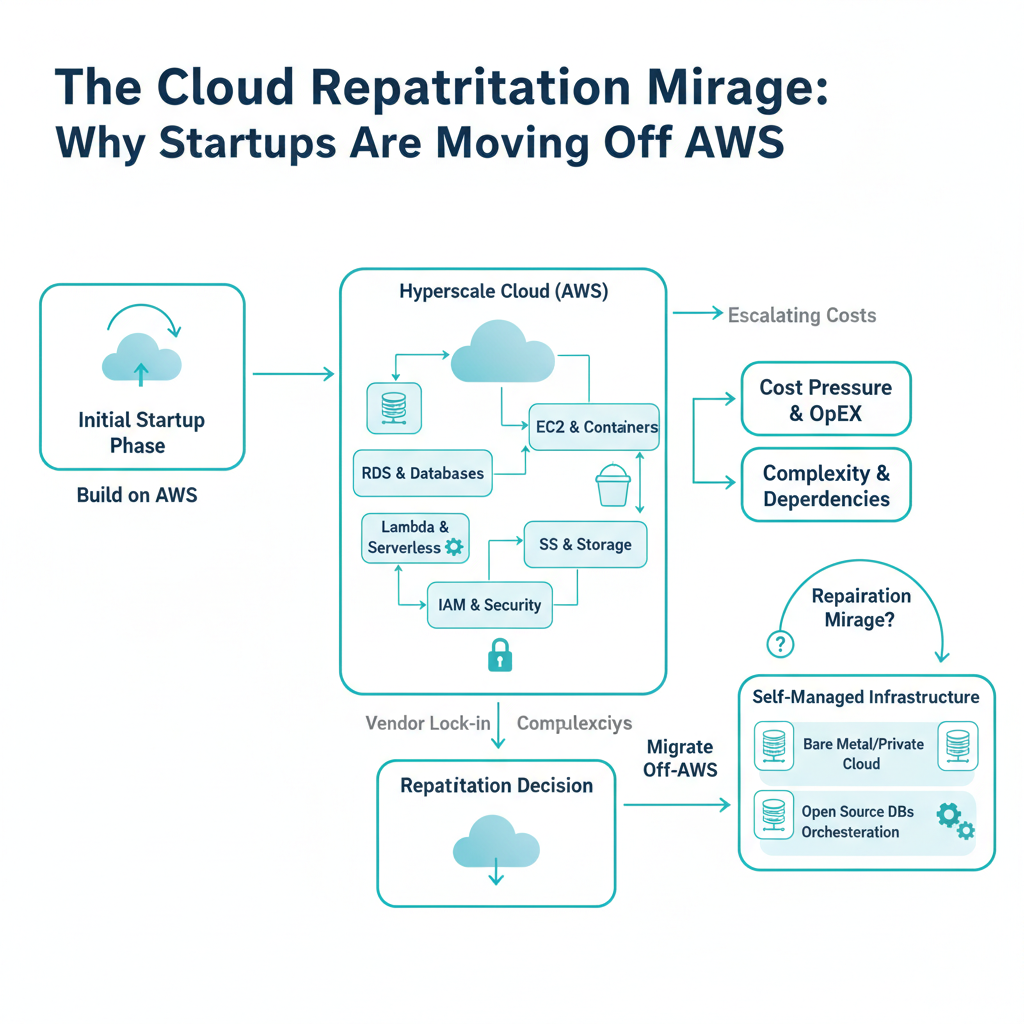
The Surface Assumption That’s Killing Budgets
The prevailing narrative is that cloud costs are out of control, and the solution is to move everything back to bare metal. DHH’s famous $1.8 million annual savings from leaving the cloud became instant gospel for every frustrated CTO.
But here’s the data the articles don’t show you: according to a 2023 Flexera report, 82% of enterprises have a cloud cost optimization initiative, yet only 29% report meaningful savings. The problem isn’t the cloud—it’s the way we use it.
Let’s be honest about what’s really happening. Most teams spin up instances, forget to turn them off overnight, provision four times the compute they need, and treat reserved instances like a foreign concept. The emotional reality is that blaming the cloud is easier than admitting we’ve built terrible habits.
The Hidden Infrastructure Tax Nobody Talks About
What happens when you actually move off AWS? You don’t just stop paying for compute. You start paying for everything else.
Think of cloud services like a rental apartment. You pay a premium, but the property manager handles the plumbing, the electrical, and the security. Going bare metal is like buying a house. Suddenly you’re responsible for the roof, the foundation, and that weird leak in the basement.
The technical reality is brutal:
- Network engineering: AWS handles BGP routing and DDoS protection. On-prem, that’s your problem.
- Hardware lifecycle: Servers fail. Manufacturers EOL hardware. Someone has to rack, stack, and swap.
- Security compliance: PCI-DSS, SOC2, ISO 27001—these certifications cost tens of thousands to maintain independently.
One startup I know spent 9 months migrating from AWS to colocation. They projected 40% savings. After factoring in a part-time DevOps hire (90k), hardware replacement fund (30k/year), and compliance audits (25k), their actual savings? 12%. And that was a good outcome.
The Industry Blind Spot We Keep Ignoring
Here’s what the repatriation cheerleaders conveniently leave out: most successful repatriations happened at companies that had already optimized their architecture on cloud.
You can’t skip the learning curve. It’s like watching a marathon runner switch to cycling and thinking you can replicate their success without doing the training. The companies that successfully moved off AWS had teams that deeply understood distributed systems. They had Kubernetes experts. They knew exactly which services they could run on commodity hardware and which genuinely needed AWS’s specialized offerings.
The dirty secret is that most startups don’t have this expertise. A 2022 survey by Cockroach Labs found that 67% of startups with fewer than 50 employees had no dedicated infrastructure engineer. Yet these same companies are the ones feeling pressured to repatriate.
What This Means For Your Next Three Years
The future isn’t all-or-nothing. It’s hybrid. Startups that survive the next downturn will be those that learn to use cloud strategically, not sentimentally.
Consider this framework:
- AWS for elasticity: Your customer-facing API needs to handle traffic spikes. Keep it on cloud.
- Bare metal for steady state: Your batch processing runs the same every day. Replace those EC2 instances with dedicated hardware at a provider like Hetzner or OVHcloud.
- Managed services for competitive advantage: Don’t build your own database cluster. Don’t roll your own CDN. These are solved problems.
The smartest CTOs I know treat cloud services like vegetables: everyone knows there’s a cheaper way to get calories, but paying a premium for pre-cut, pre-washed convenience makes sense when you’re in a hurry.
So what should you actually do? Stop trying to replicate Netflix’s architecture when you have twenty users. And stop pretending repatriation is a religion. It’s a negotiation tactic with AWS, not a strategy.
The real insight isn’t that the cloud is too expensive. It’s that most startups have neither the expertise to optimize their cloud spend nor the operational maturity to run their own hardware. If you’re spending more than $50k/month on AWS and don’t have a dedicated cloud cost engineer, hire one before you even think about repatriation. That single hire will save you more than any migration ever could.
The Truth That Nobody Wants to Hear
The cloud repatriation movement says more about our collective anxiety than it does about infrastructure economics. We’re frustrated by bills we don’t understand, so we dream of a simpler time. But the golden age of on-premise infrastructure never existed—not for startups, not for the majority of teams.
Here’s your homework: audit your AWS bill. Find the three services you’re paying the most for. For each one, decide: does this buy us flexibility we need, or is it just inertia? Then take action. Not migration—optimization.
The companies that win won’t be the ones that leave the cloud or the ones that stay. They’ll be the ones that stop treating infrastructure as an identity and start treating it as a trade-off. One they’re finally honest about.

Comments