Human-in-the-Loop: Safer Software Decisions
Everyone nods when you say “we need a human to approve that.” But getting a team to actually build a system that waits for that approval without falling over or leaking secrets is harder than the nodding suggests. You’re right to be nervous.
This tutorial teaches you exactly how to architect those systems. We’ll define every moving part: Human-in-the-Loop itself, the architecture that hosts it, approval checkpoints, guardrails, decision-making boundaries, and operational compliance. You’ll leave with code you can adapt and a mental map that connects each concept to a real-world analogy.
Let’s build the safest room in the software factory.
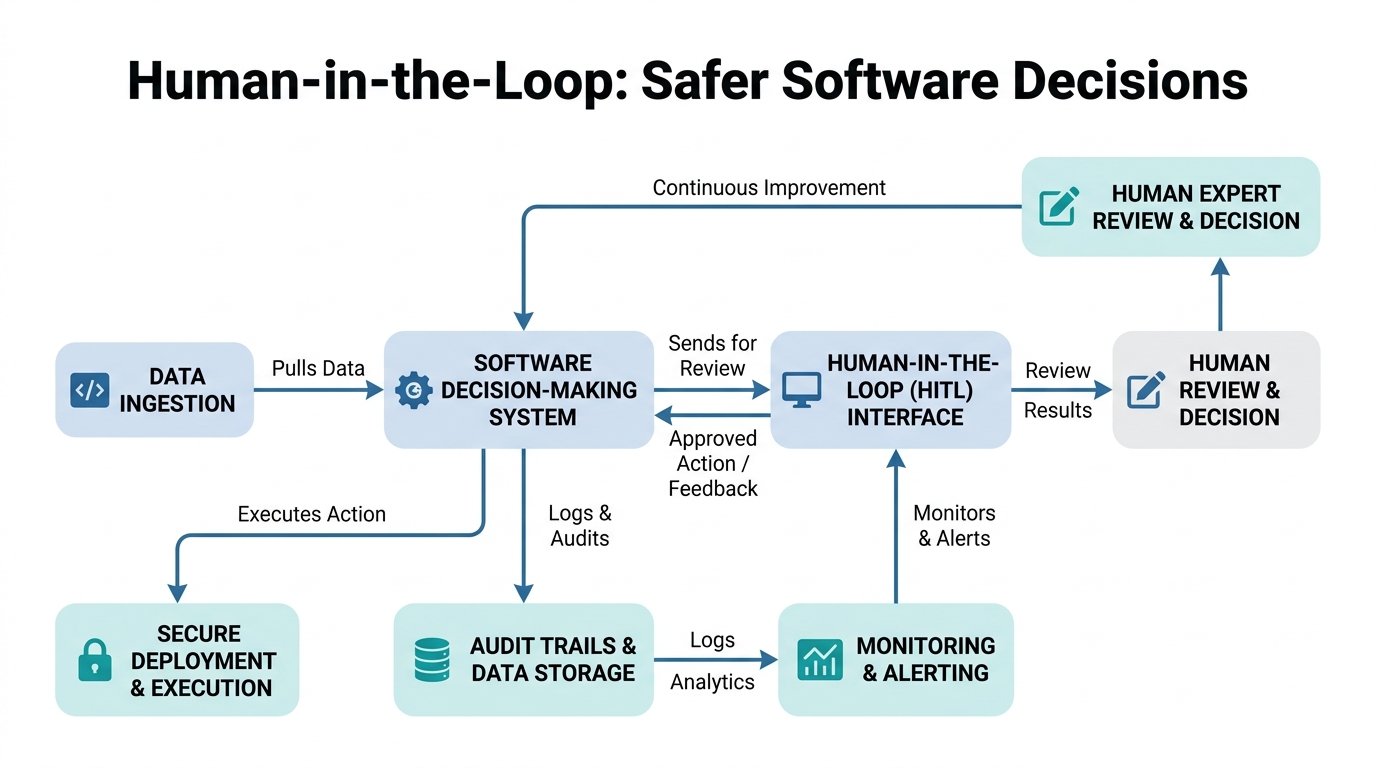
What Human-in-the-Loop Really Means
Plain-English definition: A design pattern where a software system pauses an automated process, hands control to a human for a judgment call, and only continues once that human gives the go-ahead.
How it works: The system emits an event or writes a record to a “pending approvals” queue. A human interface (dashboard, Slack bot, email) picks that record, presents context, and waits. When the human clicks “approve” or “deny,” the system reads that decision and either continues down the happy path or rolls back.
Analogy: A highway toll booth. The car (automated pipeline) drives up. The gate stops it. A human toll collector checks the window — is this a valid pass? They push a button. The gate lifts. The car proceeds. No collector, no gate lift.
Code example: A simple approval gate in Python.
import json
import time

# Simulate a pending approval record
approval_request = {
    "request_id": "deploy-42",
    "requester": "ci-bot",
    "action": "deploy_to_production",
    "environment": "prod",
    "risk_level": "high",
    "status": "pending"
}

def get_approval(user_decision):
    """Mock function simulating a human interacting with a dashboard."""
    if user_decision == "approve":
        approval_request["status"] = "approved"
    elif user_decision == "deny":
        approval_request["status"] = "denied"
    else:
        approval_request["status"] = "cancelled"
    return approval_request

# Wait for human (in real life, this polls a DB or webhook)
print(f"Approval requested: {approval_request['request_id']}")
time.sleep(2)  # Simulate human looking at the screen

decision = input(f"Approve deployment {approval_request['request_id']}? (approve/deny): ")
result = get_approval(decision)

if result["status"] == "approved":
    print("Proceeding with deployment.")
else:
    print("Deployment stopped.")
Non-obvious insight: The system must handle the case where the human never responds. A timeout is not failure — it’s a design decision. You must decide: auto-deny, auto-approve after a delta, or escalate to another human.
HITL Architectures: The Blueprint
Plain-English definition: The structural patterns and components you assemble to make human oversight work without chaos. It’s not one tool, but a logical arrangement of queues, databases, dashboards, and APIs.
How it works: A typical HITL architecture has four components: the automated system (doing the work), the pending-decision store (usually a database), the human interface (dashboard/bot), and the decision-evaluator (code that reads the human’s choice and acts). These communicate via events or polling.
Analogy: A kitchen with a pass-through window. The cook (automation) plates a dish and slides it through the window. The expediter (human) checks it, adjusts the plating, then passes it to the waitstaff. The cook keeps working, but only after the expediter signals “ready.”
Code example: A minimal architecture using a queue.
from collections import deque

class HITLArchitecture:
    def __init__(self):
        self.pending_queue = deque()
        self.decisions = {}

    def submit_for_approval(self, action, context):
        request_id = f"req-{len(self.pending_queue)}"
        self.pending_queue.append({
            "id": request_id,
            "action": action,
            "context": context
        })
        return request_id

    def show_pending(self):
        return list(self.pending_queue)

    def process_decision(self, request_id, decision):
        # Check if the request is still pending
        for i, req in enumerate(self.pending_queue):
            if req["id"] == request_id:
                self.decisions[request_id] = decision
                del self.pending_queue[i]
                return f"Decision stored: {decision}"
        return "Request not found"
Approval Checkpoints: The Where
Plain-English definition: Specific, pre-defined points in a workflow where an automated process must stop and obtain human confirmation before continuing. They are the turnstiles in the pipeline.
How it works: You insert a “checkpoint gate” into your process. The gate checks a condition (e.g., “is this a production deploy?”). If yes, it transitions the workflow to a “waiting for approval” state and blocks the next step. The gate also has a timeout and a fallback behavior.
Analogy: Airport security. You walk through the metal detector (checkpoint). If it beeps, you stop. The TSA agent (human) decides if you need a pat-down. Only after the agent clears you do you proceed to the gate.
Code example: A checkpoint function in a deployment script.
import time

def approval_checkpoint(action, risk_level):
    """
    Blocks the deployment pipeline at a checkpoint
    until a human approves.
    """
    if risk_level == "critical":
        approve = input(f"APPROVAL REQUIRED for '{action}'. Type 'approve' to continue: ")
        if approve.lower() != "approve":
            raise Exception("Deployment aborted at checkpoint.")
        print("Checkpoint cleared.")
    else:
        print(f"Skipping checkpoint for low-risk action: {action}")

# Usage in a pipeline
approval_checkpoint("deploy_to_prod", "critical")
print("Pipeline continues...")
Guardrails: The How Far
Plain-English definition: Software-enforced limits that an automated system may not exceed, even with a human’s blessing. They are the safety walls inside the HITL system.
How it works: You define rules that run after a human approves, but before the system acts. If the action violates a guardrail (e.g., “deploy to Europe without a DPO sign-off”), the guardrail blocks the action and logs an exception. Guardrails are logically separate from the approval step.
Analogy: A valet who can drive your car anywhere inside the parking lot — but the lot has barriers. The valet (automation) can turn left or right, but cannot crash through the chain-link fence (guardrail). Even if you, the owner (human), say “crash through the fence,” the fence stops the car.
Code example: A guardrail function that rejects dangerous actions.
def guardrail_check(action, target_region, compliance_rules):
    """Prevents actions that violate regulatory guardrails."""
    if target_region not in compliance_rules["allowed_regions"]:
        return {
            "blocked": True,
            "reason": f"Region {target_region} is not in the allowed list."
        }
    if action in compliance_rules["blocked_actions"]:
        return {
            "blocked": True,
            "reason": f"Action '{action}' is globally blocked."
        }
    return {"blocked": False}

# Example
rules = {
    "allowed_regions": ["us-east", "eu-west"],
    "blocked_actions": ["delete_prod_database"]
}
decision = guardrail_check("deploy_to_prod", "asia-east", rules)
if decision["blocked"]:
    print(f"GUARDRAIL TRIPPED: {decision['reason']}")
else:
    print("Guardrails clear.")
Decision-Making Boundaries: The Who Decides What
Plain-English definition: Explicit rules that define which decisions are delegated to automation and which must escalate to a human. They are the dotted lines on the org chart, expressed as code.
How it works: You configure a matrix that maps action + risk level + environment to a decision maker: automation (auto-approve), a specific human role, or a group of humans (requiring a majority or unanimous vote). The system checks this matrix before every decision gate.
Analogy: A doctor’s office. The nurse (automation) decides if your temperature is high enough to warrant a doctor’s appointment (boundary). Above 38.5°C, you see the doctor. Below, you get advice and a follow-up in a week.
Code example: A boundary matrix as a dictionary.
DECISION_BOUNDARIES = {
    "deploy_ci": {"low": "auto-approve", "medium":"auto-approve", "high":"team-lead"},
    "deploy_prod": {"low":"team-lead", "medium":"vp-engineering", "high":"cto"},
    "delete_resource": {"low":"team-lead", "medium":"vp-engineering", "high":"deny"}
}

def who_decides(action, risk_level):
    boundary = DECISION_BOUNDARIES.get(action, {})
    return boundary.get(risk_level, "deny")

print(who_decides("deploy_prod", "high"))  # Outputs: cto
print(who_decides("delete_resource", "high"))  # Outputs: deny
Operational Compliance: The Paper Trail
Plain-English definition: The system’s ability to prove that every automated decision followed the defined rules, boundaries, and guardrails — and that any override was recorded with a justification.
How it works: Every approval, rejection, guardrail block, and boundary check is logged to an immutable audit log (often a platform like Splunk, a blockchain, or a write-once database). The log includes: who decided, what action, what context, the guardrail result, a timestamp, and a unique ID. Compliance teams can query this log to produce reports for auditors.
Analogy: A restaurant’s food-safety log. Every time a cook cooled a pot of soup, they wrote down the time and temperature. The health inspector checks those logs. If the logs are missing or inconsistent, the restaurant gets fined.
Code example: A simple audit logger.
import datetime

audit_log = []

def log_compliance_event(event_type, user, action, context, guardrail_passed, note=""):
    entry = {
        "timestamp": datetime.datetime.now().isoformat(),
        "event_type": event_type,
        "user": user,
        "action": action,
        "context": context,
        "guardrail_passed": guardrail_passed,
        "note": note
    }
    audit_log.append(entry)

# Usage
log_compliance_event("approval", "alice", "deploy_prod", {"env": "prod"}, True)
log_compliance_event("guardrail_block", "system", "delete_resource", {"resource_id": 42}, False, "Region not allowed")
Comparison Table
| Concept | Purpose | Triggered By | Output |
|---|---|---|---|
| Human-in-the-Loop | Pattern to pause automation | Decision gate | Pending/Approved/Denied |
| Approval Checkpoint | Specific pause point | Workflow state | Blocked resume |
| Guardrail | Safety limit | Action execution | Blocked/Allowed |
| Decision Boundary | Decision delegation rule | Action classification | Automation/Human/Deny |
| Operational Compliance | Audit trail | Every event | Immutable log entry |
Key Takeaways
- Human-in-the-Loop is a pattern: pause, ask, proceed.
- HITL Architecture is the blueprint: queues, database, dashboard, evaluator.
- Approval Checkpoints are the specific “where” in the workflow.
- Guardrails are hard limits that even approved actions cannot cross.
- Decision-Making Boundaries formalize who decides what.
- Operational Compliance proves the system follows the rules.
- Always handle timeouts and missing humans — it’s a design choice, not a bug.

Comments